Ancient
Celtic coin cache found in Netherlands By
TOBY STERLING, Associated Press Writer Toby Sterling Associated
Press Writer – Thu Nov 13, 4:23 pm ET
AMSTERDAM,
Netherlands – A hobbyist with a metal detector struck
both gold and silver when he uncovered an important cache
of ancient Celtic coins in a cornfield in the southern Dutch
city of Maastricht.
"It's exciting, like a little boy's dream,"
Paul Curfs, 47, said Thursday after the spectacular find was
made public.
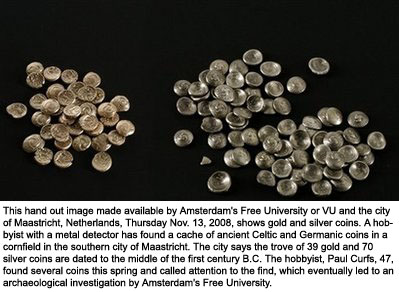
Archaeologists say the trove of 39 gold and
70 silver coins was minted in the middle of the first century
B.C. as the future Roman ruler Julius Caesar led a campaign
against Celtic tribes in the area.
Curfs said he was walking with his detector
this spring and was about to go home when he suddenly got
a strong signal on his earphones and uncovered the first coin.
"It was golden and had a little horse
on it — I had no idea what I had found," he said.
After posting a photo of the coin on a Web
forum, he was told it was a rare find. The following day he
went back and found another coin.
"It looked totally different —
silver, and saucer-shaped," he said. Curfs notified the
city of his find, and he and several other hobbyists helped
in locating the rest of the coins, in cooperation with archaeologists.
Nico Roymans, the archaeologist who led the
academic investigation of the find, believes the gold coins
in the cache were minted by a tribe called the Eburones that
Caesar claimed to have wiped out in 53 B.C. after they conspired
with other groups in an attack that killed 6,000 Roman soldiers.
The Eburones "put up strong resistance
to Caesar's journeys of conquest," Roymans said.
The silver coins were made by tribes further
to the north — possible evidence of cooperation against
Caesar, he said.
Both coin types have triple spirals on the
front, a common Celtic symbol.
The two other known caches of Eburones coins
have been found in neighboring Belgium and Germany.
Maastricht city spokeswoman Carla Wetzels
said the value of the coins is not known — their worth
is primarily historical. The Belgian cache of similar size
was estimated at around 175,000 euros ($220,000).
The farmer who owned the land agreed to sell
his interest to the city for an undisclosed sum.
Curfs, a teacher at a nearby junior college,
continues to own the 11 coins he found, but has lent them
to the City of Maastricht on a long-term basis. The coins
will go on display at the Centre Ceramique museum in Maastricht
this weekend.
Curfs said he considers his metal detector
habit a meditative hobby and not an obsession.
"I have advice for anybody hoping to
get rich like this," Curfs said. "Forget it."
























 AMSTERDAM,
Netherlands – A hobbyist with a metal detector struck
both gold and silver when he uncovered an important cache
of ancient Celtic coins in a cornfield in the southern Dutch
city of Maastricht.
AMSTERDAM,
Netherlands – A hobbyist with a metal detector struck
both gold and silver when he uncovered an important cache
of ancient Celtic coins in a cornfield in the southern Dutch
city of Maastricht.