Merrill
Lynch says rich turning to gold bars for safety By Ambrose Evans-Pritchard
Last Updated: 10:32AM GMT 09 Jan 2009
Merrill
Lynch has revealed that some of its richest clients are so
alarmed by the state of the financial system and signs of
political instability around the world that they are now insisting
on the purchase of gold bars, shunning derivatives or "paper"
proxies.
Gary
Dugan, the chief investment officer for the US bank, said
there has been a remarkable change in sentiment. "People
are genuinely worried about what the world is going to look
like in 2009. It is amazing how many clients want physical
gold, not ETFs," he said, referring to exchange trade
funds listed in London, New York, and other bourses.
"They are so worried they want a portable
asset in their house. I never thought I would be getting calls
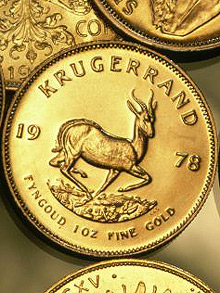
from clients saying they want a box of krugerrands,"
he said.
Merrill predicted that gold would soon blast
through its all time-high of $1,030 an ounce, and would hit
$1,150 by June.
The metal should do well whatever happens.
If deflation sets in and rocks the economic system it will
serve as a safe-haven, but if massive monetary stimulus gains
traction and sets off inflation once again it will also come
into its own as a store of value. "It's win-win either
way," said Mr Dugan.
He added that deflation may prove the greater
risk in coming months. "It's very difficult to get the
deflation psychology out of the human brain once prices start
falling. People stop buying things because they think it will
be cheaper if they wait."
Merrill expects global inflation to hover
near zero, with rates of minus 1pc in the industrial economies.
This means that yields on AAA sovereign bonds now at 3pc will
offer a real return of 4pc a year, which is stellar in this
grim climate. "Don't start selling your government bonds,"
Mr Dugan said, dismissing talk of a bond bubble as misguided.
He warned that the eurozone was likely to
come under strain this year as slump deepens. "There
is going to be friction as governments in the south start
talking politically about coming out of the euro.
I don't see the tensions in Greece as a one-off. It is a sign
of social strain in countries that have lost competitiveness."
























 Gary
Dugan, the chief investment officer for the US bank, said
there has been a remarkable change in sentiment. "People
are genuinely worried about what the world is going to look
like in 2009. It is amazing how many clients want physical
gold, not ETFs," he said, referring to exchange trade
funds listed in London, New York, and other bourses.
Gary
Dugan, the chief investment officer for the US bank, said
there has been a remarkable change in sentiment. "People
are genuinely worried about what the world is going to look
like in 2009. It is amazing how many clients want physical
gold, not ETFs," he said, referring to exchange trade
funds listed in London, New York, and other bourses. 