Gold
Climbs As Economic Catastrophe Deepens By John Browne, Senior Market Strategist,
Euro Pacific Capital
February 19, 2009
Last
week, when Congress passed its $787 billion stimulus package,
the size of the plan caused many observers to forget the water
that has already passed under the bridge. Fewer still are
wondering what havoc will erupt when all this liquidity eventually
washes ashore.
The latest spending, signed into law yesterday
by President Obama, came on top of $300 billion committed
to Citigroup, $700 billion for TARP 1, $300 billion for the
FHA, $200 billion for TAF and some $300 billion for Fannie
and Freddy. Just over the last six months, which excludes
the initial Bush stimulus and several massive, unfunded Federal
guarantees, nearly $5 trillion has been committed by the government
to the financial industry. Rational observers cannot be faulted
for concluding, despite Administration claims to the contrary,
that the government is merely throwing money at the problem.
Although the rhetoric has managed to convince
many observers of the possibility of success, the gold market
appears to clearly understand the implications of this unprecedented
spending.
The feeling that the government has no idea
how to proceed has created palpable panic. In response, pragmatic
investors are seeking the ultimate store of wealth. In 2009,
as has occurred countless times throughout history, that store
will be stocked with gold. Thus, whether the Federal government's
interventions will succeed or fail will be anticipated by
the price of gold. Right now, the market is screaming failure.
Prior to the latest round of Federal spending,
the Federal government had committed $4 trillion to postpone
bank collapses and to lay the groundwork for subsequent restructuring.
But has any of this activity actually rescued the banking
system? In light of the evidence of deepening recession, is
it likely that the additional $787 billion in the latest stimulus
will instill enough confidence to restore economic growth?
If not, what damage will it do to the eventual recovery?
Congressional rescue packages rarely work.
Nevertheless, Congress is turning up the heat with previously
unimaginable increases of government debt to fund stimulus
and rescue packages. Senator McCain rightly describes the
scheme as "generational theft". Each package of
debt will encumber many future generations, halt restructuring
and also threaten latent hyperinflation.
While Congress claims that the seriously over-leveraged
economy is in desperate need of restructuring, it appears
blind to the fact that deleveraging will encourage such restructuring.
Instead, Congressional leaders actively seek to increase leverage
and add debt. They warn of fire, while pouring petrol on the
flames.
The seriousness of the situation is magnified
by the rapidly increasing scale of the problem. Just today,
the release of the latest minutes of the Federal Reserve confirmed
that even that bastion of eternal optimism is sobering. The
American economy, which shrank by 3.8 percent in the last
quarter of 2008, is forecast to decline by some 5.5 percent
in the first quarter of this year. In some pockets, the unemployment
rate is already in double figures. Despite massive Government
spending on rescue and stimulus, the American consumer clearly
is becoming increasingly nervous, and the credit markets show
few signs of recovery.
With bad news only getting worse, investment
markets are turning into quagmires. The Dow Jones Average
is testing new lows, and the commodities markets show few
signs of life. In such times, the price of gold should fall
along with the prices of other assets and commodities. But,
the reverse has occurred. In the past two months, gold has
staged a remarkable rally. This is despite the activity of
price-depressants such as official gold sales by the IMF and
official 'approval' for massive naked short positions to be
opened by new 'bullion' banks.
Not only have gold spot prices risen in the
face of such selling pressure, but the price of physical gold
is now some $20 to $40 per ounce above spot. This would indicate
that investors are now so nervous that they are insisting
on taking physical delivery.
Make no mistake, the economy will not turn
around soon. When the recovery fails to materialize, look
for governments around the world, and especially in the U.S.,
to send another massive wave of liquidity downriver. When
it does, the value of nearly everything, except for gold ,
will diminish. Don't be intimidated by the recent spike in
gold. Buy now while you still can.
John
Browne is the Senior Market Strategist for Euro Pacific Capital,
Inc. Mr. Brown is a distinguished former member of Britain's
Parliament who served on the Treasury Select Committee, as
Chairman of the Conservative Small Business Committee, and
as a close associate of then-Prime Minister Margaret Thatcher.
Among his many notable assignments, John served as a principal
advisor to Mrs. Thatcher's government on issues related to
the Soviet Union, and was the first to convince Thatcher of
the growing stature of then Agriculture Minister Mikhail Gorbachev.
As a partial result of Brown's advocacy, Thatcher famously
pronounced that Gorbachev was a man the West "could do
business with." A graduate of the Royal Military Academy
Sandhurst, Britain's version of West Point and retired British
army major, John served as a pilot, parachutist, and communications
specialist in the elite Grenadiers of the Royal Guard.
In addition to careers in British politics and the military,
John has a significant background, spanning some 37 years,
in finance and business. After graduating from the Harvard
Business School, John joined the New York firm of Morgan Stanley
& Co as an investment banker. He has also worked with
such firms as Barclays Bank and Citigroup. During his career
he has served on the boards of numerous banks and international
corporations, with a special interest in venture capital.
He is a frequent guest on CNBC's Kudlow & Co. and the
former editor of NewsMax Media's Financial Intelligence Report
and Moneynews.com. He holds FINRA series 7 & 63 licenses.






















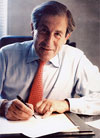 John
Browne is the Senior Market Strategist for Euro Pacific Capital,
Inc. Mr. Brown is a distinguished former member of Britain's
Parliament who served on the Treasury Select Committee, as
Chairman of the Conservative Small Business Committee, and
as a close associate of then-Prime Minister Margaret Thatcher.
Among his many notable assignments, John served as a principal
advisor to Mrs. Thatcher's government on issues related to
the Soviet Union, and was the first to convince Thatcher of
the growing stature of then Agriculture Minister Mikhail Gorbachev.
As a partial result of Brown's advocacy, Thatcher famously
pronounced that Gorbachev was a man the West "could do
business with." A graduate of the Royal Military Academy
Sandhurst, Britain's version of West Point and retired British
army major, John served as a pilot, parachutist, and communications
specialist in the elite Grenadiers of the Royal Guard.
John
Browne is the Senior Market Strategist for Euro Pacific Capital,
Inc. Mr. Brown is a distinguished former member of Britain's
Parliament who served on the Treasury Select Committee, as
Chairman of the Conservative Small Business Committee, and
as a close associate of then-Prime Minister Margaret Thatcher.
Among his many notable assignments, John served as a principal
advisor to Mrs. Thatcher's government on issues related to
the Soviet Union, and was the first to convince Thatcher of
the growing stature of then Agriculture Minister Mikhail Gorbachev.
As a partial result of Brown's advocacy, Thatcher famously
pronounced that Gorbachev was a man the West "could do
business with." A graduate of the Royal Military Academy
Sandhurst, Britain's version of West Point and retired British
army major, John served as a pilot, parachutist, and communications
specialist in the elite Grenadiers of the Royal Guard.