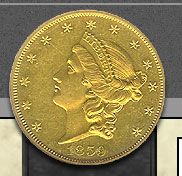
The Half Eagle was the
very first gold coin struck at the United States mint. Starting
in 1795, the Half Eagle became the only U.S gold coin struck
in each of the 8 U.S mints may or varieties exist in the early
series with several appearing for sale very infrequently, sometimes
not being seen for years.
The Small Eagle design
Half Eagle by Scot, was one of the first acts that the then
new mint director Henry William DeSaussure had proclaimed (one
of 2, first to place gold coins in circulation, and second to
improve an coin designs in general). The series ran for only
a short terms 1795 thru 1798 with 1798 being a major variety
commanding multiple hundreds of thousands of dollars in better
status of preservation.
A serious prize for specialists
as well as investors of items of great historical importance,
these Early Half Eagles have captured the imagination of collectors
since they were first made.
They are all scarce
to extremely rare and a symbol of the beginning of the United
States via its coinage and coined art.
The 1796 Half Eagle is vastly rarer than the 1795, the 1796
Half Eagle issue is quite underrated compared to its mintage.
Both the obverse and reverse dies for this year were leftovers
from 1795, with the obverse updated to 1796 by the punching
of a 6 over the 5. This date appears at auction less than
three times per year, usually in Extremely Fine to About Uncirculated
condition. Uncirculated examples are very rare, with the finest
being a single NGC MS-65.
The second year of regular
gold coinage production in the United States saw a limited number
of 1796 eagles produced. The largest denomination in coinage,
authorized in 1792, had an estimated 3,500 to 4,146 pieces produced
for circulation. These estimates have been widely fluctuating,
and most students of the early gold series have come up with
various theories as to the true mintage, based on the various
deliveries made in the years 1795 to 1796. During the calendar
year of 1796, the different varieties made up a total of 6,934
ten dollar gold coins struck for circulation. However, there
is an important aspect of history that makes the high estimate
to be unreliable.
The state of Tennessee joined the Union on June 1, 1796.
By doing so, it was the sixteenth state that formed the United
States of America, with three being added after the original
thirteen had formed in 1776. As was usual during the first
few years of production, a star was added for the state on
the nation’s coinage. As such, the 1796 eagles that
would be struck before June would carry fifteen stars, and
those minted afterwards would carry sixteen, with the added
star for Tennessee. Yet, things are not that simple. First
of all, there is not a single 1796 eagle known with fifteen
stars, all have sixteen stars, although there were pieces
struck and delivered during the early months of 1796.
All eagles dated 1796 were struck from a single die pair.
The sixteen stars on the obverse are arranged evenly, with
eight to the left of the portrait and eight to the right.
The reverse is a new die, showing eleven leaves under the
eagle, instead of the previously used thirteen or nine. It
is unknown if this is done on purpose, perhaps as an experiment,
or if this was an engraving error. The reverse die was later
paired with the only die pair of the 1797 small eagle ten
dollar gold pieces, which were struck before the reverse die
design was completely changed.
One interesting observation can be made from the use of these
dies. By studying die markers as cracks, clashing and lapping,
the use of the dies can carefully be reconstructed. The most
recent work on this subject has been written by Bass-Dannreuther
(Early U.S. Gold Coin Varieties), which also deals with the
lower denominations of gold coinage.
What we see here is a prime example what makes the studying
of early United States coinage so interesting, but at the
same time confusing. To prevent the rise of unneeded costs
at the United States Mint, workers were instructed to use
dies until they were unfit for coinage, whatever the date
was on the coinage. This has led to the situation that we
can’t be sure when the coins were actually struck, as
dies were often used in different years than those shown on
the coins.
In this case, a single 1796 eagle shows positive marks that
it was struck after a majority, if not all 1797 eagles. While
only a single piece is known, it is unknown if it was created
intentionally, part of a separate delivery or just a mere
coincidence. Unless a document of the United States Mint is
discovered showing details of the usage of dies, which is
extremely unlikely as such a document never turned up during
the last 200 years, we will never know the story of that particular
coin.
Overall, the 1796 eagle is a coin that is extremely scarce
in any grade, with approximately 125 to 175 pieces known in
all grades. Most of these will grade About Uncirculated, showing
at least moderate signs from circulation. Correctly graded
uncirculated coins are extremely rare, with most estimates
showing eight to twelve known in all uncirculated grades,
at most. While the population reports show considerable higher
numbers, it can be assumed that these include a large number
of resubmissions in hopes of a higher grade.
On the other hand, this issue is seldom found in grades below
extremely fine, and if they do most show problems of various
kinds. These pieces are usually avoided by many collectors,
but do offer some opportunities for the budget-minded collector,
although they are still not cheap and easily available.
We at U.S. Rare Coin
Investments highly recommend these Early Half Eagle coins
for investments portfolios. Whether a single coin or the long
term acquisition of them with the goal of building a set in
terms of historical importances as well as longterm profit
potential, cannot be overstated in our opinion.