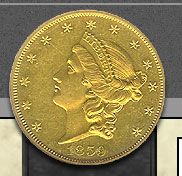
The 1796 half eagle with
the small eagle reverse is an issue that has not seen much written
about it in numismatic literature. Most references usually regard
it as a scarce issue, and it is often noted that it is less
often available then the first year of issue for the type, the
1795 half eagle. But other than that, information is relatively
scarce, a situation which goes along with the overall scarcity
of this coin. Examples are rare in all grades, and it is estimated
that somewhere around 90 pieces are still known to exist in
all grades. Judging by auction appearances and population reports,
however, it appears that this issue is much less available then
the usual references suggest. The true number of surviving examples
thus could be substantially lower. As such, this is a very interesting
issue to study, and which could very well be considered to be
extremely underrated in any grade, especially when in problem
free condition.
The mintage of this issue,
correctly identified as 1796/5, is usually considered to be
6,196 pieces. This number consists of the deliveries made by
the Mint from June 28, 1796 to December 22 of the same year.
Yet, it has been heavily disputed by modern scholars, some lowering
the number with others increasing it. Major researchers in the
field have estimated the mintage in recent times as below:
• Breen: As many
as 7,523 might have been struck, compromising of the deliveries
made between June 28, 1796 to December 22, 1796. Additional
pieces would have been delivered January 4, March 14 and 25
of 1797.
• Hilt: Believed only 1,057 would have been struck,
all in 1797 and delivered on January 4, March 14 and 25 1797.
• Bass-Dannreuther: Estimate the mintage to have been
between 1,057 and 2,000 pieces. These are the three 1797 deliveries,
along with an unknown number which would have been delivered
in late 1796. It is basically based on auction appearances
instead of study of deliveries as the other authors did for
this issue.
It would be extremely
hard to determine which of the above authors would be right,
as information from the early United States Mint is very scarce.
The true number will most likely be somewhere near the higher
estimate of Bass-Dannreuther. Many die combinations are illogical,
and there is no way we can be certain which coins were included
in certain deliveries. Estimates can be made on the number
of pieces known, but as we see above these often lead to varying
conclusions over time.
As mentioned above,
all 1796 half eagles were struck from a single die pair. The
obverse used a leftover 1795 die, which was overdated with
the underdigit clearly visible on all examples. The reverse
had previously been used to strike one of the later varieties
of 1795 eagles, where it had clashed with the other die in
use at the time. Prior to striking the 1796 $5 gold pieces
it was lapped, and during production it was relapped again
to make sure that the pieces were at least of some quality.
As can be guessed from the numbers above, this issue is rare
in any grade. PCGS and NGC have graded just 55 pieces combined,
and that number surely will include at least some resubmissions.
Most are in Very Fine and Extremely Fine grades, and anything
higher then that is extremely rare. Mint State pieces are
of extreme rarity and seldom offered at auction, which goes
along with the overall availability of this issue in any grade.
As often found with early American gold coins, many examples
have been harshly cleaned and damaged, but finding a problem-free
example might be a daunting task, regardless of a collector’s
budget.
We at U.S. Rare Coin
Investments highly recommend these Early Half Eagle coins
for investments portfolios. Whether a single coin or the long
term acquisition of them with the goal of building a set in
terms of historical importances as well as longterm profit
potential, cannot be overstated in our opinion.