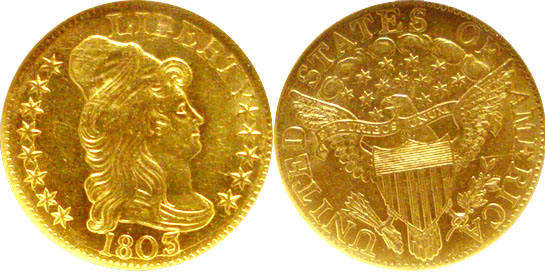
1803 Half Eagle - Like many of the early
American gold issues (say, the first 40 years of production),
the 1803 dated half eagle is a very enigmatic coin. First
of all, there are a total of four different die varieties,
made from combining two different obverse die with three
reverse dies, of which one had already been used to strike
1802 dated half eagles. Both obverse dies that were used
for coinage were made from unused 1802 obverses, and the
1803/2 overdate on both dies is bold. All four varieties,
as cataloged by Bass-Dannreuther are similar in rarity,
although it appears that BD-2 is slightly scarcer than the
other varieties. This issue is usually believed to be the
more available of the type. It is offered with some regularity
at public auctions, even in higher grades, but it remains
rare in the 63 and higher uncirculated grades, in particular
at the gem level.
The two different obverses are usually not
identified by the difference in the overdate (which is very
minor) but by the T in LIBERTY. On the first obverse die,
used on BD-1, BD-2 and BD-3 the right foot of the T is broken,
hence the name “imperfect T”. On the second
obverse die which was overdated the right foot of Liberty
is present. There are a few other minor differences, like
the placement of the date, but these are very minor and
can be hard to differentiate on circulated examples. Particularly
interesting are these overdates. The previous year, 1802
saw eight different varieties produced from a two different
obverse dies, both overdated 1802/1. This confirms that
obverse dies were made well in advance, when it was not
even affirmative that they were needed for coinage in that
year. The fact that the dies were overdated before being
put in use also shows that the Mint was beginning to care
more about the quality and correctness of their used dies.
From earlier illogical die combinations (like the 1795 large
eagle five dollar pieces or 1798 small eagle five dollar
pieces) the Mint now produced more correct issues, although
coins remained to be struck in other years as the dates
would show.
Most references, including Breen, Bass-Dannreuther
and the Red Book show a total mintage of this issue of 32,506.
While this certainly appears to be close to correct, we
can not tell what the exact number would have been. Dates
included in coin deliveries were never recorded, and as
mentioned the date on the coin would not always indicate
in what year that particular coin was struck. For example,
Breen notes of the 1803/2 half eagle that “many coins
delivered in 1804 bore date 1803”. Given the fact
that the 1804 half eagle is a regular issue, it would seem
that the 1804 half eagles were struck late in that year,
and perhaps in 1805 as well. However, die state research
has revealed that a number of 1804 half eagles were struck
before the complete mintage of 1803/2 half eagles had been
delivered. This confusing and illogical (but not for the
early U.S. Mint in Philadelphia) is explained by Bass-Dannreuther,
who try to put this in context and determine the correct
emission sequence for this issue in their description for
BD-2:
“As noted under the previous variety
(BD-1), that variety might also have a remarriage, possibly
struck between states of this variety [BD-2]. Also, it appears
that the next variety (BD-3) may have been struck between
states of BD-4. One of the 1804 combinations (BD-3) also
appears to be involved in this striking group, struck between
states of BD-3 or 4 of this year (making one or more of
these varieties likely struck in 1804!).
BD-2 of 1804 may also be involved, increasing the emission
chain. If all this is true, the possible emission sequence
for this group of coins would be: 1803 (BD-2, 3), 1804 (BD-3),
1803 (BD-4), 1804 (BD-1, 2, 1, 2) and finally the late states
of BD-3 (1804). One thing is not in doubt-there is no question
why numismatists are confused by the half eagles of 1802,
1803 and 1804!
We can certainly not disagree with the last
comment. While intensive die studies by minor differences
is mostly interesting for the specialist of early American
gold coinage who collects by variety, this die emission
sequence is important to determine the emission sequence,
and consequently the total mintage. Yet, it would be better
to solely look at the number of pieces known, as they will
give a much better indication as to the true rarity of the
1803/2 half eagle. Bass-Dannreuther suggests that 440 to
600 1803/2 half eagles survive in all grades. The population
reports of PCGS and NGC combined show an even higher number,
but obviously these will include a certain number of resubmissions,
with cleaned and damaged coins not showing in their population
reports. Yet, it is obvious that this is an available coin,
and would serve the spot of the type perfectly in an advanced
type set.
It must be noted that pieces are on the
market that at first glance appear to be 1803 half eagles,
but are distinctively different. They are produced in Brass,
and are often found gilted, with occasional offerings as
genuine U.S. Mint products. They are not, and while interesting
are of much lesser value. They were made in the early 19th
century for use as gaming counters in Birmingham, England
as tokens by the firm of Kettle & Sons. The name KETTLE
can be seen to the right of the date, but on some pieces
it has been tooled off. Because of their similarity to the
original issue, and their inclusion in every major pattern
texts has some researchers believed they were genuine off-metal
strikes. Further research has obviously proved that this
is not the case, but there remains to be some market for
these pieces. Similar pieces of the same date but of the
quarter eagle denomination also exist in various metals.