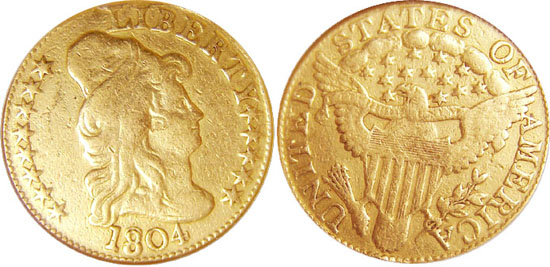
1804 Half Eagle - A very popular date, the
1804 half eagle is one of the toughest dates in the early
half eagle gold series. The 1804 half eagle gold coin is
a true rarity in any grade and almost impossible to find
in high grade. Minted more than 200 years ago, it is already
amazing that some pieces survived in any condition, yet
in what we now consider to be high grade, i.e. uncirculated
condition. This is one of the issues that has seen an increasing
demand because of publications about different denominations
of the same date, in this particular case the famous 1804
Silver Dollar, a major rarity and an extremely popular coin.
Because of this, the 1804 date has been highly coveted and
appreciated by numismatists of all periods.
The red book, and other books, quotes the usual mintage
of the 1804 five dollar gold piece at 30,475 coins. Breen,
in his Encyclopedia, mentioned that the mintage might have
been lower in reality, but Bass-Dannreuther, in their book
Early U.S. Gold Varieties, however, mention that the number
in fact might have been higher. The discussion is based
on various factors, but mostly because of a comment made
by Breen that most 1803 half eagles were actually struck
in 1804. This would mean that the reported mintages of 1804
no doubt included backdated coins, and that the true mintage
might have been lower. However, it would certainly be possible
that some of the 1804 dated half eagles in fact were struck
in later years, creating a situation which is extremely
common when it comes to early gold. Determining mintages,
even somewhat reliable ones is a very hard task for early
gold pieces, and often mintages are quoted on earlier research
and in some way on tradition.
The mintage is known to have been struck from a total of
seven different die combinations. These were struck by combining
four obverses with 4 different reverse, of which one reverse
was previously used to strike two 1803 varieties. This die
continued to be paired to 4 different obverse dies, lasting
longer than dies usually did at the time. These varieties,
as per Bass-Dannreuther range from rarity from R-4 (100
to 150 known in all grades) to R-7+ (4-8 known in all grades).
Miller, one of the earlier researchers of the half eagle
denomination listed another variety, but to this date it
has not been found and its existence has been doubted. This
is often the case with earlier reference books, as their
resources were more limited then in current times and offerings
were much scarcer (in general).
The 1804 half eagle obverse can be placed in two different
groups. The first, usually called “small 8”
has been named “normal 8” by Bass-Dannreuther.
The second is much more interesting, and also is a separate
listing in the red book, being slightly scarcer. It consists
of a normal 8 struck over a large 8. This variety (three
different die varieties per Bass-Dannreuther) is one of
the more interesting repunched dates in all of American
numismatics, as the repunching is very obvious, even in
lower graded coins.
It has been suggested that the large 8 punch might have
been intended for the larger Ten dollar denomination, but
this has not been confirmed by modern researchers. The other
numerals, except the four are larger than usual as well,
so that comment might be disputed. There is also a variety
(BD-4) that has a recut 8. It has sometimes been listed
as a normal 8 over large 8 variety, but this is not the
case. That variety also made use of a new punch for the
1 in the date, after the old broken punch had been used
since the beginning of the century. This is a truly great
find.