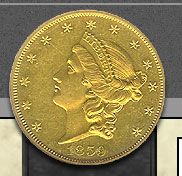
1805 Half Eagle - The 1815 half eagle is
a coin usually considered, in most grades, to be "available"
within the context of the series. Yet, as with all early
gold coins, this is an issue that remains difficult to find
in problem-free condition in any grade, mostly due to heavy
melting of gold in the decades after this issue’s
minting. As such, it certainly is not a coin which should
be considered to be easy to find, especially in problem-free
condition. The overall low mintages of these enigmatic early
gold coins and subsequent little care taken by its owners
are more reasons which have frequently been quoted by specialized
early gold collectors. Despite the relatively low interest
this coin receives from non-specialized collectors, it remains
to be an interesting issue to study. 1805 marked the first
year that no Ten dollar gold pieces (eagles) were struck
at the Philadelphia Mint, and thus would be the situation
until the late 1830s. Subsequently, the half eagle was the
largest denomination struck in 1805 and it would become
the coin of choice in handling large and in particular overseas
transactions, usually conducted in gold coin.
Five different die varieties have been identified
by Bass-Dannreuther and others, using four different obverses
paired with two reverses. By this year, the Mint in Philadelphia
had become relatively successful in making the dies last
longer. Earlier dies often broke after a couple of thousand,
sometimes only hundreds of strikings, but by now the 10,000
mark was often broken by a single die, paired with several
different opposite dies. However, this does not mean that
every coin is perfect, as the dies were still used until
they had become completely unusable because of die cracks
and clash marks. As such, with a mintage of 33,183 pieces
and two extremely rare varieties with less than 1,500 pieces
struck, it can be estimated that three die combinations
struck 10,000 coins on average, of which later strikings
often showed heavy cracks and serious die clashes, sometimes
repaired with lapping. This mintage, which perhaps included
some 1804 dated coins as well, was grouped into two by Walter
Breen in his Encyclopedia, differentiated by the number
1 punch in the date.
From study of the number 1 punch in the
date of half eagles from this era, it seems that the Mint
was somewhat struggling with it. A so-called “Blunt
1” punch was used from 1800 to 1804, when a new punch
was introduced to replace it. It was used on two 1804 obverse
dies and one 1805 die before it broke as well. The broken
punch, however, was continued to be used in 1806 before
it was once again replaced. It is identified by the missing
left foot of the one, and is clearly visible with the naked
eye although not many collectors pay attention to it. Breen
gives exact mintages for these two major varieties, with
8,803 perfect 1 coins struck and delivered with six deliveries
from March 12 to June 13 (BD-1 and BD-2). The imperfect
1 coins, numbering 25,100 in total would have been struck
and delivered with six more deliveries of September 11 to
December 19 (BD-3, BD-4 and BD-5). Given the rarity of the
imperfect 1 coins, with BD-4 and BD-5 only four to seven
coins known and BD-3 no more than 40-45, these numbers might
very well be correct, or at least in the ballpark. BD-1
and BD-2, the perfect 1 varieties are relatively available,
with an estimated 200 and 125 pieces known, respectively.
As previously mentioned, this variety is
found with some patience in all grades up to upper about
uncirculated and sometimes lower mint state grades. Yet,
there are large differences within even a single grade.
As such, a coin which would be considered to be in an AU
grade could have much more eye-appeal than the majority
of coins in that same grade. As such, every coin should
be carefully selected for its surfaces, color and originality.
Especially the latter has become increasingly hard to find
on early gold coins. This is of course the case with all
series, but is especially true with early gold coins. At
the Mint, adjustment marks were often placed to make sure
the coins were of the correct weight. Afterwards, unconscious
collectors or owners of the coins cleaned them, or they
were damaged by rough handling. Because of all this, Mint
State coins (in any numerical grade) are very rare with
less than heavily bagmarked surfaces with originality. MS-64
coins are very rare, and gems are extremely rare. NGC and
PCGS both report two gems of this issue, but it appears
that at least one of these has been resubmitted in hopes
of an even higher grade, and that no more than three 1805
half eagles exist in gem.
Several interesting “patterns”
of this issue is listed in both Judd (J-36 to J-38) and
Pollock (P-6110, 15 and 20) texts. Judd lists it has a regular
Mint issue, but Pollock correctly list these pieces as made
outside of the US Mint. This pattern, supposedly unique
in Silver and White Metal, with two pieces known in copper,
was made in the early 1860 from scrap dies sold by the US
Mint, reportedly by Joseph J. Mickley. Other pieces listed
in Pollock only have the 1805 half eagle obverse paired
with an illogical 1792 fantasy die, made by Montroville
Dickeson, who was perhaps the one who also struck the 1805
half eagle “die trails”. All these pieces are
very much in demand as fantasy pieces and are very seldom
encountered in any condition. These coins were struck from
the perfect 1 obverse in (obviously) the very last die state
known.