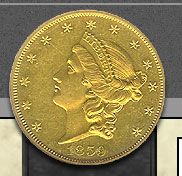
1861-S Quarter Eagle - As many other issues
struck during the Civil War, the 1861-S quarter eagle is
very scarce in all grades. A mere 24,000 pieces were struck
for circulation, where many remained for a longer period
of time. Unlike the coins struck at the Philadelphia Mint,
which were all hoarded following the outbreak of the Civil
War, the San Francisco coins did circulate.
The effects of the Civil War were minimal
in the West, and as a result gold pieces circulated freely.
Together with the fact that mintages were fairly small,
this has created a number of truly scarce to very rare pieces.
In his Encyclopedia, Breen notes the following
of this issue:
“Much rarer in all grades than mintage
figure suggests; usually weak VF, Ex. rare in EF, unknown
UNC”
Although a very limited number of pieces
have graded Mint State in recent times, one has to wonder
whether these are true Mint State pieces. The population
reports are definitely inflated by resubmissions, which
would mean that only 2 or 3 uncirculated pieces exist at
most. As a result, this issue is collectable up to the AU
grades, although it becomes increasingly hard to find in
anything above AU-50. The rarity of this issue in Mint State
was soon recognized, but has not resulted in higher prices.
In fact, only one coin that was sold at auction in the 20th
century was cataloged as uncirculated, and that was the
sell of the Bell specimen in 1944!
The rarity of this issue in higher grades,
and in all grades as well as this issue remains hard to
locate even in lower grades, is truly underestimated. The
San Francisco Mint, with the early issues as an exception,
has never yielded much specialized collectors. This is opposite
to the situation of both the Dahlonega and Charlotte Mints,
which coinage has become increasingly more popular in recent
times.
If more research were publicized on the
relative rarity of the different San Francisco issues, collectors
would learn that the San Francisco quarter eagles from this
era are usually much scarcer in higher grades than the popular
issues of the Southern Mints. Prices would rise, as both
collectors and investors would discover the investment potential
of these pieces. Up to now, however, this has not yet been
done with the result that many of these issues are underrated
in today’s market.
In lower grades, this issue remains very
scarce, again not bringing much premium over a commonly
found issue of this era. Most pieces are fairly well struck,
although some weakness is usually encountered in the central
areas. The natural coloration of this issue remains from
an orange to green-gold color, if found in uncleaned/undipped
condition. As usually, cherrypicking is advised to seek
out the original examples of this issue, although intensive
searching is most likely needed for this rare issue.