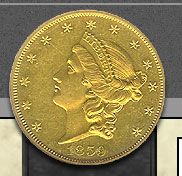
The 1865 Indian Head Cent was partly produced
in the Civil War, and was the last issue made in that historic
period as such. With a large mintage, coins of this issue
remained in circulation for at least 50 years, according
to some sources. Circulation strikes are available in all
grades, but as the previous issue Mint red coins are scarce
in higher grades. Overall however, this is the easiest issue
from the 1860’s to acquire.
Although not listed in the Guide book of
United States Coins (the red book) as listed varieties,
the date comes in two different styles. This is only shortly
mentioned in the red book, and prices are not differentiated.
However, the plain 5 is somewhat scarcer than the so-called
“Fancy 5”. These are identified by the form
of the 5 in the date. On the “Fancy 5” variety,
the top of the five is sharp and hooked. On the Plain 5,
this hook is much flatter and not as notable. Circulation
strikes were made of both varieties, but the proof is only
available with the Plain 5.
With a total mintage of 35,429,286 circulation
strikes, this is the first Bronze cent that is available
in gem grade without excessive cost. However, this is for
pieces designated as Red-Brown or brown by the grading companies,
with only part of the original Mint red color remaining.
Gem red pieces remain rare, but are slightly more available
than the previous year. These are often bought for either
complete Civil War sets, or complete Indian Head Cent sets
from 1859 to 1909. In type sets, the early issues are not
often completed to the general availability of the later
issues.
In all circulated grades, this issue can
be located without any problems. It must be noted that pieces
showing any problems, like cleaning, damaged or rough surfaces.
This applies usually to all coins, except rarities. As these
pieces circulated widely throughout the United States for
many decades, many come with problems and are correctly
called “cull pieces”.
In Mint state, as previously mentioned,
this issue is easier available than the two 1864 Bronze
varieties. It can easily be acquired in all grades up to
MS-64, gets scarce in MS-65 and very rare in MS-66. With
full Mint red surfaces, all pieces are scarce but available
up to MS-64. MS-65 Red pieces are rare, and MS-66 extremely
rare. There are less than a dozen pieces correctly graded
at that grade, and they have been bringing more than $25,000
at auction over the last few years.
The proof coin of this date is the other
way around. These are actually scarcer than the 1864 no
L proofs, but do not bring the same price. This is again
due to the fact that type set collectors have much more
subsequent issues to choose from, made in later years and
often in better quality. Yet, high grade examples are still
rare, and always in demand.
Even more than the business strike, pieces
with full Mint red color are exceptionally rare. Many were
hold in cotton, or envelopes. As a result, over many years,
these pieces have toned to various colors except the original
Mint red pieces.
The most desirable issues are those with
full red colors, as explained above. In other colors, especially
with nice appeal, these are rare as well. In gem, with any
color designation this is a perfect coin that will hold
its value for a longer period. Full proof sets of this series
are becoming more popular, and as a result collectors have
to include this issue.
The 1865 Bronze cent ends a series of cents
struck during the Civil War. Different types were struck,
in different metal compositions. Scarcity of the respective
issues is different from year to year and grade from grade.
As usual, the best pieces are those that are sharply struck
from fresh dies. These will show the most detail and will
have the best eye-appeal. However, these will not be easy
to find and intensive searching will be required for all
these Civil War issues. In the end, a full set of Civil
War cents will make for a very attractive display, whether
in circulated, uncirculated or proof grades.