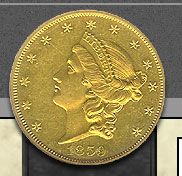
LIBERTY
HEAD DOUBLE EALGES (1849-1907)
Type 1 Double Eagles - Without Motto on Reverse
(1849-1866)
1856-O Double Eagle
The 1856-O double eagle
is one of the great rarities of the Liberty Head series.
There are thought to be fewer than 25 coins known
in all grades. The known coins range in grade from
polished Very Fine to Specimen-63. Most collectors
of double eagles have given up on this date, as the
starting price for an attractive example begins in
the six figures. The Smithsonian contains two examples,
but these are permanently off the market. Of the small
number of coins known in About Uncirculated condition,
most are at least partially prooflike. The collecting
of gold coins by mintmark did not start in earnest
until decades after the 1856-O double eagles were
struck. Today, the issue is considered a "classic."
An AU-55 example sold in the summer of 2005 for $483,000.
Note: this coin is included among the 100 Greatest
U.S. Corns (Garrett and Guth 2005).
The acquisition of an 1856-O has been
the dream of every advanced specialist in the double
eagle series. Only 2,250 pieces were struck, the smallest
mintage recorded by any New Orleans $20 coin. These
quickly passed into circulation, where most were worn
down to such grades as VF and EF. This is probably
the rarest New Orleans Mint double eagle, with fewer
than 25 known, and perhaps even fewer than 20.
The 1856-O has often been compared to the 1854-O.
If one were to play "double eagle whist"
and give points for Mint State coins and, separately,
for the total number known, the I854-O, of which no
Mint State coins are known, would nave the lower score
and, thus, would be the "winner" from a
rarity viewpoint, as two Mint State 1856-Os have been
recorded. On the other hand, there seem to be a few
more circulated 1854-Os than there are of 1856-O.
The situation may be moot, for both are key issues,
both are famous, and both are eminently desirable.
Standard four-digit logotype punch
for this year. 4 obverse dies and 2 reverse dies were
shipped to New Orleans, a generous supply considering
the small coinage of the preceding two years and the
loss of the mint's full capacity due to repairs in
progress. Only one pair of dies is known to nave struck
1856-O $20 pieces. On the obverse die date logotype
is slightly low, with the 1 closer to a dentil than
to the bust. The figures are punched deeply into the
die, resulting in a "closed 5." On the reverse
the O mintmark is high and close to the eagle's feathers.
On the reverse the crossbar of the A (STATES) is lightly
patched. All known examples are prooflike to one degree
or another, diis being true for other New Orleans
Mint double eagles of the period— and nothing
to do winS being presentation pieces.
Designer: James Barton
Longacre Edge: Reeded Weight: 33.436 grams (516 grains)
(1.075 troy ounces ) Diameter: 34 millimeters Composition: 90% gold, 10% copper Gold Content: 30.093 grams (464.4
grains) (0.9675 troy ounces) Mintmark: "O" for New Orleans.
Below the eagle's tail on the reverse.
1856
HISTORICAL HIGHTLIGHTS
Oregon
Territory, Feb. 22.
Indians kill father and sons while holding mother
and daughter captive: Geisel Family Massacre enrages
settlers California, Feb. 22. First railroad
in slate links Sacramento and Folsom. Boston, March 26. Operation of first
steam trains in New England begins. United States, Apr. 1. Western Union
Telegraph formed to handle Western telegraphic communication. Texas. Apr. 29. First camels purchased
by U.S. Army for experimental duly in Texas arrive
(--June 16, IS57). San Francisco, May 15. Politician
James Casey lynched after murdering James King, crusading
reformist editor. Kansas Territory. May 21. Lawrence
looted and sacked by pro-slavery forces; one man killed
(-Aug. 30). Bloomington, Illinois, May 29. In
a speech. Abraham Lincoln says. "You can fool
some of the people all of the time, and all of the
people some of the lime, hut you can't fool all of
the people all of the time." Boston, May. Emulating large European
music festivals, first American festival consists
of a chorus of 600 and an orchestra of 78. Cincinnati, June 6. Democrats end
week-long national convention, nominating James Buchanan
for president and John C. Breckinridgc for vice president
(~*Nov. 4) Illinois. Sept. 21. Illinois Central
Railroad completed between Chicago and Cairo: longest
in country with 700 miles of track. Chicago. Railroad companies employ
telegraph to aid engineers and operators. Terre Haute. Indiana. T.T. Woodruff
patents three-tiered berth railroad car; Andrew Carnegie
is principal investor. Richmond, Virginia. Editorial in
Examiner is first to warn that fundamental social
and economic differences between North and South may
lead to civil conflict. New York City. Freeman Hunt, author
of Wealth ami Wurth, predicts that business will become
a form of culture.