Price: 4,050.00 - SOLD - 2/28/2012* Free Shipping and Insurance for coins at $10K or above.
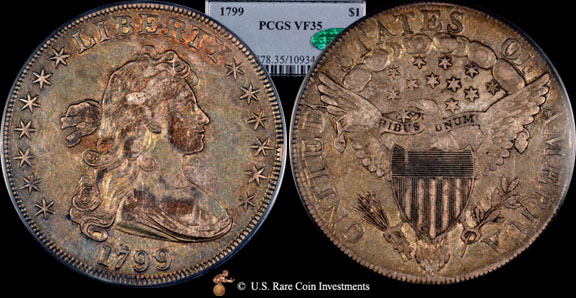
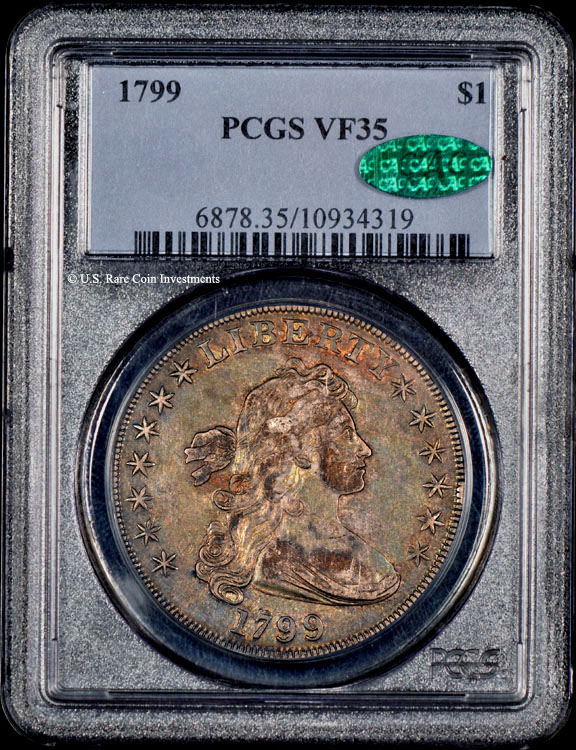
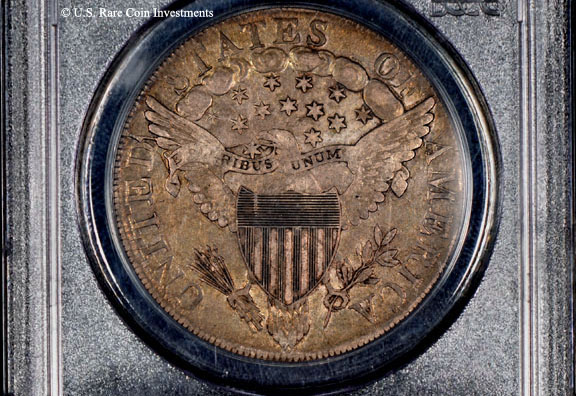
1799 Early $1 (1799 Silver Dollar) PCGS VF35 CAC. BB-161, B-11, R-3. This early 1799 Silver Dollar has outstanding color and eye appeal. The obverse colors seen include steel-blue, light green, teal, orange, gold, and tan. The reverse, which is somewhat more subdued, shows mainly tan and light purple-grey with touches of gold. While there is some wear accounting for the grade, the surfaces are original, clean, and free of distractions worthy of individual mention. The strike is somewhat variable with full details seen on Libertys drapery and lower curls, the shield, and the obverse dentils.
The 1799 dollar is the second type called the Heraldic Eagle Reverse. It was made from 1798 to 1804. The design shows a draped bust of Liberty facing right. Above is LIBERTY, and below is the date. Seven six-pointed stars are to the left and six are to the right. The portrait, taken from a drawing by the famous artist Gilbert Stuart, is of Ann Bingham. John Eckstein translated this drawing to models for Engraver Robert Scot. Evidently Eckstein made the models poorly, which might explain why Stuarts family refused to acknowledge his role in the coinage design. The heraldic eagle reverse shows the eagle with up stretched wings and a Union shield on its breast. A banner inscribed E PLURIBUS UNUM curls across the left wing and under the right. Except for the wing tips, the inscription UNITED STATES OF AMERICA is in an arc near the periphery. Thirteen stars are above the eagles head under the clouds in an arc pattern. Dentils are near the edge on both sides of the coin. The edge is lettered HUNDRED CENTS ONE DOLLAR OR UNIT with ornamentation between the words.
In a colossal design blunder, Robert Scot placed the arrows in the wrong talon. On the left side, the eagles right talon, arrows symbolize aggressive militarism. They should have been placed in the left talon with the olive branch in the right. If this rearrangement was unintentional, it shows a new, inexperienced country that cant even get its symbolism correct. If this was a deliberate rearrangement, it shows a young country taking an aggressive stance during a time of conflict. In 1799 the country was engaged with France in an undeclared naval war. Perhaps this symbolism was being used to make a statement to France and others about the sovereignty of the United States.
Bowers estimates that 600 to 1,100 BB-161 examples survive in all conditions. PCGS has certified 121 7X6 Obverse Stars variety, 3 of which are the BB-161. The population report shows, in addition to the present piece, there is 1 in VF20 and 1 better in AU55.
We are interested in buying these rare coins/tokens/medals/currency. If you are interested in selling, raw or slabbed please offer to us and ask your price or once received we'll make our highest offer! Contact us here and tell us what you have to sell us.
** All buy it now coins availability must be confirmed via email or phone before purchase. Please contact us ( email ) for availability.
* Prices subject to change with no advance notice due to market or other reasons. Paypal fee may apply.
Don't
see it here? Tell us what you want Click
Here