Price: 132,700.00 - SOLD - 7/09/2012* Free Shipping and Insurance for coins at $10K or above.
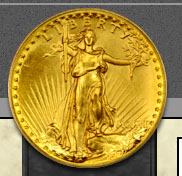
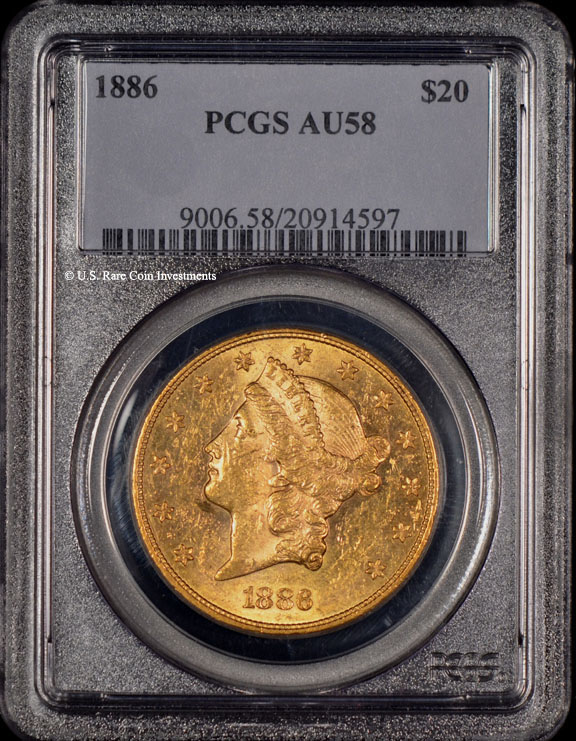
1886 $20 1886 $20 PCGS AU58
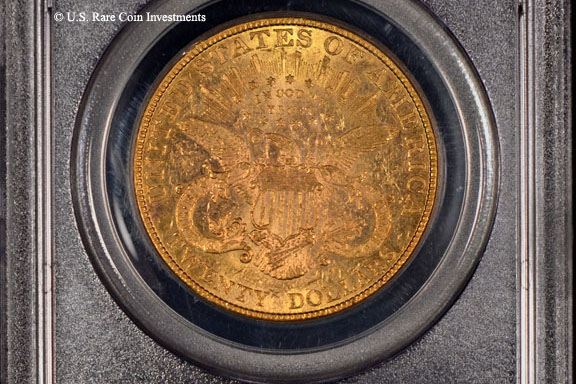
1886 Double Eagle - 1886 $20 PCGS AU58. This extremely rare, near-Mint State, Type 3 1886 double eagle has a sharp strike and shows significant mint luster. The sharpness of the strike is seen in the centers of the stars, the lines of Libertys hair, and the design details of the reverse. Most often coins of this type have less distinct hair details until the 1890s when a design modification was made. Just some light abrasion, in keeping with the grade, prevents this coin from being a Mint State piece. In the industry it is known as a slider because it is so close to being Uncirculated.
James Barton Longacre designed the pattern for the twenty dollar double eagle in 1849. It was produced because of the huge amount of gold that came into the Mint from California. With the discovery of gold at Sutters Mill in January 1848, the California gold rush began. It led to an influx of miners and others into the area. The vast quantity of gold produced led to a need for a standard form of exchange. The double eagle was the governments response. They also felt that it would be useful for large commercial transactions and that it would facilitate foreign trade.
Longacres design for the double eagle shows a Liberty head facing left wearing coronet inscribed LIBERTY. Her hair is tightly tied in the back with two loose curls hanging down her neck to the end of the truncation. She is surrounded by thirteen six pointed stars with the date below. Dentils are near the edge on both sides of the coin. The reverse shows a heraldic eagle with elaborate ribbons on both sides of the shield extending from the top corner down to the eagles tail feathers. The ribbons are inscribed, on the left E PLURIBUS and UNUM on the right. The ribbons were added to the design to symbolize the denomination since this was the first twenty dollar coin. There is an oval of thirteen stars above the eagles head and an arc of rays from wing tip to wing tip behind the upper half of the oval. UNITED STATES OF AMERICA is in an arc above the eagle, and the denomination TWENTY D. is below. The mint mark is between the tail feathers and the N of TWENTY.
The motto IN GOD WE TRUST was added to the original design in 1866 by enlarging the oval of stars above the eagles head and placing the motto in it. This modification did not require a major alteration of the coin as was the case with adding the motto to the lower denominations. It was made at the behest of Salmon P. Chase, Secretary of Treasury and Congress because of pressure brought about by the Reverend M.R. Watkinson of Ridleyville, Pennsylvania.
Originally all of the United States coinage was secular. However, in the first sixty or so years of the United States existence, religious life became more important to the populace. By 1860, twenty-three percent of the population belonged to a church or had some kind of religious affiliation. Groups such as the National Reform Association wanted to amend the Constitution to acknowledge the Lord Jesus Christ as the source of all power and authority in government. The amendment was unsuccessful; however, the sentiment to bring religion into government remained strong. President Abraham Lincoln chose James Pollock to be the Mint Director in 1861. He served until 1867. Pollock was in favor of the idea that the nation depended on the will of God. Reverend Watkinson was the first person who actually addressed this need. He believed that adding the name of God to our coinage would, relieve us from the ignominy of heathenism[and] place us openly under the divine protection. Although placed on the two cent coin in 1864, the Coinage Act of 1865 created the authority to add the motto IN GOD WE TRUST to all coins. In 1866 it was placed on the half eagle, the eagle and the double eagle as well as on silver coinage and the shield nickel. It wasnt until the newly designed eagle and double eagle of Augusts Saint-Gaudens that the motto was briefly omitted in 1907 and 1908 because of President Theodore Roosevelts objection to it. \
The design change that brought about the Type 3 double eagle was the denomination. It went from TWENTY D. to TWENTY DOLLARS in 1877. Like the addition of the motto to the reverse of the previous double eagle, it did not cause any major change in the rest of the coins design. William Barber who by then was the Engraver following Longacres death in 1869 made the modification. Later, his son Charles further modified the reverse of the double eagle by smoothing the back of the eagles neck. Many of the twentieth century double eagle coins have the new reverse, but some were made from left over hubs and have the 1899 reverse.
During this time period there were extremes of coin mintage. There were several years that saw double eagle mintages of over a million and even two million coins. However, the largest was 1904, which had a mintage of 6,256,699. Many of these were saved in European banks and are available in quantity today. On the other hand, there were great rarities created by low mintages. In 1886 there were only 1,000 coins minted, and that was the third lowest. The years 1885 and 1882 saw 751 and 571 respectively. Of course authentication is required for these rarities because the S mint mark could easily be removed from the common dates of 1885-S and the 1882-S. However, since no branch mints made 1886 double eagles, removing a mintmark could not take place for this issue.
James Barton Longacre was born in Pennsylvania in 1794. When he finished his apprenticeship in Philadelphia as a bookseller and a banknote engraver, he worked on his own as an engraver of book illustrations and bank notes. His works included one on the signers of the Declaration of Independence and another on stage personalities. In 1830, Longacre planned to do a series of biographies of famous men in the military and the political arena. In 1834 the result of this series became the National Portrait Gallery of Distinguished Americans that was published in four volumes. Longacre and those who worked with him became famous because of this work. In 1844 Longacre came to work at the Mint. He was opposed by Franklin Peale, the Chief Coiner. Peale was probably responsible for some blundered dies that Longacre was criticized for making. Peal was involved in a private, illegal medal manufacturing business using Mint facilities. He was concerned that this new political appointee would interfere with his business, and he resisted Longacres appointment as Chief Engraver. Finally in 1854, Peale was fired by President Franklin Pearce. Longacre flourished in his position and was responsible for creating many new designs including the Indian Head cent, the two cent piece, the Shield nickel, the Liberty Head gold dollar, the Indian Princess gold dollar, the three dollar gold piece, and the Liberty Head double eagle.
The 1886 double eagle had a miniscule original mintage of 1,000 coins. Because no branch mint made coins of this date, there is added pressure from date collectors who want a complete set of double eagle dates. Only 40 to 60 pieces are known to exist today. In its population report, PCGS shows 4 in AU58 with 3 better.
We are interested in buying these rare coins/tokens/medals/currency. If you are interested in selling, raw or slabbed please offer to us and ask your price or once received we'll make our highest offer! Contact us here and tell us what you have to sell us.
** All buy it now coins availability must be confirmed via email or phone before purchase. Please contact us ( email ) for availability.
* Prices subject to change with no advance notice due to market or other reasons. Paypal fee may apply.
Don't
see it here? Tell us what you want Click
Here