Price: 3,250.00 - SOLD - 7/09/2012* Free Shipping and Insurance for coins at $10K or above.
1901 Barber 10c 1901 Barber 10c NGC PF67
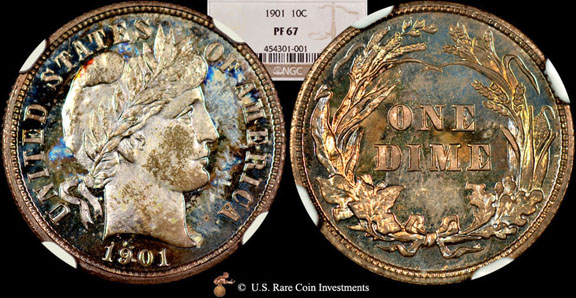
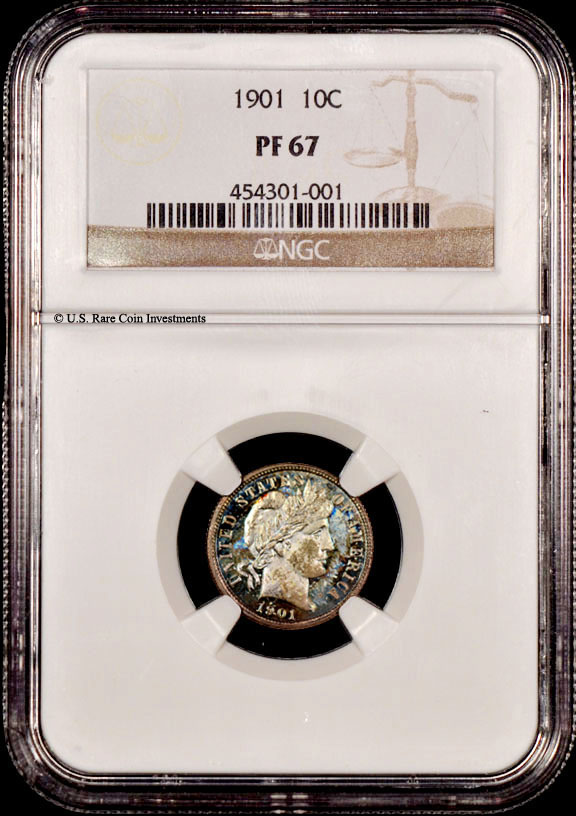
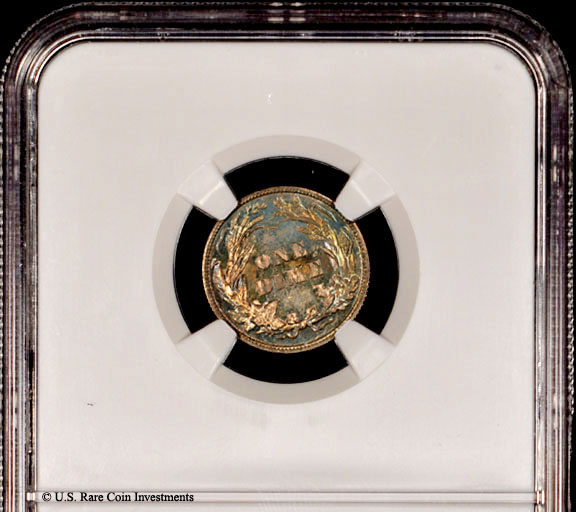
1901 Barber Dime - 1901 Barber 10c NGC PF67. This rare, lustrous, proof 1901 Barber Dime has magnificent color, a semi-cameo obverse, nearly perfect surfaces, and is tied for second finest at NGC and finest at PCGS. The coins light obverse devices are highlighted with shades of tan and red and outlined in blue. Various shades of blue, green, and aqua are on top of the dark fields with dark brown and blue towards the edge. The reverse devices have shades of light tan and yellow. The fields show shades of blue, gold, tan, and olive. The coin is completely free of hairlines, slide marks, scuffing that are endemic among proof Barber coinage.
Charles Barber designed the Barber or Liberty Head dime, which was issued from 1892 to 1916. It shows a large laureate Liberty head facing right in profile wearing an oversized Phrygian cap with a headband inscribed LIBERTY. The laurel is tied with a ribbon in the back of the neck, and the date is below the truncation. The reverse shows a closed wreath of maple, corn, oak, and wheat that is tied at the bottom with a bow. The denomination is within the wreath written in two lines as ONE DIME.
After an unsuccessful design competition open to the public with stringent legal limitations, too short a time limit, and too small a prize, Mint Director Edward O. Leech ordered Charles Barber, the Mint Engraver, to design a new dime. For his obverse Barber used a mirror image of the Morgan dollar Liberty head with back hair cut off and the rest concealed within a large cap. He left the reverse design as it had been since 1860 with minor modifications. His initial B appears at the truncation.
Charles Barber served as Engraver from 1879 to 1917. He is best known for his designs of the Barber dime, quarter, and half dollar. In addition he designed the Liberty Head nickel, several commemoratives, and the Flowing Hair Stella pattern. Barber was born in London in 1840. He came to the United States in 1852 with his family. His father became an engraver at the Mint in Philadelphia. Following Longacres death, William Barber became the Chief Engraver and made his son, Charles, his assistant. In 1879, Charles Barber became the Chief Engraver despite the fact the George T. Morgan may have been more qualified or at least more talented.
The 1901 proof dime had an original mintage of 813, which means it is rare in all conditions. In its population report, NGC shows 14 in PF67 with 2 better. At PCGS there are 4 in PF67 with none better.
We are interested in buying these rare coins/tokens/medals/currency. If you are interested in selling, raw or slabbed please offer to us and ask your price or once received we'll make our highest offer! Contact us here and tell us what you have to sell us.
** All buy it now coins availability must be confirmed via email or phone before purchase. Please contact us ( email ) for availability.
* Prices subject to change with no advance notice due to market or other reasons. Paypal fee may apply.
Don't
see it here? Tell us what you want Click
Here