Coins
Stay Strong as Stock Market Routed By
David L. Ganz, Numismatic News
October 16, 2008
The Dow Jones Industrial
Average October plummet and the worldwide consequences
of Lehman Brothers filing for bankruptcy and its stock
going from a 52-week high of more than $50 to a low
of about eight cents a share, has brought unparalleled
activity in the numismatic market. It has also in
the face of wild price swings made rare coins appear
to be the pillar of stability.
It also has brought out
consultants and commentators involved heavily in the
rare coin market, and given the impression that gold
remains an object much admired as well as feared -
the ultimate hedge against inflation and runaway tangible
assets performance, and a solid, not disjointed market.
In a record week of market
trading Oct. 6-10, American corporations have lost
equity of over $11 trillion. The amount is estimated
by CBS radio and seems reasonably accurate. At the
same time, gold has marched forward and there is solid
demand for bullion as well as numismatic products.
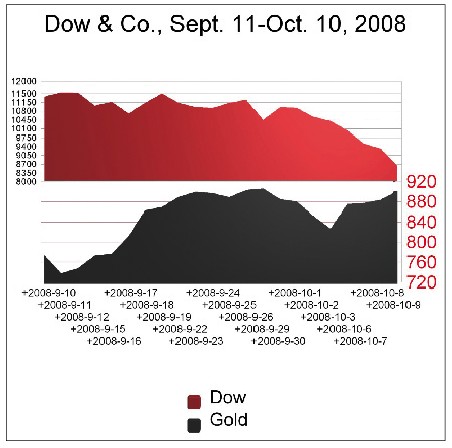
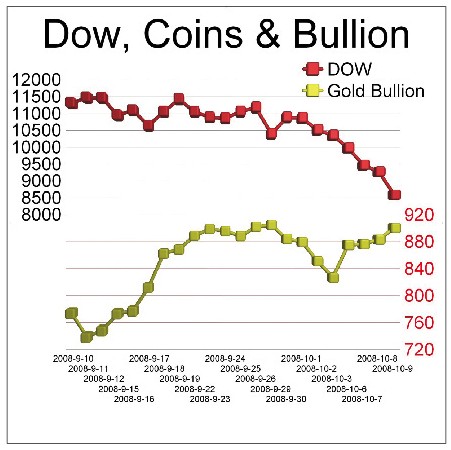
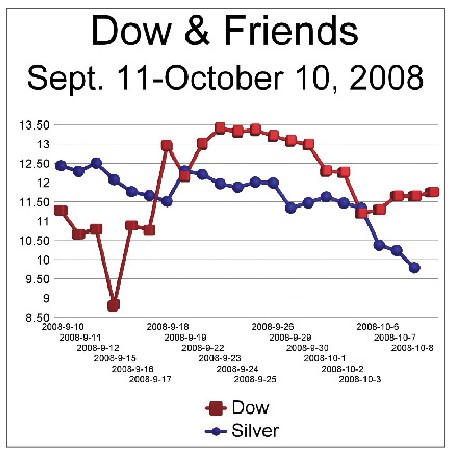
As the accompanying charts
show, the Dow has lost a lot of ground. Gold acted
protectively and has been a steady riser; silver and
platinum have declined from 2008 heights.
Tangible assets in general
did well in the past six months. Farm land, for example,
held its own according to Iowa State University professor
Michael Duffy, who maintains a farmland Web site that
has captured the spirit of the challenge.
"The latest surveys,
as of September, still showed a 17 percent year-to-year
increase in value for farm land. As for now, I think
it has stabilized. Whether or not it has dropped I
can't say for sure," Duffy declared in an Oct. 7 e-mail.
Duffy's opinion is based
on old, dirty data; his response today, "We are starting
our survey the 1st of Nov. My gut feeling is that
it has stabilized but not started dropping. Grain
prices are off and input costs are through the roof."
Dennis Baker's NumisMedia
constantly monitors price, and supplied the citations
and other problems in a less than ideal situation.
I asked Baker if he could update some gold coins for
a "daily" response, but his answer is that the market
is not homogeneous, prices are not only not uniform,
but it is impossible to give back the reliable data
that the 50+ breakfast table generation usually sees
in the financial pages of daily newspapers because
of a clear problem in accumulating reliable data.
Excerpts from a long
e-mail with Baker: "All [price guide] prices are recycled
every three weeks. However, we update some series
intermittently between this period. You get the wholesale
booklets from us ... Take a look at the specific prices
from the HD booklets over the last several weeks and
see how they look."
Baker's overall comment:
"Initially, $20s went down and there were lots of
supplies with no buyers. Then when all hell broke
loose, this is when premiums started to increase rapidly
..."
I had an idea of tracking
$20 gold pieces against the market. Baker suggested
it was impractical, given the "free market" already
established: "I cannot give you prices for $20s on
a daily basis. We don't track them daily. And I don't
have the time to try and develop something for you,"
Baker said. Maybe next time.
Baker's views may be
synthesized with these concluding comments: "Money
is the strength of the coin business and there has
never been a more opportunistic time to purchase rare
coins." He's right about that.
His final word: "Whether
buyers are acquiring numismatic coins or bullion-related
modern coins, dealers are noticing a tremendous increase
in business currently taking place. Buyers want physical
coins in their hands because they do not trust paper
stock certificates."
Baker was able to give
me pricing for what represented the list found originally
in a Salomon Brothers survey, back when it was a investment
company embarrassment. The Oct. 9 pricing makes this
column more than an estimate - it jumps up to a more
effective research tool.
The value of the Salomon
charts derives from the fact that old Salomon Brothers
information sheets knew nothing of these expansion
plans, yet is flexible enough to be usable in 2008,
even if the data harvesting began in earnest after
1978.