50-State Quarter Plan to Wrap
Up in '08 By MARTIN CRUTSINGER,
AP Economics Writer
Tue Nov 27, 6:59 PM ET
WASHINGTON -
A grizzly bear clutching a salmon, the Grand Canyon at
sunrise and a scissortail flycatcher in flight. Those
striking images will be on the final batch of state quarters
as the most successful coin program in history draws to
a close.
The U.S. Mint on Tuesday unveiled the final five designs
for the state quarters with the first one, honoring Oklahoma,
to be put into circulation in late January with the other
four following at 10-week intervals after that.
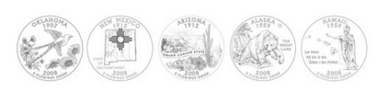
These handout artist renderings provided
by the U.S. Mint show the designs for the final five
quarters in the Mint's 50-state quarter program. The
designs, from left are, Oklahoma, New Mexico, Arizona,
Alaska and Hawaii. (AP Photo/US Mint)
The states have been honored
in the order they were admitted to the union, starting with
Delaware. It was honored with a quarter in 1999. The effort
kicked off a collecting craze unlike anything ever seen before
in the coin world.
Based on a 2005 survey, Mint officials estimate
147 million people have gotten involved in collecting the
quarters with their constantly changing designs.
"The American people have made the 50
state quarters the most successful coins in United States
history," said Mint Director Ed Moy.
The final five coins will start with Oklahoma,
which entered the union in 1907. It will feature the state
bird, the scissortail flycatcher, and the state wildflower,
the Indian blanket.
That will be followed by a Zia sun symbol
for New Mexico, which entered the union on Jan. 6, 1912. Arizona,
admitted on Feb. 14, 1912, will be represented by the Grand
Canyon and a saguaro cactus.
Alaska's coin will feature a grizzly bear
wading in a stream with a salmon in its mouth while the Hawaii
coin depicts King Kamehameha. Alaska and Hawaii were the last
states to join the union in 1959.
Through the first eight years of the program,
the Mint produced 31.2 billion quarters. Moy said about 20
billion of those quarters were due to the popularity of the
changing designs which attracted collectors in record numbers.
It costs the government around 9 to 10 cents
to make a quarter, but the Mint sells the coins at face value.
The increased production has amounted to an estimated $3.8
billion in extra profits for the government.
"It is one of those rare programs that
actually made money for the federal government," said
Rep. Michael Castle, R-Delaware, the original sponsor of the
state quarter legislation.
The quarters are scheduled to revert back
to their pre-1999 designs after next year. George Washington
will remain on the "heads" side of the coin, but
the "tails" side where the state designs had been
placed will once again feature an American eagle.
Collectors who are missing some states should
not lose heart since the coins already produced should remain
in circulation for about 30 years.