A Treasure Travels, Inconspicuously By GLENN COLLINS
Published: June 16, 2008
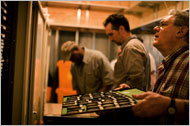
Once the coins reached their destination at
the new home of The American Numismatic Society, the trove
of coins was quickly unwrapped and filed in the new vault.
They didn’t exactly hire two guys with a truck to secretly
move one of the world’s largest and most valuable coin
collections over the weekend in Manhattan. But they did use
five standard-issue moving vans.
No armored-car convoys. No helicopter gunships.
No National Guard outriders flourishing automatic weapons.
Just sweaty movers, in blue shirts with their names stitched
at the front, schlepping 425 plastic packing crates that were
filled with treasures trussed in humble bubble wrap and garden-variety
vinyl packing tape.
Yes, the New York Police Department provided
an escort, but during more than eight hours on Saturday, one
of the great hoards of coins and currency on the planet, worth
hundreds of millions of dollars, was utterly unalarmed as
it was bumped through potholes, squeezed by double-parked
cars and slowed by tunnel-bound traffic during the trip to
its fortresslike new vault a mile to the north.
In the end, the move did not become a caper
movie.
“The idea was to make this as inconspicuous
as possible,” said Ute Wartenberg Kagan, executive director
of the American Numismatic Society. “It had to resemble
a totally ordinary office move.”
The
collection of 800,000 coins, bank notes, medals, commemorative
badges, pins, historic advertising tokens, campaign buttons
and other artifacts has been amassed during the 150-year existence
of the nonprofit society.
It was transported from the society’s
high-security headquarters at 96 Fulton Street, in the former
Fidelity and Deposit Company building at the corner of William
Street, to its future home, a secure $4 million vault and
exhibition space 22 blocks away, on the 11th floor of One
Hudson Square, at Varick and Canal Streets.
Even as the moving vans shuttled back and
forth, the society’s 14 employees began the endlessly
tedious work of unpacking the boxes. They began freeing 12,000
metal trays full of coins from their quarter-inch foam packing,
then stacking them in their new locations in custom-built
cabinets in a vault erected on the concrete floor of a former
printing building.
The society’s holdings rival the comprehensiveness
and rarity of those in the Smithsonian Institution and comprise
“one of the world’s great collections, the equivalent
of those in Berlin, Paris and the British Museum,” said
Christopher S. Lightfoot, an associate curator in the department
of Greek and Roman art at the Metropolitan Museum of Art.
“It is a vast, encyclopedic collection
of the highest quality,” he added.
Of the collection’s value, Dr. Wartenberg
Kagan said, “It is priceless because it has so many unique
pieces,” adding with deliberate vagueness that experts
had valued it in the hundreds of millions of dollars.
The collection “is incredibly valuable,
so you can understand why they don’t want to publicize
exactly how much,” said Rosemary Lazenby, curator of
the Federal Reserve Bank of New York.
During the move, coded numbers on each sealed
crate were checked again and again, and “nothing fell
off a truck,” said Andrew R. Meadows, the society’s
deputy director.
Society staff members were pledged to secrecy
about the timing of the move, and “we didn’t tell
our movers what the cargo was until the morning of,”
said James McVeigh, operations manager of Time Moving and
Storage Inc. of Manhattan, referring to the crew of 20 workers.
“How could you not think that there are
crazy people out there who want to do crazy things?”
he added, noting that he spent six months planning the move
with his brother, Tom, another manager of Time Moving.
And so as bright orange rubber-wheeled crates
concealing fabulous doubloons rumbled out onto the sidewalk,
pedestrians obliviously headed into the Duane Reade two doors
away at 130 William Street.
Amid much shouting and hand gesturing, the
moving vans barely squeezed past a parked Duane Reade truck
on the narrow street as the drivers maneuvered past water
and gas main renovation work on Fulton Street.
Then, before arriving at their loading-dock
destination on Watts Street, the trucks had to battle Holland
Tunnel approaches clotted with weekenders on the way to the
Jersey Shore.
“It’s our first coin collection,”
said a New York police detective, Gregory Welch, of Emergency
Service Unit Truck One, which shadowed the move with hidden
heavy weapons “just in case,” along with patrol
cars from the First Precinct. He said his unit was accustomed
to protecting Federal Reserve gold transfers and gem shipments
in the Midtown diamond district.
The numismatic society, which has about 2,000
members, was founded by a group of New York collectors in
1858. Thanks to the discovery and minting of gold in California
and the development of new federal coinage, interest in coin
collecting — as well as the size of the society’s
collection — grew quickly. By 1908, the society had its
first permanent home, in a neoclassical building next to the
Hispanic Society of America on Audubon Terrace at 155th Street
and Broadway.
Portions of the collection — which grew
through donations from the society’s members and officers
— were long on view. But a decline in its finances starting
in the 1970s resulted in a whittling down of the staff, and
the society considered shutting its doors, Dr. Wartenberg
Kagan said. However, she added, an infusion of new board members
and wealthy donors has given it a current endowment of $45
million.
In 1998, the society bought the seven-story
Fulton Street building for $6.5 million and reopened its doors
to scholars in 2004, but the growing cost of renovations in
the antiquated structure proved too great to provide an exhibition
space, Dr. Wartenberg Kagan said.
So the society lent hundreds of its rarest
and most valuable holdings to a museum in the Federal Reserve
Bank of New York, as well as some 250 gold and silver coins
to the Metropolitan.
The society sold its building this year for
$23.9 million, “which was mostly for the endowment, and
some for the build-out in the new space,” Dr. Wartenberg
Kagan said.
The oldest item in the society’s “cabinet”
(the coin-maven word for collection) is one of the first coins
ever produced, made of gold-silver alloy and issued around
650 B.C. by a Lydian king who was an ancestor of Croesus.
There is also a 2,000-year-old gold aureus
coin of the Roman Emperor Augustus; a gold stater of Alexander
the Great, dating to about 330 B.C. (minted in Babylon from
Persian loot); and one of the rarest examples of Confederate
States currency, a $1,000 note printed in Alabama in 1861.
Fewer than 700 were printed.
The society also has a library of 100,000
books, pamphlets, manuscripts, catalogs and other items, which
will open to the public in September.
The new, 20,000-foot space, with its 14-foot
ceilings, has panoramic views north to the Chrysler Building
and west to the Hudson River and will have a climate-controlled
rare-book room, conference and lecture spaces, administrative
offices and an exhibition hall.
“Our collection is amazing, and much
of it has not been on view,” Dr. Wartenberg Kagan said.
The first exhibition, celebrating the society’s 150th
anniversary, is to open in October.
The society “deserves a new home, where
its holdings can be displayed to the public,” said Ms.
Lazenby of the Federal Reserve, which has exhibited parts
of the society’s collection in recent years in the bank’s
admission-free coin museum, in its massive iron-barred neo-Florentine
building at 33 Liberty Street.
All day Saturday, after the movers put the
crates in place, workers quietly and steadily unpacked the
coins, some golden and gleaming, others dulled by the centuries.
For long stretches, the only sounds were the popping of tape
and bubble wrap, the squawk of trays sliding into cabinets
and the very occasional ring of a coin bouncing on the concrete
floor, accidentally tipped from its tray. Instantly work would
cease as the errant coin was hunted down and restored to its
niche, undamaged.
Finally, after the massive doors and gates
of the vault slammed shut, Dr. Wartenberg Kagan expressed
gratitude to the police and the heroic efforts of her staff,
and gave the order for the alarm to be armed. “To say
I’m relieved,” she said after the lockdown, “is
putting it mildly.”

























 Once the coins reached their destination at
the new home of The American Numismatic Society, the trove
of coins was quickly unwrapped and filed in the new vault.
Once the coins reached their destination at
the new home of The American Numismatic Society, the trove
of coins was quickly unwrapped and filed in the new vault.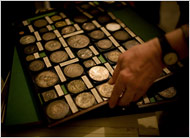 The
collection of 800,000 coins, bank notes, medals, commemorative
badges, pins, historic advertising tokens, campaign buttons
and other artifacts has been amassed during the 150-year existence
of the nonprofit society.
The
collection of 800,000 coins, bank notes, medals, commemorative
badges, pins, historic advertising tokens, campaign buttons
and other artifacts has been amassed during the 150-year existence
of the nonprofit society.