All
That Glitters Is Not Gold By VITO J. RANCANELLI
- April 13, 2009
Tanzanian
Royalty rallied on the reputation of CEO James Sinclair. But
the gold guru's actions cast doubt on the exploration company's
fortunes.
GOLD EXPLORER TANZANIAN ROYALTY
EXPLORATION HAS NO revenue, no earnings and no proven gold,
as well as some accounting issues. So why do its shares trade
at a premium to peers that seem to be in much better shape?
It helps that its chairman and chief executive,
James E. Sinclair, is famous for correctly forecasting gold
prices, and he is very bullish on the metal on his avidly
followed newsletter-style Website, www.jsmineset.com. Over
the years, Sinclair's views on gold have been sought out by
newspapers like the New York Times and on cable-TV networks
like CNN. Barron's has interviewed him and run his advertising.
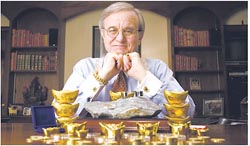
Jim Sinclair, shown on the U.S. Rare Coin
Investments Website, is bullish on gold prices. He expects
them to rise to about $1,650 an ounce by 2011.
So it is surprising to learn
that the widely known bull on gold has been a steady seller
of shares of his own gold-related company.
Tanzanian Royalty (ticker: TRE) is a
small-cap Canadian outfit (including its predecessor)
that has been looking for gold for a decade. None of
its properties, all in Tanzania, have yet shown economically
viable mineral reserves, as defined by regulators. Were
it valued more like rivals with similar cash and gold
reserves, its share price would be substantially lower
than the current $4.05.
TRE's market capitalization is $370
million. Some rival miners with more cash on their balance
sheets than TRE and actual gold have market caps one-sixth
that size.
Dubbed Mr. Gold by the media for prescient
calls on gold in the late 1970s and 1980s, Sinclair ran his
own precious-metals trading firm in those days. On his Website
and in interviews, a bullish Sinclair today says gold will
trade as high as $1,650 an ounce by January 2011 and says
he would wager $1 million that it will. Gold was trading at
about $881 an ounce Friday.
In an interview with Barron's last week, Sinclair
disputed the view of TRE's shares as overvalued, saying the
market cap was due to its less-capital-intensive structure
and the potential of its properties. Moreover, he promised
that a third-party evaluation of its important Kigosi property
in Tanzania would be ready in "about six months."
While TRE puts out press releases on his share
purchases, the CEO says he isn't required to put out press
releases on his share sales.
In addition to Sinclair's devoted following
-- he is sometimes referred to as "Uncle Jim" on
Yahoo!'s TRE message boards -- shareholders could be speculating
that he will sell TRE to a big miner. Though he was ousted
as chairman of Sutton Resources in 1995, some remember that
Sutton was bought by Canadian gold giant Barrick Gold (ABX)
in April 1999 for its Tanzanian properties. Not everyone credits
Sinclair for the deal, but some do.
There is no question that Tanzanian shares
have done extremely well since Sinclair and his family became
its largest stockholders in April of 2002 (as a result of
a merger they ended up with about 25% of the shares, which
trade on the American Stock Exchange, and on the Toronto Stock
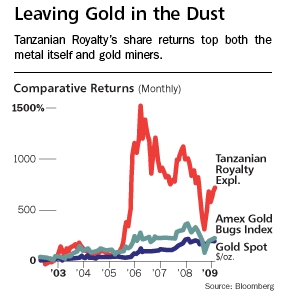
Exchange under the ticker TNX.Canada). TRE shares have soared
about 711% since then. That trounces the 218% rise in the
metal itself over the same period, though TRE has no gold
reserves. Meanwhile, the American Stock Exchange Gold Bugs
Index (HUI) composed of companies involved in gold mining
-- many of which have gold in hand -- is up much less, just
198%. Since last summer, the credit crisis has hurt the juniors,
as the small prospectors are called, on worries that they
won't be able to get the financing needed to develop mines.
In that time, TRE has fallen less than its peers.
Yet TRE faces the same business risks that
rivals do, and continued financing is among the most important.
TRE's financing is accomplished by the unusual method of private
placements of its stock with CEO Sinclair, who then sells
his shares into the market.
In a March 5 press release on this subject
from the company, TRE reported that Sinclair has purchased
another 189,036 shares for one million Canadian dollars (US$810,000)
and that Sinclair's "total share placements to date aggregate
C$22 million." TRE doesn't put out releases on his sales
of millions of shares of the stock, though he has steadily
sold TRE shares into the open market. He sold stock more than
50 times in 2008. Over the years, as the stock price soared,
Sinclair and his family have reduced their TRE stake from
25% in 2002 to less than 3% now, company documents show. According
to Canada's System for Electronic Disclosure by Insiders,
or SEDI, his TRE stake has dropped to about 2.3 million shares
as of March 12, from 3.9 million in October 2004.
Though company announcements claim he is financing
TRE, ultimately the main financiers are mostly the retail
shareholders who buy from Sinclair. In his interview, he repeated
that he is a strong backer of the company and that he recently
agreed to another $2.43 million private placement for TRE
shares. But if Sinclair is unwilling or unable, for any reason,
to continue these private placements, how will TRE finance
its activities? With the credit crunch, the environment has
become tougher for juniors dealing in speculative endeavors
to get traditional financing through selling equity directly
into the stock market. That is especially true for a company
without any proven reserves, like TRE.
When
Barron's asked why he was selling TRE shares, Sinclair replied
that it was for personal liquidity. Asked why he didn't put
out a press release on the stock sales, Sinclair replied,
"Is it required?...I take no salary, no options, no warrants.
I have purchased more than I have sold." But when asked
to furnish that data, he refused and referred Barron's to
the SEDI Website. The selling trend shown by SEDI insider-trading
records is seconded by TRE documents: Sinclair had 3.17 million
shares in August 2008 and 2.88 million in January.
Sinclair has declared he won't go to the public
markets to finance the company, but it is probable that TRE
couldn't easily get an investment bank to underwrite its shares
because of that lack of economically viable mineral resources.
There is little institutional interest --
roughly 17% of TRE's 89 million shares are held by mutual
funds, according to Bloomberg. TRE filings report that 83%
of its shareholders are American, most of them individual
shareholders who, unless they are familiar with Canada's SEDI,
are perhaps unaware that Sinclair is selling shares after
buying them.
These TRE shareholders might not know that
Sinclair is listed as a "disciplined person" on
the Website of the Canadian Securities Administrators, an
organization of provincial securities regulators. On July
22, 1998, Sinclair was ordered by the British Columbia Securities
Commission to pay $2,000 to settle a violation of "misrepresentation"
in a press release having to do with Sutton. Sinclair called
it a small "misunderstanding."
Unlike many peers, TRE doesn't appear to be
followed by any sell-side analysts from brokers specializing
in Canadian miners, so third-party information is scarce.
TRE is an Alberta-registered corporation with headquarters
in South Surrey, B.C., while Sinclair himself is based in
Sharon, Conn.
If analysts looked at TRE, they would find
its finances are stretched. For example, as of Nov. 30, the
company had about $1.2 million in cash, not much more than
the $1.17 million in salaries and fees paid to its directors
for the fiscal year ended Aug. 31, 2008.
As Sinclair makes clear, TRE is a royalty
company, not a mining firm. That means it will find lands
with potential, then sell them off to bigger miners in exchange
for royalties from mine production, if that occurs. As Sinclair
noted, royalty firms need less capital than a junior miner,
but $1.2 million is hardly enough. Even royalty firms must
drill on properties to entice partners.
According to a TRE filing for the year ended
last Aug. 31, TRE spent $2.37 million for exploration in fiscal
2008, just $267,000 more than fiscal 2007. For the past three
years TRE has spent less than $8 million in exploration and
written off roughly half of that in mineral-property value.
By comparison, Barrick eventually spent some $400 million
to develop its Buzwagi mine in Tanzania.
On its Website's projects-description page,
TRE often promotes its own properties in Tanzania that are
near Barrick developments and continues to list Barrick as
a joint-venture partner in an Itetemia prospect. Barrick says
it has no JV partnership with TRE.
Sinclair disputes that TRE doesn't have the
cash for its drilling program: "We have our own drills
and team." Sinclair also said the firm has one rig for
all its properties, similar to some other companies. None
of them, however, has the market cap of TRE.
Moreover, David Duval, a Vancouver-based mining
technologist, says that before a gold mine can be developed,
$20 million to $30 million in drilling and exploration costs
are typical, depending on the property. Duval called Barron's,
saying he had done so at the behest of Sinclair and that he
is a consultant to TRE. Duval is also listed as a contributor
and co-founder of Sinclair's Website: www.jsmineset.com.
Something else that might trouble investors
is that TRE has been cited by its auditor KPMG for a "pervasive
material weakness" in accounting controls. In TRE's annual
report for the year ended last Aug. 31, KPMG, gave an adverse
opinion on the effectiveness of TRE's internal controls: "The
company has limited accounting personnel with expertise in
generally accepted accounting principles to enable effective
segregation of duties with respect to financial reporting
matters and internal control over financial reporting."
The company says it is attending to that.
But the greatest risk to TRE shareholders
is its lack of gold reserves. TRE has put out many positive-sounding
press releases since 2002 about its properties, but it hasn't
discovered any economically viable gold resources as defined
by a National Instrument 43-101-compliant document. The document
-- established by Canadian authorities after the giant BRE-X
Minerals fraud in 1997 -- is an officially sanctioned disclosure
measure of "mineralization," or the presence of
minerals like gold.
An NI 43-101 reports whether the property
has "proven" minerals -- the highest measure of
geological confidence -- or lesser reliability, like "probable,"
or "inferred," the least strong. No miner is likely
to get substantial mine-development financing without such
a document, and TRE doesn't have one.
Instead, press releases are issued about preliminary
drilling results, but no gold mines follow. For example, TRE
reported Oct. 13, 2004, a "significant gold discovery"
in the Luhala property in the Lake Victoria Goldfields area.
On Oct. 19, 2005, another "significant gold discovery"
was announced in the Tulawaka region. Three to four years
later, there is no news of any commitments to develop these
properties into gold mines, or any of Tanzanian's leaseholds.
Sinclair is upbeat about TRE's probability
of finding economically viable gold soon: "We have discovered
about four grams per ton in Kigosi....We are going to have
an NI 43-101 on Kigosi in about six months -- as soon as consultants
finish their work," he says. "It could fall apart...[BUT]if
all goes well, from the time the report is completed there
will be a mine within 18 to 24 months."
"All of our extremely positive results
are on the Website. If gravels continue to show the grades
that are indicated now, I would move immediately to an open
pit and underground mine," Sinclair vows.
That sounds optimistic, since gold mines often
take three or more years to build after the finding of economically
viable metal.
Despite having resource prospects that don't
measure up to peers', TRE's valuation is golden compared with
many. (See nearby table.) For example, TRE has its $1.2 million
in cash, no gold reserves and its $370 million market cap.
Meanwhile, rival MDN (MDN) whose market cap is $55 million,
also has prospects in Africa, but $14.6 million in cash and
100,000 ounces of gold resources, according to broker Canaccord
Adams. Semafo (SMF) has a market cap similar to TRE's but
also has 4.8 million ounces of gold reserves.
Another way to benchmark TRE is to look at
the S&P/TSX Metals & Mining Index (STMETL) of 35 stocks,
many with real revenue and cash flow. The index's average
price/book ratio is 1.35, but TRE, which is in the index,
trades at about 17 times its book value of 24 cents a share.
Membership in such indexes and the International
Stock Exchange Gold index (HVY) may boost TRE shares higher
than they would be otherwise. In both indexes, TRE's weightings
are equivalent to companies with many times its market cap
and actual gold, like Eldorado Gold (EGO), which has 7.6 million
ounces of proven or probable gold.
Speaking with Barron's, Sinclair repeatedly
said that TRE's market cap is due to its less-capital-intensive
royalty structure and the value of its leaseholds. "It's
not me, it's the underlying assets. The company assets will
have to stand on their own two feet and I think that it can."
When it was pointed out that TRE has no NI 43-101, yet its
valuation was much higher than companies with 43-101- compliant
gold and actual gold, he replied: "I will come after
you," and ended the phone call.
Rising gold prices have boosted TRE's stock
value lately, but it needs to find some gold soon. Otherwise,
its exploration failures so far and its dependency on Sinclair's
financing methods will catch up with the shares.
While Sinclair has had success predicting
gold prices, TRE doesn't have a good track record of finding
gold in economically viable amounts. Without Sinclair, it
is likely TRE's market cap and share price would be significantly
less golden.
The Bottom Line If you apply the same metrics
to Tanzanian Royalty that are used for its peers, the stock
looks substantially overvalued. And Tanzanian has less cash
on its books than most.
























 When
Barron's asked why he was selling TRE shares, Sinclair replied
that it was for personal liquidity. Asked why he didn't put
out a press release on the stock sales, Sinclair replied,
"Is it required?...I take no salary, no options, no warrants.
I have purchased more than I have sold." But when asked
to furnish that data, he refused and referred Barron's to
the SEDI Website. The selling trend shown by SEDI insider-trading
records is seconded by TRE documents: Sinclair had 3.17 million
shares in August 2008 and 2.88 million in January.
When
Barron's asked why he was selling TRE shares, Sinclair replied
that it was for personal liquidity. Asked why he didn't put
out a press release on the stock sales, Sinclair replied,
"Is it required?...I take no salary, no options, no warrants.
I have purchased more than I have sold." But when asked
to furnish that data, he refused and referred Barron's to
the SEDI Website. The selling trend shown by SEDI insider-trading
records is seconded by TRE documents: Sinclair had 3.17 million
shares in August 2008 and 2.88 million in January.