LONDON, England (CNN) -- Antony and Cleopatra
-- one of history's most romantic couples -- were not the
great beauties that Hollywood would have us believe, according
to British academics.
A study of a 2,000-year-old silver coin found
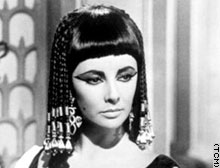
the Egyptian queen, famously portrayed by a sultry Elizabeth
Taylor, had a shallow forehead, pointed chin, thin lips and
sharp nose.
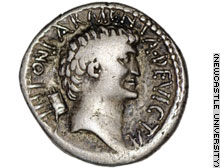
On the other side, her Roman lover, played
in the 1963 movie by Richard Burton, Taylor's husband at the
time, had bulging eyes, a hook nose and a thick neck.
History has depicted Cleopatra as a great
beauty, befitting a woman who as Queen of Egypt seduced Julius
Caesar, and then his rival Mark Antony.
But the coin, which goes on show on Wednesday
at Newcastle University for Valentine's Day, after years lying
in a bank, is much less flattering about both famous faces.
The 32BC artifact was in a collection belonging
to the Society of Antiquaries of Newcastle upon Tyne, which
is being researched in preparation for the opening of the
new Great North Museum.
Clare Pickersgill, the university's assistant
director of archaeological museums, said: "The popular
image we have of Cleopatra is that of a beautiful queen who
was adored by Roman politicians and generals.
Relationship romanticized
"The relationship between Mark Antony
and Cleopatra has long been romanticized by writers, artists
and film-makers.
"Shakespeare wrote his tragedy Antony
and Cleopatra in 1608, while the Orientalist artists of the
19th century and the modern Hollywood depictions, such as
that of Elizabeth Taylor and Richard Burton in the 1963 film,
have added to the idea that Cleopatra was a great beauty.
"Recent research would seem to disagree
with this portrayal, however."
The university's director of archaeological
museums, Lindsay Allason-Jones, said: "The image on the
coin is far from being that of Elizabeth Taylor and Richard
Burton.
"Roman writers tell us that Cleopatra
was intelligent and charismatic, and that she had a seductive
voice but, tellingly, they do not mention her beauty.
"The image of Cleopatra as a beautiful
seductress is a more recent image."
The silver denarius coin would have been issued
by the mint of Mark Antony.
On one side is the head of Mark Antony, bearing
the caption "Antoni Armenia devicta" meaning "For
Antony, Armenia having been vanquished."
Cleopatra appears on the reverse of the coin
with the inscription "Cleopatra Reginae regum filiorumque
regum," meaning "For Cleopatra, queen of kings and
of the children of kings," or possibly "Queen of
kings and of her children who are kings."
Experts say the coin, on display in Newcastle
University's Shefton Museum, is not particularly rare but
is very collectable. The collection has been owned by the
Society of Antiquaries of Newcastle upon Tyne since the 1920s.

























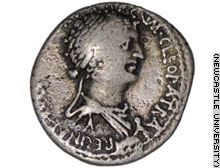 Cleopatra
is shown with a shallow forehead and sharp nose.
Cleopatra
is shown with a shallow forehead and sharp nose.