Picture
Perfect: Capture Your Coins on Film By
Mike Thorn, Coins Magazine
November 19, 2008
Of
the many topics I've discussed in this column, coin photography
has not been one of them. The main reason for this lack of
discussion is that until fairly recently I've not had any
expertise or interest in the subject.
If you've never given coin photography a thought,
you may be wondering why anyone would be interested in it.
After all, what's in it for you? How would it help you be
a better coin collector?
First of all, if you've ever looked at the
auctions or bought any coins on eBay, then you've seen the
difference between people who know how to photograph coins
and people who don't. The former produce pictures of their
coins that make you, the potential buyer, want to bid on them.
The latter produce pictures that are often of coins that are
too far away from the camera, badly out of focus, too dark
to see details, or some combination of the above.
Thus, one big reason to learn something about
coin photography would be so that you can take decent pictures
of coins you would like to sell on an online auction site.
Of course, if you have no interest in either buying or selling
coins online, this reason will not appeal to you.
Beyond selling your coins, another reason
to learn how to take coin photographs is so that you can have
a photographic record of your favorite (or most expensive)
coins. In other words, you could use photographs as part of
keeping an inventory of your collection. Also, if you keep
your better coins in a lock box at the bank, having photographs
of them will allow you to enjoy your collection after banking
hours.
As I said earlier, until recently I had little
interest in learning anything about coin photography. Although
I've bought and sold coins on eBay since 1999, I only recently
began to take photographs of the coins I offered for sale.
For several years, I used a scanner to make pictures of the
coins I was offering.
Sometimes my scans were satisfactory in describing
the coins, and this was particularly true for well circulated
pieces. However, I found the scans unsatisfactory for uncirculated
coins, as they never showed a coin's mint luster. Also, in
the few cases when I sold toned coins, the scans didn't reproduce
the colors accurately.
I would probably have continued to use my
scans, limited as they were, but necessity forced me to change:
My scanner died at a time when I had several coins I wanted
to sell.
I tried taking flash pictures with an inexpensive
digital camera, but this was totally unsatisfactory. Either
my pictures taken with a flash showed no detail on the coin
because of the reflection of the flash, or my handheld close
ups taken without flash were too blurred to be useful. It
was at this point that I decided to try to learn something
about coin photography.
And that brings me to the topic of this column:
a review of Numismatic Photography by Mark Goodman. With a
list price of $29.95, Goodman's book was published by Zyrus
Press (1-888-622-7823 or go to www.zyruspress.com) and is
available online from booksellers such as Amazon. Amazon's
current price is $19.77.
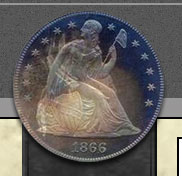
My initial impression is that Numismatic Photography
is worth adding to your numismatic library if only for the
gorgeous pictures of interesting coins it contains. Of course,
there is far more than this to recommend it.
In a brief section about the author, Goodman
explains that he is a professional radiologist, and this background
informs his interest in the quality of photographic images.
As he puts it, "Attention to detail has, in part, fueled
my obsession with image quality in coin photography."
In his introduction, Goodman explains that
his book's purpose "is to provide the reader with the
detailed information needed to take high quality coin pictures."
Each of the book's 17 chapters is divided into two sections,
one titled "ESSENTIALS" and another titled "ADVANCED."
Reading the essentials of each chapter's topic will get you
started with coin photography, whereas reading the advanced
section will take you to a higher plane of knowledge.
As you would expect, the cameras Goodman discusses
are all digital. One important feature of digital photography
is that it gives you immediate feedback. You can tell instantly
whether or not your technique works, and you can also see
quickly what effect changes in your method have on the coin
photographs you're taking.
Although Goodman talks frequently about digital
SLRs (single lens reflex cameras, where you're looking directly
through the lens when you look through the viewfinder), these
are not essential for good coin photography. With proper technique,
a simple (and relatively inexpensive) point-and-shoot digital
camera will take excellent coin pictures.
From my experience, one thing that is essential
for coin photography is a copy stand, which Goodman discusses
in Chapter 3 (Useful Gadgets). The reason is camera movement:
"To get really sharp pictures, camera motion must be
kept to a minimum. Good shots can be achieved with a steady
hand, but having a copy stand&makes things a lot easier."
I quickly found that my hand was not nearly steady enough
to prevent blurring of the coin's features, and I'm willing
to bet that this is true of you as well.
Lighting is also important in coin photography,
and Goodman discusses this topic in Chapter 4, "Lighting
Types." Some of the other chapters (and topics) in this
book are "Determinants of Sharpness," "Color
and Luster," "Raw Coins," and "Imaging
Slabs."
In addition to Goodman's book, which I highly
recommend if you're interested in photographing your coins,
you can find lots of free information about the subject online
if you Google something as simple as "coin photography."
If you have a digital camera and a computer,
you might consider giving coin photography a try. It's a lot
of fun and also a way to better enjoy your collection.