Planning
ahead prepares collectors for security risks Tracking devices
may be newest threat
BY CINDY BRAKE COIN WORLD STAFF
Traveling
with coins is as simple as ABC - Always Be Careful.
When traveling, collectors
and dealers can be targets for thieves and robbers. And while
a multitude of practical means may lessen the risk, the risk
remains and thefts do occur. "Security risks can never
be eliminated," states veteran collector and security
specialist Steven K. Ells-worth. He adds, "one out of
three collections will eventually be stolen" and "few
full-time coin dealers with 10 years experience have avoided
being a victim of theft."
Given those warnings, Ellsworth offers suggestions that may
deter thieves. He has written a series of articles that are
posted on his Web site www.butternut.org. Ellsworth warns
that "next to homes, vehicles are the most likely place
for a theft to occur."
Greatest security
mistake
He adds that the single greatest security mistake
is leaving coins unattended in a vehicle. Jean and Joe Gallo
of Louisiana can vouch for that fact.
In spite of using numerous
pre¬cautionary measures when traveling home from a coin
show in November, they lost more than $500,000 in rare coins
and merchandise taken from their vehicle when it was left
unattended. The Gallos drove four hours, going on and off
the Interstate to deter any vehicles that might be following
them, a precaution many knowledgeable dealers take after leaving
a show. The Gallos stopped at a rest area. They stopped at
a gas station. Each time they kept .their eyes open for any
vehicles that might be following them. They never saw anything
suspicious. But they were being watched. It appears that thieves
attached a tracking device to their vehicle.
When they checked into a hotel,
the thieves struck. A security camera revealed two men. One
was acting as a lookout. The other popped their vehicle lock;
he also appeared to remove a tracking device from the vehicle.
The Gallos returned to the
vehicle to get their luggage and a beverage in a cooler located
in the same area as the coins. All appeared to be secure.
They then drove across the street to eat at a restaurant with
lots of people coming in and out. They even parked under a
light. When they returned to the vehicle, Mr. Gallo noticed
a strap hanging from the vehicle. When they checked the vehicle
for their inventory, they found that everything was gone.
"It is devastating," Mrs. Gallo said, adding that
the coins were their retirement investment. Authorities have
been alerted and the Gallos are praying that someone, somewhere
saw something.
Tracking
devices
The use of GPS tracking devices may be the
latest wrinkle criminals are using in targeting dealers after
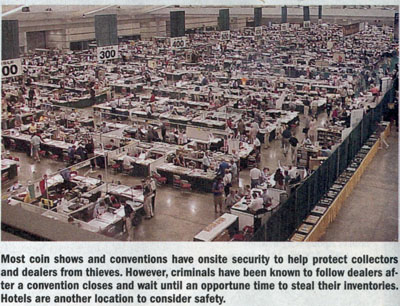
a coin show has closed. Some show sponsors consider the possibility
of someone monitoring a dealer's vehicle from afar using a
tracking device a very real possibility and acts accordingly.
The Money Show of the Southwest is one show that inspects
vehicles for tracking devices.
"We are somewhat nuts
about security for our dealers," writes show chairman
Carl Schwenker. "We have three Houston Police Department
individuals, who are techno-type personalities and specialize
in security, electronically and visually (on their hands and
knees and with mirrors) inspecting every dealer vehicle for
GPS devices."
Schwenker explains the check
takes about six minutes per vehicle and devices have been
found infrequently.
"You have to consider how the thieves pick out their
prey. At our show, since our loading dock is three stories
above ground and obstructed from street level view and guarded
on both entrances, the thieves more than likely select the
dealer from inside the hall, then follow him/her to the parking
lot where they identify the dealer's vehicle. Then they come
back the next morning [departure day], walk the lot until
they find the selected vehicle and place the GPS device on
it," Schwenker states.
Five years ago, according
to Schwenker, one collector "showed his complete collection
of very high grade nickels to everybody and anybody."
After leaving the show, he placed the set on the floor of
his vehicle behind the front seat, placed a blanket on top
of it and then two large bags on top of that. He checked his
mirrors all along the way, finally stopping after 70 miles
for gas and to use the restroom. "The gas station's security
cameras showed that as soon as he went into the restroom,
a red foreign car quickly appeared, stopped next to his, [and
someone in the car] broke the driver's side window, opened
the door, then opened the sliding side door, took the bags
and blanket off and took the collection all in the space of
20 seconds. The last thing he saw of his collection was on
the security tapes as the thieves' car disappeared onto the
highway."
Schwenker states that thieves
prefer older single drivers. Seasoned dealers traveling with
a compan¬ion will take turns when stopping for restroom
breaks, ensuring that someone is always in the vehicle. Ellsworth,
however has his doubts about tracking devices.
"There have been claims by those who have left their
vehicle unattended and had theft occur to feel that there
must have been a GPS tracker attached. There has never been
any evidence to support this claim or theory," Ellsworth
writes in an email.
Personal responsibility
Remembering that "security is a personal
responsibility," Ellsworth recommends coin dealers "try
to think like a thief" when traveling with coins by casing
the facility and looking for problem areas. "Trust your
instincts," he suggests.
Before beginning a trip, Ellsworth
recommends a visual inspection of the vehicle's exterior.
Check the tires and tire pressure. Check for leaking fluids
by looking under the car and under the engine. Start with
a full tank of gas prior to loading coins, and a cell phone
is a must. Just remember when using the cell phone to keep
conversa-, tions private by making sure no or is within earshot
while you are oil the phone. "When packing your vehicle,"1
always remember 'Coins in last when departing. Coins out first,
when arriving,' " Ellsworth states. Some thieves have
struck when a dealer arrived home and left the vehicle unattended
for a few moments.
Be alert
Drivers should "be very alert and drive
defensively," keeping night driving to a minimum. Plan
a course or route. Decide early where to stop for fuel and
food, using only drive- j through restaurants. Keep the car]
locked when refueling. Vary your routine.
Be cautious and aware of being
followed by another vehicle. Ellsworth suggests traveling
at different speeds for 20 to 30 minutes. It becomes more
obvious if a vehicle is following when traveling at slower
speeds. During the first hour of travel, take an exit and
then return to the highway.
Ellsworth states that "most
robberies of jewelry or coins occur in parking lots, alleys,
parks, public transportation centers, financial institutions
and retail stores."
When sleeping or taking a shower in a hotel room, Ellsworth
recommends using a bicycle lock to attach valuables to a fixture.
He also suggests bringing a stubby door wedge and little flashlight.
And never open a hotel door to any stranger. All deliveries
should be made to the front desk. "Most hotel experts
agree that in the United States, Miami, New Orleans and New
York have the greatest number of thefts," Ellsworth writes.
Outside the United States, in "Mexico and anywhere in
South America you are not only more vulnerable to theft, but
also to kidnap-for-ransom abductions that are now near epidemic
levels."
According to Ellsworth, the
"world leader in hotel theft" is Jamaica. When making
a hotel reservation, Ellsworth recommends requesting a room
on the second or third floor and not next to a stairwell or
across from or near an elevator. Electronic locks or plastic
slide cards are "the single greatest deterrent to theft
in hotel/motels."
Hotel lobby safe deposit boxes
and in-room safes "are not foolproof," Ellsworth
writes. When carrying coins, use a nondescript, zippered bag
rather than the aluminum cases some dealers prefer to carry.
Ellsworth recommends travelers with coins use the five Ps
principle: prior planning prevents poor performance.

























 Tracking
devices
Tracking
devices