Dollar Slumps to Record on China's Plans to Diversify Reserves By Agnes Lovasz and Stanley White
Last Updated: November 7, 2007 07:17 EST
Nov. 7 (Bloomberg)
-- The dollar fell the most since September against the
currencies of its six biggest trading partners after Chinese
officials signaled plans to diversify the nation's $1.43
trillion of foreign exchange reserves.
The dollar fell against all 16 of the
most-active currencies, declining to the weakest versus
the Canadian dollar since the end of a fixed exchange
rate in 1950, a 26-year low against the pound and a
23-year low versus the Australian dollar. The New York
Board of Trade's dollar index dropped to 75.21 today,
the lowest since the gauge started in March 1973.
``Further weakening of the dollar is
very likely,'' said Teis Knuthsen, the Copenhagen-based
head of foreign-exchange, fixed-income and derivative
research at Danske Bank A/S, the Nordic region's second-biggest
lender. China may ``diversify out of dollar holdings.''
The U.S. currency slumped to $1.4704 per euro, the lowest
since the 13-nation currency debuted in January 1999,
before trading at $1.4671 as of 7:15 a.m. in New York,
from $1.4557 late yesterday. The dollar dropped the
most in two months against the yen, trading as low as
112.87 yen. The euro fell against the yen to 165.84,
from 166.99 yesterday.
The U.S. dollar index may be due for
a reversal, according to a technical indicator. Its
14-day relative-strength measure fell to 21.38 today,
below the 30 mark, which may signal the currency's decline
has bottomed out.
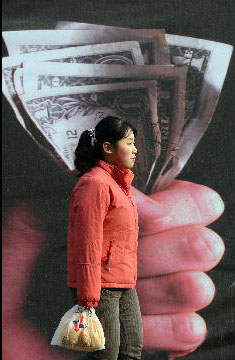
A woman walks past a sign featuring
a fist holding U.S. dollars in central Beijing on Nov.
27, 2006. Photographer: Natalie Behring/Bloomberg News
In technical analysis, investors and analysts
study charts of trading patterns and prices to forecast changes
in a security, commodity, currency or index.
Chinese Comments
``We will favor stronger currencies over weaker
ones, and will readjust accordingly,'' Cheng Siwei, vice chairman
of China's National People's Congress, told a conference in
Beijing. The dollar is ``losing its status as the world currency,''
Xu Jian, a central bank vice director, said at the same meeting.
The dollar also fell to an all-time low against
the synthetic euro, a theoretical value that estimates where
the currency would have traded before its inception. The prior
record was $1.4557 set in 1992.
The U.S. currency may weaken to between $1.48
and $1.50 against the euro by year-end, Knuthsen said.
Chinese investors have reduced their holdings
of U.S. Treasuries by 5 percent to $400 billion in the five
months to August. China Investment Corp., which manages the
nation's $200 billion sovereign wealth fund, said last month
it may get more of the nation's reserves to invest to improve
returns.
Treasuries Rise
U.S. 10-year Treasury notes rose today as
mounting credit-market losses and declines in stocks pushed
investors to the safety of government debt.
``The world's currency structure has changed,''
Xu said at the conference in Beijing. Cheng, speaking to reporters
after his speech, said his comments don't mean China will
buy more euros. The National People's Congress, China's legislature,
isn't involved in setting currency policy.
``Cheng has a history of speaking out on a
range of financial market and economic developments, and his
comments are not always accurate,'' said Glenn Maguire, chief
Asia economist at Societe Generale SA in Hong Kong.
Cheng's remarks on Jan. 30 that China's stock
rally was a ``bubble'' caused the benchmark index to fall
the most in almost two years the following day. The Shanghai
and Shenzhen 300 Index, then over 2,500 points, has since
climbed above 5,300.
The euro's gains may be limited by speculation
European economic growth may slow, reducing the need for higher
interest rates.
ECB Rates
The European Central Bank will keep its key
rate at 4 percent tomorrow, according to all 61 economists
surveyed by Bloomberg News. Data yesterday showed manufacturing
orders in Germany fell more than expected in September.
``The euro is clearly overvalued against the
dollar,'' Emanuele Ravano, co-head of European strategy for
Pacific Investment Management Co., which manages the world's
biggest bond fund, said late yesterday in Brussels. The ECB
``over the course of 2008 will totally change its tune'' by
cutting in the second half.
Europe's single currency will trade at $1.43
versus the dollar by year-end, according to the median forecast
of 42 analysts and brokerages surveyed by Bloomberg News.
The dollar's decline helped drive the price
of crude oil to a record $98 a barrel and gold to a 27-year
high, encouraging investors to buy assets in commodity-producing
nations.
Commodity Currencies
Commodity currencies led the gains today.
The Canadian dollar advanced to $1.1040. The Australian dollar
gained to 93.98 U.S. cents, the highest since April 1984,
from 92.87 U.S. cents. The rand rose to as high as 6.4294
per dollar, the highest since May 2006. The pound rose to
$2.1052, the highest since May 1981.
The dollar's 9.8 percent drop against the
euro this year boosted the competitiveness of U.S. exports,
helping shrink the nation's trade deficit to $57.6 billion
in August, the smallest since January.
French President Nicolas Sarkozy yesterday
raised concern about the euro's strength during a visit to
the U.S., saying ``you don't need too weak a dollar'' to spur
growth in the world's largest economy.
``This is an asset story and shows sentiment
for the dollar continues to be quite negative,'' said David
Forrester, currency economist at Barclays Capital in Singapore.
The Australian dollar gained after the country's
central bank raised its benchmark borrowing cost to 6.75 percent
today. Governor Glenn Stevens, announcing the quarter-point
rate increase, said inflation will exceed the bank's target.
Pressure on Fed
The dollar fell against the Norwegian krone
as traders added to bets Norway's central bank will increase
its 5 percent deposit rate. It declined to 5.2835 kroner,
from 5.3474. The dollar also dropped as losses from subprime-mortgage
defaults added to pressure on the Federal Reserve to lower
its target for the overnight lending rate between banks to
4.25 percent next month.
``The interest-rate outlook is dragging down
the dollar against major currencies such as the euro and the
Australian dollar,'' said Seiichiro Muta, director of foreign
exchange in Tokyo at UBS AG, the world's second-largest currency
trader. ``I cannot see the bottom of the dollar depreciation
yet.''
Interest-rate futures traded on the Chicago
Board of Trade show a 62 percent chance of a quarter-percentage
point Fed rate cut on Dec. 11, compared with 6 percent a month
ago. Citigroup Inc. may write down an additional $2.7 billion
worth of subprime- related assets, CreditSights Inc. said
yesterday.
New Zealand's dollar rose to 78.35 U.S. cents
from 78 U.S. cents on speculation a report tomorrow will show
the unemployment rate remained at a record low, boosting the
chance of another increase to the country's record 8.25 percent
benchmark interest rate.