Take Steps to Diversify By Debbie Bradley,
Numismatic News
October 02, 2008
Investors
are increasingly bullish on gold coins as part of a personal
portfolio amid a financial market that is currently in turmoil.
"Diversify," advises Mike Fuljenz,
president of Universal Coin and Bullion. "Take 20 percent
of your money out of the market and put it in gold."
That's the same advice given Sept. 22 by CNBC's
Jim Cramer, host of the "Mad Money" television show,
and Fuljenz thinks he's spot on.
Fuljenz said it wasn't that long ago when
he was the "lone wolf" advising people to put money
in gold, which is hovering around $875 an ounce, and now a
mainstream cable news network is advising the same.
"But don't get wrapped up and send all
your money to a coin dealer," Fuljenz said. "Have
balance and diversification with your stock broker, coin dealer
and banker. Open multiple accounts that are FDIC insured."
It may mean moving your money to five different
banks, he said, but that's what people are doing to make sure
they don't exceed the FDIC levels.
And as good as gold is as an investment, don't
go overboard.
"Don't get caught up with anybody telling
you to put 50 or 100 percent of your money anywhere unless
you're a speculator," he said, "because that's not
saving, that's speculating."
John Kamin, who has published the newsletter
The Forecaster since 1962, advises investing in gold.
"We've been recommending gold coins since
gold was $35 an ounce," Kamin said.
He likes gold for a number of reasons.
"Silence is golden but gold is silent,"
he said. "It's private. Nobody needs to know you have
it and you can give it to whomever you want."
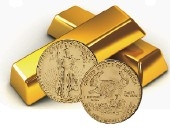
The U.S. Mint is allocating 1-ounce American
Eagle coins to dealers and suspended sales of Buffalo gold
coins on Sept. 25 because of depleted inventory.
But Fuljenz reminds investors that there are
other gold coins available, such as fractional gold Eagles.
"They may not get the exact denominations
they want, and they may have to pay a little more premium,"
he said.
Kamin said fractional gold Eagles are selling
for about 6 to 10 percent above melt.
"That's affordable," he said.
Fuljenz said there is a silver lining to this
all as more and more people get introduced to coin collecting.
"In 1979 and 1980 people lined up in
front of coin shops to buy or sell gold. What happened is
a lot of very moderate to wealthy individuals were introduced
to coin dealers. Those people became very good coin buyers
and investors."
He sees that same thing happening now. People
who never bought gold before are being introduced to precious
metals. They may start buying American Eagles and Canadian
Maple Leaves, but if they like their dealers, they may then
get introduced to $20 gold pieces.
"As long as there is wealth, people will
buy coins and the coin market will be fine," Fuljenz
said. "If we have just a blip in the economy what will
happen is a lot of people with wealth are exposed to the coin
market. As long as we don't go into a major recession or depression,
it will be good for the coin market."
For now, people need to protect against having
their money in an unsafe place and protect against inflation,
he said, and gold will be a safe thing to have.
"People should be cautious and concerned,
but the world's not falling apart," Fuljenz said.























 Investors
are increasingly bullish on gold coins as part of a personal
portfolio amid a financial market that is currently in turmoil.
Investors
are increasingly bullish on gold coins as part of a personal
portfolio amid a financial market that is currently in turmoil.