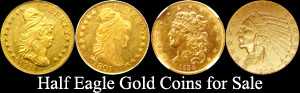
The
Half Eagle was the very first gold coin struck at the
United States mint. Starting in 1795, the Half Eagle became
the only U.S gold coin struck in each of the 8 U.S mints may
or varieties exist in the early series with several appearing
for sale very infrequently, sometimes not being seen for years.
Capped
Bust to Right, Heraldic Eagle (1795-1807. In 1797, Robert Scot
created a heraldic reverse design for the half eagle and eagle,
a theme that would eventually be echoed on all U.S. coins except
for the half cent and cent. (Coins of this type dated 1795 are
thought to have been struck in 1798.) Scot's Heraldic Eagle
reverse borrowed heavily from the Great Seal of the United States,
which was affixed to all official government documents.
The
success of the half eagle depended on the quantity of gold bullion
deposited at the Mint. Because only small amounts of gold were
received by the Mint in its early years, quantities struck for
this type are generally low. However, mintages trended upward
as the years passed. Coins were struck in every year except
1801, when all of the gold deposits were used to strike $10
coins.
The
1795-dated Heraldic Eagle half eagle was actually struck later,
using an odd combination of a leftover 1795 obverse and a
reverse of the new type. Most likely, this odd "mule"
was struck in 1798, at the same time as the 1798 Small Eagle-reverse
half eagle. This type is replete with interesting varieties,
including some overdates (1797/5, 1802/1 and 1803/2). In 1797,
obverses can be found with either 15 or 16 Stars (this number
was lowered to 13 stars beginning in 1798). In 1798, obverses
come with either a large or a small 8 in the date and, on
the reverse, either 13 or 14 stars float above the eagle's
head.
As with most early American
gold and silver coins, this type often has problems with adjustment
marks and/or weak or uneven strikes. Buyers should also beware
of cleaned and/or repaired examples. All examples of this
type were struck at the Philadelphia Mint (the only coinage
facility existing at the time). No Proofs were made, but one
1795 eagle with a Heraldic Eagle reverse has been certified
as a Specimen.
NGC
has designated one example of the 1795, Heraldic Eagle half
eagle as a "Specimen" piece. The coin is incredibly
struck, and displays unusually reflective surfaces. The coin
is unique and is the earliest gold coin issue that has been
called Proof or "Specimen" by the major grading
services. The 1795, Heraldic Eagle half eagle was struck in
1798, and the cir¬cumstance for the issue is unknown.
Regardless of the designation, the coin is certainly spe¬cial,
and is one of the most interesting early U.S. gold coin issues.
We at
U.S. Rare Coin Investments highly recommend these Early Half
Eagle coins for investments portfolios. Whether a single coin
or the long term acquisition of them with the goal of building
a set in terms of historical importances as well as longterm
profit potential, cannot be overstated in our opinion.