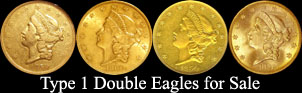
Type 1 Double Eagles - Without Motto on Reverse
(1849-1866)
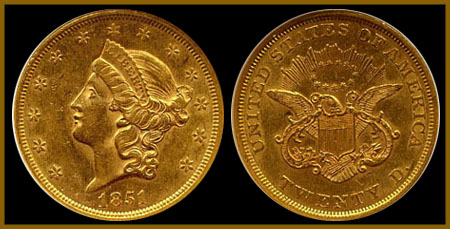
1851 Double Eagle
With
gold rushing in from California, the production of double
eagles soared to a level that would not be exceeded until
1861. A large number of coins was produced, but the vast majority
of 1851 double eagles did not survive. Of the coins seen today,
most are heavily worn. Examples were found on the S.S. Central
America and the S.S. Republic, nearly all of which were circulated.
High-grade 1851 double eagles are very rare, with only two
dozen coins known in choice condition. The highest-grade 1851
double eagle certified to date has been MS-64. An example
in that grade sold in early 2004 for $29,900.
Longacre’s Liberty
Head Type 1 Double Eagle (1849-1866): James Barton Longacre
designed the pattern for the Twenty
Dollar Double Eagle in 1849. It was produced because
of the huge amount of gold that came into the Mint from
California. With the discovery of gold at Sutter’s
Mill in January 1848, the California Gold Rush began. It
led to an influx of miners and others into the area. The
vast quantity of gold produced led to a need for a standard
form of exchange. The Double
Eagle was the government’s response.
They also felt that the Double
Eagle would be useful for large commercial transactions
and that it would facilitate foreign trade.
Longacre’s design
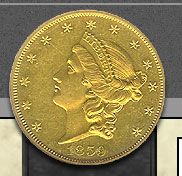
for the Double Eagle shows a Liberty head
facing left wearing coronet inscribed LIBERTY. Her hair
is tightly tied in the back with two loose curls hanging
down her neck to the end of the truncation. She is surrounded
by thirteen six pointed stars with the date below. Dentils
are near the edge on both sides of the coin. The reverse
shows a heraldic eagle with elaborate ribbons on both sides
of the shield extending from the top corner down to the
eagle’s tail feathers. The ribbons are inscribed,
on the left E PLURIBUS and UNUM on the right. The ribbons
were added to the design to symbolize the denomination since
this was the first Twenty
Dollar Double Eagle coin. There is an oval of thirteen
stars above the eagle’s head and an arc of rays from
wing tip to wing tip behind the upper half of the oval.
UNITED STATES OF AMERICA is in an arc above the eagle, and
the denomination TWENTY D. is below. The mint mark is between
the tail feathers and the N of TWENTY.
The Double
Eagles were minted in Philadelphia, New Orleans, and
San Francisco. In total there were 23,526,676 business strikes.
The largest mintage was in 1851 with 2,087,155, and the
lowest was 1856-O with 2,250 (not counting the single pattern
coin that was struck in 1849).
It is interesting to note
that until the discovery of the shipwrecked S.S. Central
America, 1850’s Double Eagles in gem condition were
virtually unavailable. The ship, originally called the S.S.
George Law, was a United States mail steamship. In 1857
it sank off the coast of the Carolinas because of a huge
hurricane. It was a three-mast, side-wheel steamship that
traveled between Panama and New York. The journey took approximately
21 days. In the five years prior to its sinking, it has
been estimated that the Central America carried about $150
million worth of gold or one-third of all of the gold mined
in California. The ship was 272 feet long and had 578 passengers
and crew on board. It also had on board over 35,000 pieces
of mail and gold bars, nuggets, dust, and 5200 newly minted
San Francisco gold coins. The loss of the Central America
triggered the “Panic of 1857,” which was actually
caused by bank instability and generally poor economic conditions.
In 1985, the Columbus-America
Discovery Group raised ten million dollars and began to
search for the wreck. They found it at a depth of 8,500
feet off the coast of South Carolina. It is estimated that
the total coins, ingots, and gold bars were worth more than
one hundred million dollars.
Now Mint the state 1857-S
Double Eagle as well as other dates from the Central
America are available today encapsulated and authenticated
by the two major grading services.