LIBERTY
HEAD (NO MOTTO ON REVERSE) TWENTY DOLLARS OR DOUBLE EAGLE
(1849-1866)
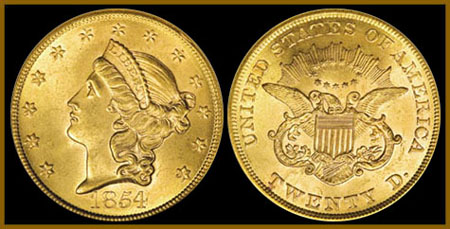
1854 Double Eagle
1854
Double Eagle or $20 Gold
PCGS
No:
Circulation
strikes Mintage:
757,899
Proofs:
Unique?
Designer:
James Barton
Longacre
Diameter:
±34
millimeters
Metal
content:
Gold - 90%
Other - 10%
Weight:
±516
grains (±33.4 grams)
Edge:
Reeded
Mintmark:
None (for Philadelphia,
PA) below the eagle's tail on the reverse.
Introduction:
There are two major varieties of the 1854 double eagle.
The first and more common variety is the 1854, Small
Date. Most of the 1854 double eagles seen are of this
variety. The overall rarity of the issue is very similar
to that of the 1852 and 1853 issues. Low-grade examples
are readily available, and high-grade coins become
increasingly rare. The Small Date is not greatly different
from the Large Date; the photos of both varieties
in this book should be helpful in accurate identification.
Examples are also seen with recutting on the last
two dig¬its of the date. Two examples have been
certified at the MS-64 level, but the best specimen
to cross the auction block in recent years has been
an MS-62 coin. However, an MS-63 piece sold privately
in 2004 for $26,450.
The Large Date variety of the
1854 double eagle is much rarer than the Small Date.
The date size difference is not hugely dramatic, and
the coin brings a large premium in any grade. This
is an issue that an astute collector could possibly
cherrypick, as many are unaware of its rarity. The
wreck of the S.S. Republic offered an interesting
random sample that showed the rarity of this issue.
The 1854 double eagle was represented by 36 Small
Date and 7 Large Date examples. The finest piece the
authors have seen has been the coin illustrated here,
which came from the estate of John Jay Pittman. The
coin was purchased by Pittman in 1949 for $60 and
sold in 1997 for $10,450. A prooflike example, which
has been graded by PCGS as AU-58, was recovered from
the S.S. Central America and sold in 2005 for $19,500. Key to Collecting: Small Date 1854
double eagles, more accurately described as Medium
Date, con¬stituted the larger part of the mintage
this year. Most collectors are content to have but
a single 1854 Philadelphia Mint double eagle. In the
past, listings have not mentioned the date size and,
indeed, the difference between the Medium Date (Small
Date) and the Large Date is not dramatic.
The 1854 Large Date is by the rarest
Philadelphia Mint double eagle minted up to this point
in dine. However, in the marketplace not much notice
is given to date sizes, and there is a good possibility
of buying a Large Date for a "Medium Date price"
if you look around here and there.
Aspects of Striking: Usually fairly well
struck.
Die Data: Certification
data are of little help, as some earlier were not
studied for date size and were later lumped as "Small
Dates." 1854 Four-digit Medium (a.k.a. Small)
Date logotype: Date with 85 farthest apart, 1H spaced
nearly hut not quite as close together as 85; 54 very
close. Uprights of 1 and 4 both thick. Italic style
5. Various logotype positions exist. Breen-7167 is
a Small Date with obvious repunching.
1854 Four-digit Large Date logotype: Date in larger
numerals than the standard (Small Date) logotype of
this year. Date with 18 farthest apart (but still
quite close); 854 spaced about equally; top interior
of 8 slightly smaller than bottom interior. Upright
of 1 thin; upright of 4 thick. Italic style 5.
Number of Appearances:
146 (33%)
High Grade Condition Points: 62
Average Grade: VF-37
Auction Records: (16) Unc: Stack's 9/81; B&R 6/81;
New England 7/80; ANA 1976; Davies/Niewoehner 1975;
Stack's 6/74, 2/72, 10/70; DiBello 1970; Stack's 3/69;
Miles 1968; Stack's 6/67; Ward 1964; Holmes 1960;
Bell 1944; Dunham 1941
(30) AU: Stack's
6/80, 2/80, 9/79; ANA 1979; Auction '79; New England
3/79 (2); Paramount 3/78; New England 11/77, 7/77
(2); ANA 1976 (2); AAA 2/76; Superior 10/74; ANA 1974;
Stack's 2/73; Paramount 2/73 (2); Stack's 6/72, 2/72,
12/71, 4/71; Alto 1970; Stack's 1/70; ANA 1969; ANA
1966; Walton 1963; Bell 1963; Wolfson 1962
(50) EF: Stack's 12/81; Coin Galleries
9/81; Ivy 9/81; NASCA 7/81; Stack's 6/81; NASCA 4/81;
Stack's 3/81 (3); NASCA 12/80; Coin Galleries 6/80;
Stack's 2/80 (2), 12/79 (3); Superior 10/79; Stack's
10/79, 6/79; Ivy 2/79; B&R 2/79; ANA 1978; Stack's
6/ 78; Kagin's 5/ 78; New England 7/77; Stack's 2/
77; ANA 1975; Pine Tree 6/75; Stack's 4/30/75; AAA
11/74; Paramount 11/74; Merkin 9/74; Scanlon 1973;
Stack's 12/72, 9/72; Merkin 6/70; Paramount 11/69;
Stack's 1/69; ANA 1966; Bolt 1966; Kosoff 10/65; Stack's
2/65; FUN 1963; Cicero 1960 (2); Holmes 1960; Melish
1956; MC 1948; Atwater 1946; WGC 1946
Comments: As a date, the 1854 is decidedly more rare
than the 1850, 1851, 1852 and 1853. However, it is
not as difficult to obtain as any of the P-Mint issues
from 1855 to !859. Most known 1854 Double Eagles grade
VF or EF but AU's are also available from time to
time. In mint state condition, the 1854 is definitely
rare and choice or gem quality uncs are extraordinarily
difficult, if not impossible, to find. There are two
major varieties of 1854, Large Date and Small Date.
The size difference is considerable and readily noticeable
but, unfortunately, very few cataloguers have noted
the distinction. In my experience, the Large Date
Variety is the scarcer of the two. No proofs are known
of this issue although at least one was reportedly
struck.