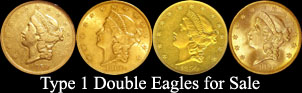
Type 1 Double Eagles - Without Motto on Reverse
(1849-1866)
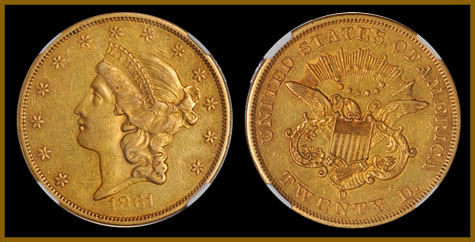
1861-O Double Eagle
The 1861-O Double Eagle
is a Type 1 Liberty Head or Liberty Head, No Motto.
Made from 1849 to 1866, No Motto Liberty Heads are
different from the next type in that the motto IN
GOD WE TRUST has not yet been added. James B. Longacre
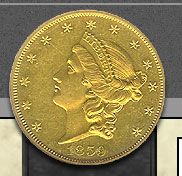
designed the Liberty Head double eagle. Its obverse
shows a profile of Liberty facing left wearing an
inscribed coronet. Her hair is tied in the back, and
two curls flow down her neck. Thirteen stars surround
her and the date is below. Dentils are on both sides
of the coin at the periphery.
The double eagle reverse shows a heraldic
eagle with elaborate motto inscribed scrolls on both
sides of the shield. The left one says E PLURIBUS,
and UNUM is on the right. Since this design is the
first double eagle, the scrolls were added to symbolize
it. An oval of thirteen stars is above the eagle with
an arc of rays from wing tip to wing tip behind the
oval. The required inscription UNITED STATES OF AMERICA
is above the eagle and the denomination TWENTY D.
is below. The mintmark is between the tail feathers
and the N of TWENTY.
Because of the large discoveries of
gold in California in the late 1840’s, large
quantities of gold were coming into the Mint for coinage.
In 1849 Congress authorized the double eagle denomination.
It was felt that a coin of this size would facilitate
interbank and international transactions as well as
large domestic ones. Weighing 33.44 grams, double
eagles were comparable to the coinage in use in several
Latin American countries.
Authorized to produce
gold and silver, the New Orleans Mint struck quarter
eagles and dimes in 1839. The New Orleans Mint operated
from 1838 to 1909. In that time period 427 million
silver and gold coins with the O mintmark were coined.
By the mid 1850’s denominations made in New
Orleans included three cent silver pieces, half dimes,
dimes, quarters, half dollars, silver dollars, gold
dollars, quarter eagles, three dollar pieces, half
eagles, eagles, and double eagles. The first deposit
was of Mexican dollars which amounted to more than
32,400 dollars. The first coins struck were Liberty
Seated Dimes. Each year between the beginning of August
and the end of November, the mint closed because of
the annual outbreak of yellow fever.
During the Civil War
the New Orleans Mint was held by the Confederacy and
used to produce its coinage. It was the only mint
to produce uniquely identifiable Confederate coinage,
the 1861 half dollar with Confederate reverse and
the copper-nickel cent of the same year. In 1862 the
New Orleans Mint was captured by United States Marines
commanded by Commodore David Farragut and closed as
a minting facility.
Although it is impossible
to tell with any certainty because they were made
from the same dies, it is likely that most of the
1861-O coins were made when the Mint was under the
control of the Confederacy. Most likely those made
by the Confederacy are the ones showing weakness at
the base of the date.
The 1861-O Double
Eagle is a rare coin in any condition. In their population
reports, both major grading services have certified
a total of 213 coins in all grades. Of course this
number does not account for crossovers and resubmissions.