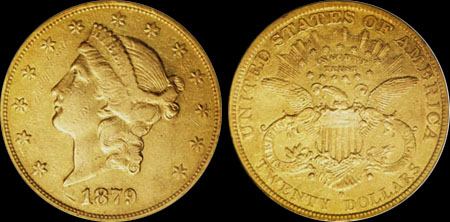
LIBERTY
HEAD (WITH MOTTO ON REVERSE) "TWENTY DOLLARS" ON
REVERSE (1877-1907)
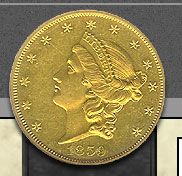
1879-O Double Eagle
1879-O
Double Eagle or $20 Gold
PCGS
No:
8990
Circulation
strikes Mintage:
2,325
Proofs:
0
Designer:
James Barton
Longacre
Diameter:
±34
millimeters
Metal
content:
Gold - 90%
Other - 10%
Weight:
±516
grains (±33.4 grams)
Edge:
Reeded
Mintmark:
"O"
(for New Orleans, LA) below the eagle's tail on
the reverse.
Introduction:
The 1879-O double eagle issue is the only Type 3 double
eagle struck at the New Orleans Mint. That, along
with a very small mintage, makes the 1879-O double
eagle a very desirable coin. Of the 2,325 coins struck,
there are fewer than 150 known today. Most of the
remaining coins grade Very Fine or Extremely Fine,
with several known that are harshly cleaned. The Smith-sonian
example is About Uncirculated, but it has been cleaned.
There are just a few Mint State coins known. At least
one of these is deeply prooflike in appearance. The
finest known example by far is the Dallas Bank Collection
piece. The coin has amazingly clean surfaces, with
full mint frost. It was sold to a prominent Midwestern
collector for $115,000.
After it was shut down in 1861, the
New Orleans Mint resumed operations in 1879. Very
limited quantities of eagles and Double Eagles were
produced. For reasons still not entirely known, New
Orleans Double Eagles were never struck again after
1879; production of eagles continued until 1906. The
1879-O is a rare and very desirable issue. It is the
only Type Three Liberty Head Double Eagle from this
mint and the only Type Three issue that qualifies
as a one year type.
This is a surprisingly well struck coin when one considers
that the New Orleans Mint had not struck Double Eagles
in close to two full decades. The obverse is nearly
always well impressed with full details noted on the
curls of Liberty, the bun and the stars. There is
also weakness on the obverse denticles on many pieces.
The reverse is reasonably sharp overall although the
lower border is sometimes weak. Many are extensively
abraded with deep, detracting marks in the fields.
In addition, a number of 1879-O Double Eagles show
either copper spots or black "grease stains."
These are mint-made and they do not generally effect
the value unless they are severe. Most are prooflike
although a few frosty, non-reflective coins exist.
The coloration on original, uncleaned pieces ranges
from a light yellow gold to a deeper green-gold hue.
Locating an example with good eye appeal is very difficult.
However, there are a few very pleasing 1879-O Double
Eagles in existence. These are extremely popular with
collectors.
No hoards are known. There are no significant die
varieties reported.
The 1879-O Double Eagle is scarce and desirable in
all grades. Most are well worn and nice Extremely
Fine pieces are the best examples generally available.
This date is rare in the lower About Uncirculated
grades and very rare in the higher About Uncirculated
grades. Mint State 1879-O Double Eagles are exceedingly
rare.
Key to Collecting: The 1879-O double eagle
has the second lowest (1856-O is slightly lower) mintage
among New Orleans Mint double eagles. However, many
more 1879-O coins were saved. More than a few were
exported. Today, the 1879-O is exceedingly popular
as the only coin of this denomination struck at New
Orleans after the Civil War. About 100 pieces, more
or less, exist of the 1879-O, mosdy in high circulated
grades. A few Mint State coins are known as well.
Most show extensive bagmarks.
Aspects of Striking: Usually well struck.
Die Data: Standard four-digit logotype
punch for this year. Logotype about centered between
neck and dentils on the single 1879-O obverse die.
Small O mintmark on reverse.
Number of Appearances:
68 (15%)
High Grade Condition Points: 24
Average Grade: VF-34
Auction Records:
(8) Unc: ANA
1979; Ullmer 1974; Kreisberg/Cohen 6/70; Miles 1968;
Wolfson 1962; MC 1948; Bell 1944; Roach 1944
(25) VF: Auction '80; Kreisberg/Cohen
10/78; New England 7/78; Stack's 6/77; New England
12/76; RARCOA 4-5/76; New England 11/75; ANA 1975;
Stack's 6/75; AAA 6/75; Stack's 4/30/75; ANA 1974;
Pine Tree 9/73; ANA 1971; Alto 1970; Stack's 3/69;
ANA 1968; Shuford 1968; Stack's 5/68; Paramount 2/67;
Golden 1962; Cicero 1960; Farouk 1954; MC 1948; WGC
1946
(4) Fine: Paramount 4/80; Stack's
10/66; Menjou 1950; Lee 1947
(1) VG: Melish 1956
Comments: Next to the rare and famous 1856-O, the 1879-O
has the lowest mintage of any New Orleans Mint Double
Eagle. However, in my opinion, the 1879-O ranks only
sixth among the 13 O-Mint issues in terms of overall
rarity. In particular, it is not nearly as rare, especially
in high grade, as the 1860-O, 1855-O and 1859-O. Most
known 1879-O twenties grade no better than EF and
an accurately graded AU is rare. A few uncs are known,
including the choice specimen (photographed above)
in a prominent Dallas bank collection, but the 1879-O
certainly must be considered to be very rare in full
mint state.
1879
HISTORICAL HIGHTLIGHTS
Washington, D.C.,
Jan. 1. Under terms of 1S75 Specie Resumption
Act. government redeems greenbacks in coin (-March
3, 1884). Washington. D.C., Jan. 25. Congress
passes Arrears of Pensions Act. authorizing veterans
to collect back pay from date of discharge to present. England, January'. William James
publishes "Are We Automatons?" in Mind magazine,
attacking "prevailing scientific materialism."
Washington, D.C., Feb. 15. President
Hayes signs bill allowing female lawyers to argue
cases before Supreme Court, provided they have practiced
at state supreme court level for minimum of three
years. Washington, D.C., Apr. 29. Army appropriations
bill vetoed by President Hayes. blocking rider barring
President from sending federal troops to protect voting
rights in congressional elections. Boston, Apr. 30. First factory inspection
law enacted, direct¬ing governor to appoint police
to inspect factories and public buildings for safety
violations. Rochester, New York, May 8. Attorney
George B. Scldon unsuccessfully applies for pat¬ent
on idea for horseless carriage powered by an internal-combustion
engine. Grangeville. Idaho, May 30. Captain
Reube Bernard and First Cavalry ordered to move against
"sheepeater" Indians. Mississippi, May. Southern whites
threaten to sink all boats on the Mississippi River
that carry Negroes; shipowners strand 1.500 Negroes
along banks of river (-Oct. 15. 1883). Pennsylvania, June 24. First Child's
Cup rowing contest won by University of Pennsylvania. England, July. William James publishes
The Future of Raiianaliiy, dealing with "the
motive which leads men to philosophize." Idaho, October. Pacific Northwest
Indian Wars end with capture of 388 Indians by Major
Edward S. Farrow. Detroit. Parke. Davis & Company
introduces pharma-ceuticals of standardized dosage.