August Saint-Gaudens, son of a shoemaker,
was one of the most talented American sculptors of
the late nineteenth and early twentieth centuries.
He was born in Dublin in 1848 and moved to New York
with his family before his first birthday. When Saint-Gaudens
was thirteen, he left school and apprenticed with
a cameo cutter. During this time he took classes at
the National Academy of Design and Cooper Union. At
nineteen he moved to Paris and then to Rome where
he studied classical art and architecture. He then
began work as a professional sculptor.
When he returned to New York Saint-Gaudens
received his fist commission in 1881, a statue of
Admiral Farragut, which still stands in Madison Square
Park in New York City. In Europe Saint-Gaudens had
learned to express the physical being of a person
as well as his or her personality.
By the 1890’s Saint-Gaudens
had produced his statues of Diana and Abraham Lincoln,
both considered some of his greatest works. He also
created works such as the Robert Gould Shaw Memorial
on Boston Common and the equestrian monument to Civil
War general John A. Logan in Chicago. He became part
of a group of new artists and architects and worked
for an architectural firm for whom he produced a considerable
group of monuments and decorative sculpture. Throughout
his career, he worked with architects creating works
that were designed specifically for the architectural
sites they were building.
In the last decade of the nineteenth
century, Saint-Gaudens worked on several projects
that took more than ten years to complete. The most
famous of this time was the draped figure in the Rock
Creek Cemetery in Washington D.C., which shows the
grandeur as well as the emotional component of his
work. At the entrance to New York’s Central
Park is his bronze statue of General Sherman led by
Victory. It took him eleven years to complete this
project.
Saint-Gaudens moved to his summer
home in Cornish, New Hampshire in 1900. Joined there
by a community of artists including his brother, Louis
who was also a sculptor, Saint-Gaudens spent his final
years. He died of stomach cancer in 1907 just after
he created the beautiful high relief models for the
eagle and double eagle coins at the request of President
Theodore Roosevelt.
Roosevelt had a vision of a totally
redesigned United States coinage. He spoke of his
“pet crime” now that he was president
and could act on his feelings. He recruited Saint-Gaudens
to aid him in this new project. The two had met in
1905 when Roosevelt chose Saint-Gaudens to design
his inaugural medal for his second term as president.
Not only did Roosevelt love
the medal, but he realized that Saint-Gaudens shared his admiration
for the high relief coinage of ancient Greece. Despite the
fact that his health was in decline, the artist accepted Roosevelt’s
challenge to redesign America’s coinage. Although he
never lived to see his designs in circulation, many feel that
High Relief double eagle is finest United States coin ever
minted.
After Saint-Gaudens succumbed
to stomach cancer, Henry Hering, his student and assistant,
attempted to reduce the relief of the Ultra High Relief pattern
coins and have them put into production. At each step of the
way, he was opposed by Charles Barber, the jealous Mint Engraver,
who felt that even the lower relief coin was simply impractical
for commerce and banking. Because of Barber’s interference,
Hering decided to go to France to have Saint-Gaudens’
bas-reliefs made to coin size. When he returned, President
Roosevelt had to intervene to get the coins minted. Finally,
12,367 High Relief coins were struck.
There are two varieties, the
flat rim and the knife-rim, which are also called the flat
edge and the wire edge double eagle. The “wire edge”
is actually a rim or flange around half or more of one or
both sides of the coin. It was made when metal was squeezed
between the collar and the die. Most researchers believe that
the flange was made unintentionally since it caused problems
in ejecting the coins as they were struck. Charles Barber
used this characteristic as another reason to remake the coin
with lower relief, and he did so with the date in Arabic numbers
on later 1907 coins.
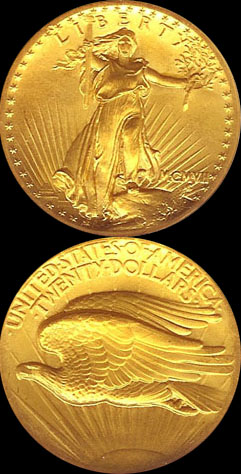
The double eagle is considered
by some to be the most beautiful coin of all time and Saint-Gaudens’
most famous work. Certainly numismatists feel that the double
eagle is his most important work. Struck in high relief Liberty
is seen striding towards the viewer as the sun rises behind
her. She holds a torch, symbol of liberty, in her right hand
an olive branch in her left. On her right at the bottom is
the Capitol building. LIBERTY is above her head, and she is
surrounded by forty-six stars, one for each state in the Union
at the time. Saint-Gaudens took the figure of liberty from
his statue of Victory, which is part of the Sherman monument
in New York City. The reverse of the coin shows a magnificent
eagle in flight to the left above the sun. UNITED STATES OF
AMERICA and TWENTY DOLLARS form a double arc above it.
Saint-Gaudens deliberately
left off the motto IN GOD WE TRUST at the request of President
Roosevelt, a religious man who felt that it was blasphemous
to have God’s name inscribed on a coin. He did not wish
the name of Lord on coins to be dropped and stepped on or
passed around brothels, saloons, gambling halls or used for
other immoral purposes.
When Roosevelt saw the first
double eagles, he knew that Saint-Gaudens had created a masterpiece.
What he could not have known was that, in a supreme irony,
his cousin Franklin Delano Roosevelt would recall all privately
owned gold including many of the Saint-Gaudens’ twenties.
With fewer than fifteen specimens
of the Ultra High Relief double eagles in the hands of collectors,
they are prohibitively rare and often sell for over a million
dollars each. However, while both the “wire rim”
and “flat rim” types of regular MCMVII High Relief
coins are beautiful and famous, they are not particularly
rare; consequently, a pleasing example is affordable for a
serious collector.