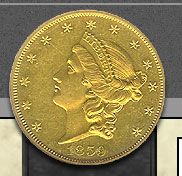
These pattern coins (pattern gold coins) were first suggested
by John A. Kasson, then U.S. envoy ex ordinary and minister
plenipotentiary to Austria-Hungary. It was through the efforts
W.W. Hubbell, who patented the alloy goloid (used in making
another pattern piece, goloid metric dollar), that we have
these beautiful and interesting gold coins.
The four-dollar Stella-so called because of the five-pointed
star on the reverse was envisioned by Kasson as America's
answer to various foreign gold coins popi in the international
market. The British sovereign, Italy's 20 lire, and the
20 pesetas Spain were three such coins: each smaller than
a U.S. five-dollar gold coins, they were used widely in
international trade.
The Stella was one of many proposals made to Congress for
an international tra coin, and one of only several that
made it to pattern-coin form (others include t 1868 five-dollar
piece (five dollar gold coins) and 1874 Bickford ten-dollar
piece).
Odds were stacked against the Stella from the start. The
denomination of fc U.S. dollars didn't match any of the
coin's European counterparts, and at any rate t U.S. double
eagle (twenty-dollar coin)-already used in international
commerce was a more convenient medium of exchange. The Stella
was never minted in quan ties for circulation. Those dated
1879 were struck for congressmen to examine. The 1880 gold
coins were secretly made by Mint officials for sale to private
collectors.
There are two distinct types in both years of issue. Charles
E. Barber designed the Flowing Hair type, and George T.
Morgan the Coiled Hair. They were struck as pattern in gold,
aluminum, copper, and white metal. (Only those struck in
gold are listed here.) It is likely that of the 1879-dated
Flowing Hair Stellas, about 15 were struck in 1879, and
the rest in 1880.
Precise mintage numbers are unknown. The estimates given
below are based on surviving pieces, certified population
reports, and auction records.
Some of the finest Stella Gold Coins specimens are housed
in the National Numismat Collection in the Smithsonian Institution.
Others are in private collections, and the auction block
from time to time.