Home
Newsletter
About Us
Coins For Sale
Selling Your Coins
Coin Collecting
Investing in Coins
Coin Information
Coin Articles
/World Coins
Books, Loupes etc.
Link to Us
Links
Contact Us
  Sign up for our free NewsLetter
  e-mail: 
  Sign Up 


FLOWING HAIR HALF DOLLARS

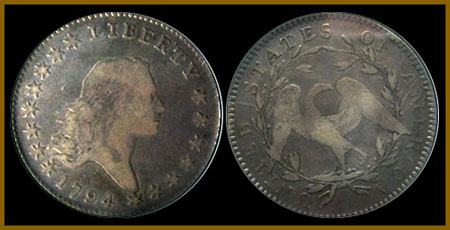
1794 Half Dollar

1794 HALF DOLLAR
PCGS No: 6051
Mintage:  
Circulation strikes: 23,464
Proofs: none
Designer: Robert Scot
Diameter: ±32.5 millimeters
Metal content: Silver - 89.2%
Copper - 10.8%
Weight: ±208 grains (±13.5 grams)
Edge: Lettered - FIFTY CENTS OR HALF A DOLLAR (various ornaments between words)
Mintmark: None (all dates of this type were struck at Philadelphia)
Varieties (10):
  1. Lowest Curl at Second Star
    1. Normal truncation line
      1. 21 Reverse Berries 10-11
        Overton 106 - Very Rare
        Overton 108 - Very Scarce
      2. 18 Reverse Berries 9-9
        Overton 105 - Very Scarce
    2. Looped truncation line
      Overton 110 - Extremely Rare
  2. Lowest Curl at First Star
    1. 21 Reverse Berries 10-11
      Overton 101 - Very Scarce
      Overton 107 - Rare
    2. 19 Reverse Berries 9-10
      Overton 104 - Rare
    3. 18 Reverse Berries 9-9
      Overton 103 - Rare
    4. 17 Reverse Berries 9-8
      Overton 102 - Very Rare
    5. 17 Reverse Berries 8-9
      Overton 110 - Extremely Rare
Notes:
The finest 1794 Half Dollar graded by PCGS is a single MS-64.
Significant examples:
See individual varieties
Recent appearances:
See individual varieties
Sources and/or recommended reading:
"Early Half Dollar Die Varieties 1794-1836", Third Edition, by Al C. Overton and Don Parsley
"Walter Breen's Complete Encyclopedia of U.S. and Colonial Coins" by Walter Breen
"The PCGS Population Report, July 2004" by The Professional Coin Grading Service

SCOT'S FLOWING HAIR DESIGN (1794-95)

As the Chief Coiner, Henry Voigt, and the Assayer, Albion Cox, could not post the 510,000 surety bonds required for tak¬ing office (or rather for handling gold and silver bullion), only copper coins were made during 1793. On Dec. 10, 1793, Thomas Jefferson wrote to Pres. Washington recommending that bonds be reduced to a figure these officers could manage. Washington persuaded Congress to comply (Act of March 3, 1794), and at once local banks began depositing silver. Before this could be coined, the new Mint Engraver, Robert Scot, had to complete device punches and working dies. With Adam Eckfeldt's help, Scot produced an oversimplified copy of the cent head for the half dollars, and a stylized eagle punch for their revs. Individual numeral, letter, star, and leaf punches (with some hand finishing) served to complete the designs.

On Oct. 15, 1794, Voigt delivered 5,300 half dollars, followed by 18,164 more on Feb. 4, 1795, from 1794-dated dies: five pairs in 10 combinations, one of them a new discovery (4551), only one (ill. at 4552) not rare. Survivors are mostly well worn; col¬lectors were very few, and the general public remained slow to squirrel away choice ones.

During the remainder of spring and summer 1795, half-dollar coinage continued from 1795-dated dies [299,680], from 19 obv. and 22 or 23 rev. dies, the first rev. left over from 1794. Several slightly differing head- and eagle-device punches were used dur¬ing the year, the final ones attributed to John Smith Gardner, briefly Assistant Engraver: the famous and rare Small Heads. These are associated with four Heavy Wreath revs, showing a small dot in lower field between ribbons; this is thought to be Gardner's "signature," to tell his dies from Scot's. The Double Date and Three Leaves coins belong with this group, evidently at the end of the mintage, summer 1795.

Coinage was interrupted to allow personnel to devote time to making silver dollars and gold coins, on orders of the new Mint Director, Henry William DeSaussure.
The vars. in this series (without or with die blunders) are nearly as individualized and distinctive as their cherished coun¬terparts in the cents, but they have long remained neglected owing to lack of a reference work in a class with Sheldon {1958} on cents. Even Overton {1970} is unsatisfactory: It lacks ills, of three obv. and five rev. dies, lacks a rational de¬scriptive system, lacks an emission sequence, and (perhaps worst) its illustrations obscure many distinctive features. Re¬search is continuing on this series, and we may eventually ex¬pect a definitive text from the Bust Half Nut Club (BHNC), which has already published a supplement illustrating new discoveries.

What look like file marks on many specimens, even in mint state, are adjustment marks. Adjusters (including the first women hired by the Mint) wore leather aprons and sat with metal files. As the Weighers checked each newly cut blank, the lightweight ones were returned to the Melter and Refiner, those within legal tolerances went to the Chief Coiner, and heavier ones went to the Adjusters, who gave them a stroke or two (more if necessary after reweighing), to reduce weights to legal limits. Periodically, the contents of their leather aprons went to the Melter and Refiner. Adjustment marks, accordingly, are not counted as impairments, as they preceded stamping designs into the planchets. Note ills, of 4550, 4556.
Irregularities at rims (as on ills, of 4553, 4556) are from the machine used for lettering edges; these also are not counted as impairments, but they must be carefully distinguished from rim dents.

SCOT'S FLOWING HAIR DESIGN

Designer, Robert Scot. Engravers, Scot and John Smith Gardner. Mint, Philadelphia. Diameter, approx. 20.5/16" = 32.5 mm. Edge, FIFTY CENTS OR HALF A DOLLAR (varying ornamentation between words: circles, rectangles, stars). Weight standard, 208 grs. — 13.48 gms. Composition, 892.43+ Fine silver, 107.56+ Fine copper (1,485/1,664). Au¬thorizing Act, April 2, 1792.
Grade range. POOR to UNC. GOOD: Date and all letters legi¬ble; devices outlined. VERY GOOD: Few hair and feather details. FINE: Details at ends of curls distinguishable; some hair details clear behind ribbon; partial feather and leaf details. VERY FINE: Some detail in central hair; demarcation between hair and neck and cheek (but not temple) visible; most wing feathers intact, breast feathers partly fiat- EXTREMELY FINE: Almost all hair details; isolated tiny rubbed spots only.
4550 1794 Lowest curl at second star. [5,300] Very rare. Delivered Oct. 15, 1794. Overton 105, 106, 108 = Hilt 3C, 3D, 5D. Usually in low grades.

  • 1794 Same, looped shoulder truncation. Unique? BHNC 109 - Hilt 2C. Loop is as in 1795 Small Heads, whence Hilt attributes this obv. to Gardner. Discovered by Robert Hilt, 11/8/76.
  • 1794 Lowest curl at first star. Delivered Feb. 4, 1795. Ov. 107, 101-4, BHNC 110 = Hilt 4D, 6D, 6E, 1A, 1B, new var. Price for Ov. 101 (ill.), with crack from rim to wreath between D S; others are all very rare, BHNC 110 unique (long crack, from rim through D, wing, and head to rim between F A).


<< BACK


Have a question? Contact us here

Have a friend who might be interested?
Inform them about us now!
Your E-mail: Your Name: Friend's E-mail: Friend's Name:
Send to a Friend