DRAPED BUST,
SMALL EAGLE REVERSE HALF DOLLAR (1796-1797)
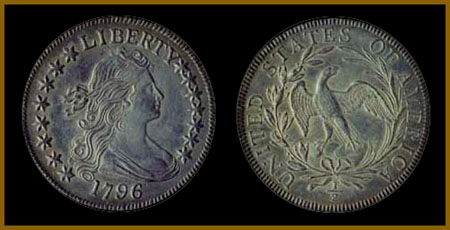
1796 Half Dollar
1796
HALF DOLLAR
PCGS No:
6057, 6058
Mintage:
Circulation
strikes:
3,918 (includes
Half Dollars dated 1797)
Proofs:
none
Designer:
Robert Scot
Diameter:
±32.5 millimeters
Metal content:
Silver - 89.2%
Copper - 10.8%
Weight:
±208 grains
(±13.5 grams)
Edge:
Lettered -
FIFTY CENTS OR HALF A DOLLAR (various ornaments
between words)
Mintmark:
None (all dates
of this type were struck at Philadelphia)
THE SCOT-ECKSTEIN DRAPED BUST/SMALL
EAGLE (1796-97)
These are among the
most mysterious of U.S. coin types, as well as among
the most elusive. Two obvs. dated 1796, respectively
with 15 and 16 stars, were muled with a single rev.,
which was carried over to make the first of the two
vars. dated 1797— again with 15 stars, not 16:
Why? The mystery deepens when we consider delivery
dates: 1796. none; 1797, [60] Feb. 28, [874] March
21 (both to the Bank of the United States in Philadelphia),
and finally [2,984] May 26. By internal evidence,
both 15-star obvs. must have been made before June
1796. as the shift to 16 stars commemorated the admission
of Tennessee to the Union on June 1.
Then the 16-star die
must have been completed either anticipating or following
the celebrations of that time.
My tentative solution—presented only as conjecture,
as no other Archives data survive about these mintages—is
that early in 1796, a few prooflike presentation coins
were struck, but as usual not recorded as regular
coinage. A second 15-star obv. was made but (as in
many other instances) omitting final digit, for possible
use later that year or in 1797 or some subsequent
year. Then, for the Tennessee celebrations, the 16-star
die was made and used only for a few prooflike presentation
sinkings. No more half dollars were coined from either
die until Feb. 1797.
Those coined in February
were 1796's with 15 stars; those in March included
some with 15 and others with 16 stars, both obvs ..cracking.
Their shared rev. began to crack with the 16-star
obv. At this point the incomplete 15-star die was
given a final 7 and hardened for use, and a second
rev. made ready. The mintage of May 26 consisted mostly
of coins dated 1797 from both revs., but may have
included the last of the 1796's with 16 stars.
Many high-grade survivors
show vaguely prooflike surfaces, from a tiny group
once owned by Col. E. H. R. Green (peg-legged collector
of railroad cars, coins, pornographic films, etc.;
son of Hetty Green, the "Witch of Wall Street").
Real presenta¬tion strikings, from the very earliest
states of both 1796 obvs., are much rarer: Breen {1977},
p. 35.
The portrait of Ms.
Liberty is after a drawing by Gilbert Stuart, modeled
by Mrs. William Bingham (nee Ann Willing), Philadelphia
socialite reputed to be one of the most beautiful
women of her day—not that either this or the
Gilbert Stuart connection could be proved by Scot's
device punch. John Eck-stein is credited with the
eagle; the palm branches were origi¬nally a compliment
to Mint Director DeSaussure's South Caro¬lina
homeland, but by the time these half dollars were
made, the device was an anachronism, as DeSaussure
had long since resigned.
THE SCOT-ECKSTEIN
DRAPED BUST/ SMALL EAGLE
Designers, Robert
Scot and John Eckstein, obv. after Gilbert Stuart.
Mint, Physical Specifications, Authorizing Act, as
be¬fore.
Grade range, POOR to UNC. GOOD: Date and all letters
legible; devices outlined. VERY GOOD: Few hair and
wing-feather details; deepest drapery fold shows.
FINH: All drapery folds visible; partial hair, leaf,
and feather details. VERY FINE: Only slight wear on
r. drapery folds; 1. side (to curls) smooth. Over
half hair details; internal details of over half of
leaves and of wing feathers. EXTREMELY FINE: All drapery
lines complete to junction with curls; few isolated
tiny rubbed spots only.
EXCEPTION:
Even in mint state, breast feathers and most leg and
neck feathers may not be clear, except on presentation
strikings.
1796 [all kinds
934 + ?] 15 stars. Very rare. Hilt 2A. Usually in
low grades.
1796 16 stars. Ex.
rare.
Hilt 3A. Usually in low grades. See introductory
text. Robi-son, Auction 85:1700, VF, $22,000.