DRAPED
BUST, LARGE EAGLE REVERSE HALF DOLLAR (1801-1807)
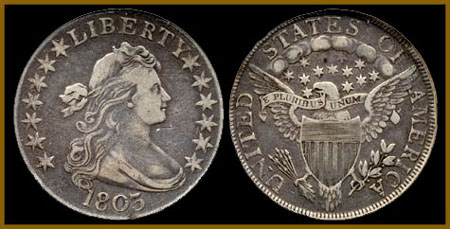
1803 Half Dollar
1803
HALF DOLLAR
PCGS No:
6066, 6067
Mintage:
Circulation
strikes:
188,234
Proofs:
none
Designer:
Robert Scot
Diameter:
±32.5 millimeters
Metal content:
Silver - 89.2%
Copper - 10.8%
Weight:
±208 grains
(±13.5 grams)
Edge:
Lettered -
FIFTY CENTS OR HALF A DOLLAR (various ornaments
between words)
Mintmark:
None (all dates
of this type were struck at Philadelphia)
SCOT'S HERALDIC DESIGN (1801
- 1807)
Following the lead
of the dollars (1798) and the dismes and half dismes
(1800), the first half dollars minted after 1797 bore
the new Heraldic Eagle design, Scot's copy of the
Great Seal of the United States (1782). This device
punch lacked stars, berries, and also the end of stem;
it also, either from blunder or bravado, placed the
warlike arrows in the eagle's dexter claw (observer's
I.), the peaceful olive branch in the less honorable
sinister claw.
For many years collectors believed in the existence
of half dollars dated 1804, especially because mint
reports listed a large mintage [156,519]. Early auction
catalogs filled the gap by listing "1804 under
5" (the vars. now known as 1805/4); but to
date the only
1804-dated halves seen are fraudulent alterations
from other dates, either by removing the 5 from an
1805/4 or by fabricating a 4 from some other digit.
Most likely the pieces delivered in 1804 came from
1803-dated dies, as with the silver dollars.
On the other hand, the so-called 1806/9 (formerly,
in error, "1806/00") is a corrected blunder,
whereas the 1805/4 obvs. reflect Mint economy in use
of dated dies as long as possible. The "9"
is a 6 punch first entered rotated 180° from normal.
And the 1806/5 dies (one of them an actual die used
in 1805, reannealed for redating, then rehardened)
reflect an emergency: The Engraving Department was
running out of die steel.
For many of the Mint's earliest years, its principal
business was making cents, half dollars, and half
eagles, which mostly found their way into bank sacks
rather than public circulation. Large mintages of
these denominations resulted in a proliferation of
vars., mostly positional (because letters, stars,
numerals, and berries had to be entered into each
working die by hand), but in many instances also major
(reflecting changes in punches, additions or omissions,
or corrections of blunders). The complexity of listings
in the 1805-6 period reflects all these factors. No
really satisfactory reference work yet exists (see
Sect, i, introductory text). Nevertheless, the sequence
herein, though not pretending to be completely chronological,
makes more sense than any previously published. (Absolute
chronological se¬quence would place the 1805/4
vars. in the middle of the year, the small 5 coin,
4576 — Ov. 107. at the beginning.)
Mintage of this design was interrupted in summer 1807
so that the new Reich dies could be introduced: All
1807's seen to date have a new edge device without
any ornaments between words, a style continued for
some decades. The mintage figure [301,076], from Snowden
{I860}, almost certainly includes many dated 1806.
SCOT'S HERALDIC
DESIGN
Designer, Engraver,
Robert Scot, obv. after Stuart, rev. after the Great
Seal. Mint, Physical Specifications, Authorizing Acts,
as before.
Grade range, POOR to UNC. GOOD: Date and all letters
legible except for motto; devices outlined. VERY GOOD:
Some few internal details of bust, hair, and wing
feathers; deepest drapery fold shows; some motto letters.
FINE: All drapery folds show; partial hair, leaf,
feather, and stripe details; most motto letters. VERY
FINE: Only slight wear on r. drapery folds. 1. side
(to curls) smooth; over half hair, feather, and leaf
details; full motto. EX¬TREMELY FINE: All drapery
lines complete to junction with curls; few isolated
tiny rubbed spots only; generally, over half mint
luster. EXCEPTIONS: Coins from buckled dies may not
show full motto even in mint state; breast feathers
may be weak even in mint state (look for mint luster
on weak areas).
1803 [all kinds
188,234] Large 3. Reverse, small stars. Obverse
101-2. Probably the [31,715] delivered in 1803 comprised
these 2, the [156,519] in 1804 in the next 2.
1803 Large 3. Reverse, large stars.
Obverse 103. Large 3 has vertical serif at r.
angle to top stroke and extending above the latter:
Compare next. Large reverse stars continued through
1807. Doubtless this and next include most or all
the [156,519] struck in 1804; comprises the majority
of survivors of this date.
1803 Small 3. Reverse, large stars.
Obverse 104. Struck in 1804. Note slanting serif to
3.