Capped
Bust Half Dollars - John
Reich, the former indentured servant, designed the
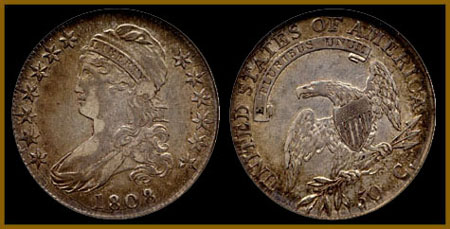
Capped Bust half dollar. The obverse shows Liberty
in profile facing left wearing a LIBERTY inscribed
cap that was intended to represent a Phrygian cap.
Seven stars are to her left and six are to the right
with the date below the truncation. The reverse shows
the heraldic eagle with wings pointing downward. Above
the eagle, on a banner, is the motto E PLURIBUS UNUM.
The required inscription UNITED STATES OF AMERICA
surrounds the coin, interrupted by the wing tips,
and the denomination written as 50 C. is below.
For its time, the
Capped
Bust Half Dollar was the workhorse of American
coinage. Hundreds of dies were used creating a huge
number of die varieties. Capped Bust half dollars
are often collected by date as well as by die variety
today.
Specifications:
1807-1836 Designer: John Reich Weight: 13.48 grams Composition: .8924 silver, .1076
copper Diameter: approximately 32.5 mm Edge: 1807-1814 FIFTY CENTS OR HALF
A DOLLAR; 1814-1831 Star added between DOLLAR and
FIFTY; 1832-1836 Vertical lines added between words.
Specifications: 1836-1839 Designer: Christian Gobrecht Weight: 13.36 grams Composition: .900 silver, .100 copper Diameter: 30 mm Edge: reeded
This
date comes with Large and Small Stars on the obverse.
One variety has 50 punched over 20 on the reverse, a mistake
made by the engraver when he was preparing the die.
Includes
1820/19 overdates. The 2's in the date come with curved
or straight bases - the 2's with straight bases come with
or without knobs at the top.
There
are 23 varieties for the year. A popular variety uses
a Large Letter rev. with heavy die break across left wing.
Another has a dash to the left of the date.
There
are 15 varieties for the year. Look for “laced lips”
vertical die line connecting lips and chin. Also 1 over
1 variety visible on higher grade specimens.
Look
for the blundered 50/00 reverse die. Late in this year,
the reverse was modified by replacing the C of the denomination
with CENTS and the edge lettering was replaced with reeding
(see the following)