Liberty
Seated Half Dollars - Christian
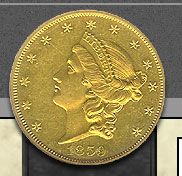
Gobrecht designed the Seated
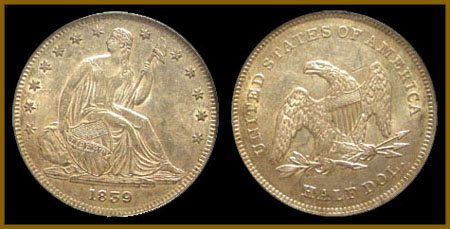
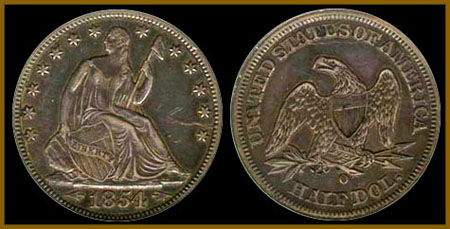
Liberty Half Dollars. The obverse of the
Liberty Seated Half Dollars depicts Liberty seated looking
over her shoulder to the left. She balances the Union Shield
inscribed LIBERTY with her right hand and holds a staff
on which is placed a Phrygian cap in her left. There are
seven stars to the left and six to the right interrupted
by her head and the capped pole. The dated is below. The
reverse shows the heraldic eagle looking left. It is surrounded
by the required inscription and the denomination written
as HALF DOL. below. Dentils are around the periphery of
both sides of the Seated Liberty half dollar.
There were five varieties of the Seated
Liberty Half Dollars. Type 1, 1839-1853 and 1856-1866
(resumed with weight standard of Type 2) has no motto above
the eagle. It weighed 13.36 grams. Type 2, 1853, added rays
around the eagle to indicate the change in weight to 12.44
grams. Type 3, 1854-1855, had the rays removed but arrows
added to each side of the date. The weight remained the
same. Type 4, 1866-1873 and 1875-1891 (resumed with weight
standard of Type 5) had the motto IN GOD WE TRUST added
to a banner above the eagle. The arrows at the date were
removed. Type 5, 1873-1874, had the arrows at the date added
back to show the change in weight to 12.50 grams.
There were also several varieties of the
Seated Liberty half dollar. In 1839 the drapery was modified
to cover more of Liberty’s left arm. The varieties
are No Drapery and Drapery. Both Small and Medium letters
are found for the 1840 issue. The next Red Book variety
was made in 1842. There were Small Date and Small Letters
and Small Date with Large Letters. The New Orleans Mint
for that year made a Small Date with Small Letters also
and a Medium date with Large letters. A doubled date is
found in 1844-O. Excessive die polishing caused the 1845-O
to have Drapery and No Drapery. The Philadelphia issues
of 1846 had a Medium Date, a Tall Date, and a 6 over a Horizontal
6. Medium and Tall dates are found for 1846-O, and 1847
has a 7 over 6 overdate. A very rare 1853-O Type 1 (no arrows)
exists. Only 3 specimens are known. An overdate was made
in 1855 that shows the numerals 854 under the normal date.
In 1861 the New Orleans Mint used a federal
die obverse and a CSA reverse to strike a few CSA half dollars.
This same obverse die was also paired with a regular federal
reverse to strike some 1861-O half dollars. They can be
identified by a die crack that runs from to the right of
the sixth star down to Liberty’s nose and shoulder.
Both the No Motto and With Motto coins were made in San
Francisco in 1866. The new dies that had the With Motto
reverse did not arrive in time so an older die was used
in the first group of coins struck for that year. Close
and Open 3’s were found in 1873. Carson City and San
Francisco made both Type 4 and 5 coins for that year. Another
overdate was made in 1877 with a 7 seen over a 6. Just the
top portion of the 6 is visible over the upper part of the
last 7.
Mintages of the Seated Liberty half dollar
range from a low of 4,400 in both 1882 and 1884 to a high
of 8,418,000 in 1876. Mint records show a No Arrows half
dollar for 1873-S with a mintage of 5,000; however, none
are known to exist today.
Look
for the rare 1846/5 overdate. Date sizes vary and one
interesting variety had the 6 of the date punched into
the die horizontally, then corrected.
Type
1 reverse, tops of LF in HALF nearly touch, long
closed claws, large arrowheads; Type 1 No Drapery;
Type 1 double date – very rare; Type 2 rev.
– very rare, tops LF apart, shorter open
claws, small arrowheads.
Type
1 reverse; No Drapery; First Blundered Die –
very rare, extra 18 shows above 18, part of another
8 between 58; Second Blundered Die – very
rare, lower part of final 8 in rocky base below
skirt.
Type
1 reverse – very rare; Type 2 – normal
reverse; Type 2, No Drapery – rare; “Cracked
Confederate Obverse,” Type 2, some of these
were struck under the auspices of the Confederacy
using U.S. dies - unfortunately, there's no way
to tell them apart. The extremely rare Confederate
Half Dollars and the more common Restrikes were
separate issues that still deserve mention here.
Type
1 reverse, Large S, 64 apart; Type 2, Small broad
S, 64 apart; Type 2, Small narrow S, 64 apart;
Type 2, Small narrow S, 64 almost touching –
very rare.
71
almost touch, Minute narrow S; 71 almost touch,
Minute narrow S, No Drapery – rare (S sometimes
very weak); 71 almost touch, Small broad S; 71
apart, Minute narrow S – rare; 71 apart,
Small broad S – rare.
Long
obverse arrows, tall narrow S – very rare;
Long obverse arrows, tall narrow double punched
S – rare; Small broad S; Small broad double
punched S – very rare. Minute S –
very rare.
Type
1 reverse, smallest, roundish CC – very
rare; Type 1 reverse, small bold CC – very
rare; Type 2 reverse, smallest CC – extremely
rare; Type 2 reverse, small wide CC – very
scarce; Type 2 reverse, small close CC; Type 2
reverse, small close CC, repunched 77.
Type
1 reverse, small S widely doubled – very
rare; Type 1 reverse, small S widely doubled,
No Drapery – very scarce; Type 1 reverse,
micro S – scarce; Type 1 reverse, No Drapery,
micro S – scarce; Type 2 reverse, micro
S – extremely rare; Type 2 reverse, micro
S, No Drapery – extremely rare; Type 2 reverse,
small narrow S.