Reich’s
CAPPED BUST FIVE DOLLARS OR CAPPED BUST HALF EAGLES (1807-1834):
John Reich designed the Capped
Bust Half Eagle of 1807 to 1834. Although the 1818 to
1829 were done by Robert Scott, he copied Reich’s earlier
design, and the 1829 to 1834 designs were modified by William
Kneass.
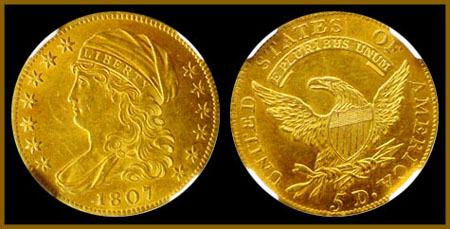
The obverse shows Liberty
in profile facing left wearing a LIBERTY inscribed cap that
was intended to represent a Phrygian cap. The Capped
Bust Half Eagle, John Reich’s design, has seven
stars to the left of Liberty and six to the right with the
date below. Scott’s copies of the Capped
Bust Half Eagle were not nearly as artistic as Reich’s.
On his design, all thirteen stars encircle Liberty’s
head with the date below. Liberty’s features are coarse
and thick. His eagle on the Capped
Bust Half Eagle is more defiant with its opened mouth
and aggressively curved neck. The inscription UNITED STATES
OF AMERICA is in an arc around the eagle, interrupted by the
wing tips. On a banner over the eagle’s head between
its wings is the motto E PLURIBUS UNUM. The denomination written
as 5 D is below. Dentils are seen at the periphery of both
sides of the Capped
Bust Half Eagle coin.
Reich corrected the error
made by Robert Scot in the design of the previous half eagle
(as well as his other heraldic eagle motifs). Scot had placed
the arrows in the eagle’s right or dexter claw and put
the olive branch in the left or sinister claw. This reversal
of the positions of these two items is an inaccurate modification
of the Great Seal of the United States. Arrows in the right
claw symbolize extreme militarism, which is hardly a message
a young nation should place on its coinage. On the Capped
Bust Half Eagle, the olive branch is in the right claw
and the arrows are in the left.
In 1825 Mint Director Samuel
Moore wrote to Thomas Jefferson asking him about the proper
emblem of Liberty for our coins. Jefferson replied that the
Phrygian cap was not appropriate to be worn on the head of
a goddess on United States coinage since we were never slaves.
Nonetheless, the cap remained until the Capped
Bust Half Eagle was replaced by the Classic Heads of 1834.
Look
for the slightly tougher 1808/7 overdate, which is four
times rarer than normal and exceedingly rare in Mint
State. The regular date is rare above MS64.
Found
with different combinations of Small or Large Dates
and Small or Tall 5s. Small 5s prohibitively rare—about
20 known with Small Date and about 6 with Large Date.
Most common is Large Date, Tall 5 which is rare above
MS64.
Found
with Small and Tall 5s. The Tall 5s are rarer although
1 has been graded MS66. Pops reports on this date are
misleading because many were certified with no variety
indicated. All are rare in higher MS grades.
All
stars have a notched inner point- about 60 are known.
Perhaps the most interesting variety has no space between
STATES OF on the reverse- about 90 are known Other variety
– 5D over 50- about 30 are known. All are rare
in MS.
Regular
issue prohibitively rare- only 8 are known. Highest
is an MS61. On one variety, the denomination was improperly
cut into the die, resulting in 5D over 5O. Only about
17 are known. Only 6 in Mint State. 2 MS65s are the
highest.
Found
with Curved and Square Base 2s. Curved Base 2s have
Large and Small Letters. Square Base 2- less than 100
known, about half in MS; Curl Base 2 with Small Letters
– about 14 are known with 4 in MS; Curl Base 2
with Large Letters – about 35 are known with 8
in MS.
Either
the mintage is wrong or most were melted since only
three examples are known today. Two are in the Smithsonian
and 1 was part of the Eliasberg Collection graded XF40.
It is in 100 Greatest U.S. Coins by Garrett and Guth.
Most
of these are 1825/1 overdates of which only about 30
are known to exist. Only two examples are known of the
1825/4 overdate. 13 have been certified in MS by both
PCGS and NGC.
Both
the Normal Date and the 1828/7 overdate are extremely
rare. Normal Date – about 13 are known 6 of which
are in MS. Overdate – only 6 are known, 3 in MS63
and 1 in MS64.
Comes
with Large and Small Dates. Large Date – 8 known,
3 in MS66. Small Date – 9 known, highest 1 in
MS65. Two proofs are known, both are with Large Dates.
A
total of 35 have been certified in all grades. Finest
known are 2 in MS66. Found with Large or Small D’s
at the base of the reverse. Small D is slightly rarer.
Found
with Curved or Flat Based 2s in the date. The Curved
Base 2, 12 Stars is extremely rare with only 3 certified
by both services. It is in 100 Greatest U.S. Coins by
Garrett and Guth. The Flat Based 2s have about 40 known
with the finest a single MS65 example. Two proofs are
known.
Found
with Large and Small Dates. About 40 Large Dates and
25 Small Dates are known. The highest certified is a
single MS65 Small Date. Three proofs are known, all
with Large Dates.
Found
with Plain and Crosslet 4s. About 40 with Plain 4s are
known with 46 certified by both grading services. The
highest is a single MS65. 18 Crosslet 4s have been certified.
The highest is a single MS65.