CLASSIC HEAD HALF EAGLES (1834-1838):
William Kneass designed the Classic
Head Half Eagle, which was minted from 1834 to 1838.
He chose to use Reich’s Classic Head motif that was
used on large cents of 1808 to 1814. Kneass also adapted
Reich’s eagle from the five dollar piece of 1807.
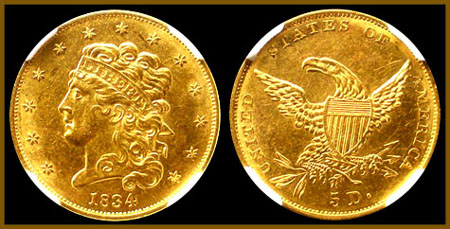
The design of the Classic
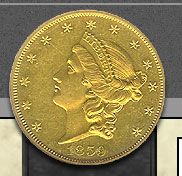
Head Half Eagle shows a profile of Liberty facing left.
Her curly hair is held with a band that is inscribed LIBERTY.
She is surrounded by thirteen six-pointed stars, with the
date below. Around the periphery of the Classic Head Half
Eagle are dentils on both sides. The coin has a reeded edge.
The reverse of the Classic
Head Half Eagle shows a heraldic eagle whose head is
turned to the left. In its talons it holds the olive branch
and arrows, symbols peace and preparedness.
The legend UNITED STATES OF AMERICA appears
in an interrupted arc around the coin with the denomination,
written as 5 D. below. Missing is the motto IN GOD WE TRUST,
which was removed from the reverse of the Classic
Head Half Eagle to signify the change in weight from
135 grains to 129. It seems that Mint Director Samuel Moore
was looking for a reason to phase out the motto for several
years, and the change in weight mandated by Congress was
the perfect opportunity. The weight and fineness of the
coin were changed in order to prevent continued melting
for bullion purposes. As a result most of the original gold
coins that were minted prior to1834 were turned in to the
mint, much of it to be used to make the new half
eagles.
William Kneass (pronounced
Niece) was the second Chief Engraver. He served from 1824
until his death in 1840. In addition to the Classic
Head Half Eagle, his classic head motif was used on the
quarter eagles of 1834 to 1839. Kneass modified Reich’s
Capped Bust motif for silver coinage for the years 1829 to
1837 and the half dime in 1829.
For the last five years of
his life, Kneass suffered from the results of a severe stroke
that left him paralyzed on his right side. For those years,
his assistant Christian Gobrecht did the die and pattern work
at the Mint. When Kneass died in 1840, Gobrecht succeeded
him as Chief Engraver.
Mintages of the Classic
Head Half Eagle varied from a high in 1834 of 657,460
to a low of 17,179 in 1838 at the new Mint in Charlotte.
Comes
with Plain or Crosslet 4s in the date. The Plain 4 type,
the much more common variety, comes with Fancy or Block
8's in the date. The Plain 4 is common up to MS64 and
rare in Gem and above grades. The Crosslet 4 is rare
in all MS grades; 8 proofs have been certified for the
date.
This
is the second most common date in the series. However,
Gem examples are rare with only 4 certified by both
services; 4 proofs have been certified for the date,
2 are UCAM67.
This
is the first year of issue at Dahlonega. The D mintmark
appears on the obverse above the date. Only 20 coins
have been graded in Mint State. The finest are 3 MS63s.