Home
Newsletter
About Us
Coins For Sale
Selling Your Coins
Coin Collecting
Investing in Coins
Coin Information
Coin Articles
/World Coins
Books, Loupes etc.
Link to Us
Links
Contact Us
  Sign up for our free NewsLetter
  e-mail: 
  Sign Up 


FLOWING HAIR SILVER DOLLARS (1794-1795)

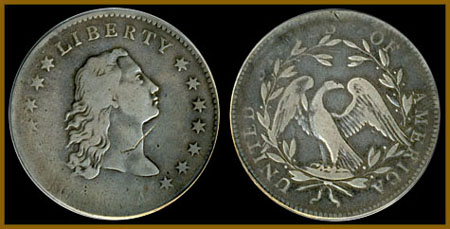
1794 Flowing Hair Silver Dollar

Mintage: Calendar year, Mint report: 1,758 distributed (from total mintage of c. 2,000)
Of all the Silver Dollars ever struck the 1794 date is the Grandfather of them all. The year represents the first official One Dollar coin from the United States Mint. Just 1,758 were made and from that number it is estimated that only about 130 or so remain in any grade today. The coin is listed in the Top 20 in the book 100 Greatest U.S. Coins.

1794 Silver Dollars

Dollars authorized: The Mint Act of April 2, 1792 authorized the production of silver dollars of 416 grains weight, with silver content of 371.25 grains, equivalent to .89243 fine. The remaining metal was to be copper, added for strength. Such coins were intended to circulate at par with Mexican and other Spanish-American silver "dollars" (of the eight reales denomination) which were common in the states at the time. Indeed, earlier the Continental Congress had denominated its paper currency in Spanish milled dollars. The framers of the Mint Act of 1792, mindful of Alexander Hamilton's Report of January 28, 1791, chose the gross weight of 416 grains and the pure silver content of 371-1/4 grains for the silver dollar, and other silver coins in preparation, to match the average weight of Carolus dollars then in circulation, and to exceed the middle fineness Hamilton had specified. (Hamilton had specified pure silver content as ranging from 374 grains to 371 to 368, corresponding to 899, .8918 and .8846 Fine.) No one knew the official Spanish fineness (65/72=902-7/9 or .90278), but the actual Spanish dollars were not then coined in that quality.

A problem with the weight: Albion Cox, Mint assayer who was well versed in coinage (and who earlier produced New Jersey coppers), found that the statutory fineness of .89243 was difficult to attain, and he proposed adjusting it to the point at which the silver content of the dollar was 371.25 grains (thus achieving the amount of silver Congress wanted), but with the copper content lowered to 41 grains, thus yielding a 412.25-grain coin of .900456 fine silver (which was close to what Congress authorized over 40 years later under the Act of March 31, 1837). Congress did not agree with the Cox plan.

Mint Director David Rittenhouse then proposed to increase the silver content from 371.25 grains to 374.74, for a total coin weight of 416 grains, resulting in .90084 silver fineness. Under this proposal, unauthorized by Congress, all 1794 dollars and, it is believed, most if not all 1795 Flowing Hair dollars were minted. Each had 3.49 grains of extra silver, above the Mint Act's limit of 1/144 deviation (2.578-1/8 grains) in weight of fine silver. Depositors receiving silver dollars in exchange for bullion were thus short about 1 % in value for each dollar received (see Additional Information below).

Concerning the copper with which to alloy the silver, R.W.Julian noted this: '
It is my opinion, based on the fact that I have yet to find in the Mint records any purchases of scrap copper after 1792, that the source of 99% of the copper alloy for the dollars of 1794-1804 was the copper coinage, either in misstruck half cents and cents or in the scissel (the remainder of the flattened copper ingot after the planchets had been punched out). Depositors usually had to wait several weeks for their coins, and very rarely obtained them within a month. For example, years later when silver coinage was heavy and regular in 1814, the delays were sometimes for several months.

Dies made: The dies for the 1794 dollar are almost certainly the work of Robert Scot, a medalist and die sinker. He had begun his career in England as a watchmaker, and had come to America, where he engaged in engraving plates for money and bills of exchange during the Revolutionary War, scales used in the office of financier Robert Morris, and plates illustrating architectural items for Dobson's Encyclopedia, among numerous other commissions. In 1780 he produced an Indian peace medal, "Happy When United," for the state of Virginia. In 1781 his workshop was located in Philadelphia on the west side of Front Street, near the corner of Vine.
Following the death from yellow fever in the summer of 1793 of Joseph Wright, a talented artist of whom many fine things were expected, the Mint sought to add a full-time engraver to the staff.

Wright had worked on and off for the Mint, and today is credited with designing the 1792 eagle-on-globe patterns and the 1793 Liberty Cap cent, both beautiful works of art.
On November 23, 1793, Secretary of State Thomas Jefferson, who was in charge of the affairs of the Mint, wrote to Robert Scot and sent him a commission to be engraver at the Mint. To Scot fell the task of cutting the dies for coinage, including the 1794 Flowing Hair dollar. In November 1794, John Smith Gardner was hired as his assistant, but by this time the initial delivery of silver dollars had been accomplished. Probably, Gardner worked on some of the 1795 and later dies.

Planchet preparation: Silver was obtained by the Mint from various depositors, who primarily brought foreign silver coins, but often furnished silver utensils and other wrought items as well. The silver was received by the Mint, and in due course, dollars or other coins were made from the metal and paid out. Unfortunately, the Mint did not have a bullion fund, or house account, to provide for the purchase of silver and the immediate payment in kind from earlier-minted coins on hand. Under the procedure in effect during the era of the 1794-1803 silver dollars, depositors often had to wait several days or more for their coins.
After receipt, the silver would be melted, refined, cast into ingots, rolled into bars, and then rolled and drawn into sheets the thickness of the desired planchets. Great difficulties were experienced during these processes, especially with the rolling mills, as the rollers tended to deteriorate and produce strips of metal with uneven thickness. At one time, the Mint operations almost shut down because of rolling mill problems.
From the finished strip of the proper thickness, a small punch and die would cut out planchets one at a time. By this point in time, a great deal of effort and expense had been invested in creating each planchet. However, there was more to be done.

Adjustment marks: At the time the Mint did not have elaborate quality-control procedures in place, and it was difficult to produce planchets precisely of the required weight. Accordingly, the typical planchet was made slightly heavier than needed, and the weight was adjusted by hand filing to the correct level. Underweight planchets would have been useless, as their weight could not have been increased, and they instead were discarded, to go through the entire process of melting, conversion to ingots, rolling the strip, and punching planchets again. (In 1795, the problem of underweight planchets may have been solved by plugging; see description under 1795.)
Evidence of the hand filing is seen today in the form of parallel or criss-cross grooves known as adjustment marks. The majority of 1794 dollars show these marks, usually at the lower left obverse and the corresponding part of the reverse, where metal flow was not as great (due to non-parallel die alignment; in this area the dies were too far apart, little metal movement occurred, and adjustment marks on the original planchet were less likely to be obliterated).

Edge lettering: To prevent filing and clipping by the public to reduce a minted coin's weight, it was desired to ornament the edge. In this way, the removal of silver could be detected. For the silver dollar, lettering was applied by a machine which rolled the finished planchet between two parallel steel bars, upon each of which was half of the edge lettering inscription: HUNDRED CENTS ONE DOLLAR OR UNIT and ornamentation between words.
These steel bars compressed the letters incuse into the edge of each planchet, and at the same time raised a rim around the border of each side of the planchet. Apparently, the height of the rim varied over a period of time, for some 1794-1803 dollars are known with rims that are almost flat, and others have rims that are quite high.
The raised rim did several things:
1. During the striking process, the metal could flow more easily into the toothlike notches at the edge of each die, to create denticles around the border.
2. The raised rim would protect the coin's surface from wear, and it would last longer in circulation. Coins with low rims wore quickly; those with high rims preserved their details for a greater length of time.
3. The coins would stack better, a convenience to banks, merchants, and counting houses.
In later years (beginning with the 1836 Gobrecht issues), the Mint would raise the rims on silver dollars by means of an upsetting machine; the closed collar equalized diameters. However, in the 1790s, whatever rim was to be raised was a by-product of the process of squeezing the edge of the coin during the lettering process.
Dollars struck: In 1793 and 1794, the largest press at the Mint was intended for striking no coins larger than a half dollar. Surviving documents indicate that Mint officials lamented the lack of a press suitable for coining silver dollars and medals. It was not until spring 1795 that one was installed.
In the meantime, a screw press suitable for coining cents and half dollars was put into service to make silver dollars. The initial coinage of the new denomination was accomplished in the first part of October 1794. The effort was not completely successful, as evidenced by surviving coins which show areas of weak striking. Apparently, just one blow of the press was used (as evidenced by the lack of double struck features on surviving pieces).
Known silver dollars dated 1794 are from a single pair of dies and are believed to have been made to the extent of, perhaps, 2,000 coins (Walter H. Breen's estimate), of which 1,758 pieces were considered to be satisfactory delivered by the coiner on October 15, 1794. The remaining impressions, possibly amounting to 242 coins, rejected as being too weak, probably were kept on hand for later use as planchets. Supporting this theory is the existence of at least one 1795 silver dollar (BB-14) plainly overs truck on a 1794 dollar.

As several die states exist, the striking could not have been continuous, but was interrupted by the removal of the dies from the press for resurfacing (relapping) after clash marks were sustained early in their life (see Die States below). The silver for striking these came from ingot deposits made by Director Rittenhouse and Charles Gilchrist. This is certain, because Rittenhouse personally received all the first coinage of dollars.1
The obverse and reverse die faces were not parallel, with the result that on almost all pieces surviving today the lower left obverse side appears weaker than the upper right obverse side, with corresponding weakness and strength on the opposite areas of the reverse. As the die faces remained out of parallel after having been removed from the press for resurfacing and removal of clash marks, and re-inserted in the press, the cause of the maladjustment must have been that the face of one die (or, less likely, both) was not perpendicular to its shank.
After the effort at coining dollars, the project was abandoned as a bad job, and a large supply of silver dollar planchets was put into chests for storage until a larger, satisfactory press could be installed.

Thus, the mintage of 1794 dollars was much smaller than had been intended.

Reception of the dollars: So far as is known, the new 1794 silver dollars slipped into circulation and immediately began doing their duty in the channels of commerce. Despite all good intentions, when the first 1794-dated United States silver dollars reached merchants and bankers, and when their successors dated 1795, 1796, etc., did also, the Spanish-American dollars, or eight-reales pieces, were preferred over the native American product. The old eight-reales coins were worth slightly more on the market than were the sparkling new United States coins with the head of Miss Liberty on one side and an eagle on the other. The reason is that the citizenry was familiar with the eight-reales coins, and especially in the export trade they were welcomed worldwide. Although the new United States dollars might test properly by weight or analysis, most business was done at sight, and the new coins had yet to prove their status.
By early December 1794, a few of the new dollars had traveled north to the Granite State, where the New Hampshire Gazette reported the following on December 2nd:
Some of the dollars now coining at the Mint of the United States have found their way to this town. A correspondent put one into the editor's hands yesterday. Its weight is equal to that of the Spanish dollar but the metal appears finer. One side bears a head, with flowing tresses, encircled by Fifteen Stars, and has the word "LIBERTY" at the top, and the date, 1794, at the bottom. On the reverse, is the Bald Eagle, enclosed in an Olive Branch, round which are the words "One Dollar, or Unit, Hundred Cents." The tout ensemble has a pleasing effect to a connoisseur; but the touches of the graver are too delicate, and there is a want of that boldness of execution which is necessary to durability and currency.
Numismatic historian Don Taxay viewed the 1794 dollar as unsatisfactory, noted that engraver Robert Scot's "talents, never marked, show a rapid decline."2 He took the position that Mint Director Rittenhouse's successor (after June 1795), William DeSaussure, did not like Scot's work, and, apparently, not his assistant Gardner's either, and in September 1795 went over the heads of Scot and Gardner to enlist an outside artist, John Eckstein, to redesign the dollar and replace the Flowing Hair motif with the Draped Bust obverse, Small Eagle reverse, type.
I, for one, disagree with Don Taxay-and find the Scot and/or Gardner work on 1794-1795 Flowing Hair coins to be very attractive, not only on the early dollars, but on half cents, large cents, half dimes, and half dollars as well. Unfortunately, very few contemporary accounts survive to tell us of the contemporary public reception of the newly minted 1794 silver dollars and their use in commerce. Coins were taken for granted, and relatively little notice was taken in print concerning them. ' All too often, historians judge by today's standards what happened two centuries ago. In 1794, the almighty Spanish-American dollar, showing "that boldness of execution which is necessary to durability and currency," had little in the way of aesthetic appeal. Depicting the kings of Spain and, earlier, the Pillars of Hercules and two globes, these coins had virtually no fine detailing. The dies were made quickly, and crudely. By contrast, we have it on the word of an unnamed editor of a New Hampshire newspaper that the new 1794 United States silver dollar had "a pleasing effect to a connoisseur." What more could be asked for?

Numismatic Information Desirability of the 1794 dollar: Today, the 1794 dollar is recognized as a great classic, not only because it is rare, but because it stands as the first silver dollar produced by the fledgling Philadelphia Mint. From the inception of coin auction sales on a large scale in the 1860s, to the present day, the appearance of a 1794 silver dollar in an auction usually has provided the opportunity for the cataloguer to provide an extended comment. Similarly, 1794 dollars have occupied the spotlight in numerous dealers' fixed-price lists over the years.
Charles Steigerwalt, in The Coin Journal, September 1880, commented as follows concerning the 1794 dollar:
The number of pieces coined in this year was not large and they have become very rare. Good specimens bring about 50 dollars. The dies of the dollars and half dollars of this year were not sharp and the impressions are generally weak; good specimens being difficult to obtain.
When Ebenezer Locke Mason wrote Rare American Coins: Their Description, and Past and Present Fictitious Values, in 1887, he focused upon this coin and noted the following:
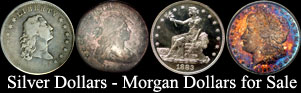
The 1794 United States silver dollar, which occupies the centre of the group in our illustration [a collage of coins at

the top of the page], was authorized by an act of Congress, April 2, 1792, and was struck at the old Mint, opposite Filbert Street, in Seventh Street, Philadelphia, and is still standing. This dollar, which is considered very rare, commanded a premium of about $25 in I860, and has steadily advanced in fictitious value from year to year, and commanded, in every condition, in 1885, the sum of three hundred dollars.
It is said that but few of the 1794 dollars were struck, and the earliest from the dies equaled Proof pieces in their glistening splendor. The British Museum contains the best known specimen of the 1794 dollar, and probably received it as a gift from our government the year it was coined.1
Population of 1794 dollars. The number of 1794 silver dollars known is subject to conjecture. Many pieces offered in nineteenth and early twentieth century catalogues were not illustrated, making it difficult to trace their pedigrees with certainty today. Jack Collins, who has made a detailed study of this date, suggests 120 to 130 possibly survive.
Mint State grades: Over the years several different specimens of the 1794 dollar have been designated as Uncirculated by various cataloguers. Today, fewer than 10 coins are believed to be MS-60 or finer by current grading interpretations.
Circulated grades: Nearly all 1794 dollars seen today are in lower grades ranging from Good to Fine. Not many make the VF grade, and perhaps fewer than 15 totally are EF or better. Population report data are not particularly useful in determining the number of EF 1794 dollars known, as a number marked "EF" (or the curious "XF") are, in my opinion, only VF. There seems to have been a grade escalation in regard to this particular date.
Caveat emptor: It is apparent that possibly two dozen or more 1794 silver dollars in numismatic hands today, ostensibly normal coins exhibiting varying degrees of wear, were at one time holed, plugged, initialed, or otherwise damaged. Over the years numerous of these have been expertly repaired so as to almost defy detection. Jack Collins, in the course of his research on dollars of this date, has found numerous instances of damaged pieces being described as such in auction catalogues, and then later reappearing as "undamaged" coins. The inescapable conclusion is that they were cleverly repaired in the meantime. Purchasers of 1794 dollars are urged to check carefully for signs of repair.

One explanation for the survival of so many impaired coins is probably that bullion dealers and others were alerted to the rare 1794 dollars by coin collectors when the hobby was in its infancy in the 1840s and 1850s. While holed and damaged dollars of other dates, such as 1795, were even more common, the bullion dealers did not extract these as they passed through their hands. However, any dollar dated 1794 was saved, no matter what the damage was. Accordingly, a higher proportion of this date survived in damaged condition in numismatic hands than any other early dollar issue of either the Flowing Hair or Draped Bust types.

Varieties - 1794. BB-1.

Dollars bearing the 1794 date were struck from a single pair of dies. Nearly all seen by the author are lightly struck at the lower left of the obverse and corresponding part of the reverse. Some few pieces display a well-balanced strike and are exceedingly rare. Perhaps because there was just one variety of the year, Bolender did not assign a number to it in his 1950 book. However, specialists since then have called it Bolender-l. Bolender was following the tradition of Haseltine (1881), who omitted a description of the dies, simply noting this: "There is but one die known of the 1794 dollar."
o OBVERSE 1: Flowing Hair design with six curls, the third curl weak. First star close to 1 in date. Second star near first curl, but does not touch it. The head of Miss Liberty in the 1794 dollar has a fuller cheek and more pronounced jaw line than does any of 1795, and admits of consanguinity with some of the finely-detailed heads seen on large cents made early in the year 1794. Blunt tip to neck point.
No head on a 1795 dollar is exactly like this head, although three obverse dies of 1795, one used to coin BB-11, 12, and 13; another to produce BB-14; and a third to strike BB-16, 17, and 18, each have a blunt tip to neck point and are more like the 1794 head than any others. If any 1795 obverses are worthy of the "Head of '94" appellation, these three are. In the 1795 Flowing Hair dollar study, below, I designate these "Head of '94" coins as Portrait I (PI) issues.
A curious fact is that while the eight stars on the left of the 1794 silver dollar are each oriented with a point toward the denticles (as standard), the seven stars on the right are each positioned differently, unique to 1794 in the early dollar series, with two points toward the denticles (see plate).1
o REVERSE A: Eagle perched on a rock within a wreath; 21 leaves on each branch. The wreath has 19 berries, 10 on the left branch, 9 on the right. A leaf is joined to second T in STATES, and another almost touches the right corner of F in OF. "Lobster claw" leaf pair under second T of STATES and first A of AMERICA. Eagle's wing touches R in AMERICA. Ribbons below wreath thinner and much closer together, and branch ends thinner and straighter, than on any 1795 reverse. Ribbon (not a knot) around junction of the two wreath stems. Seven feathers in eagle's tail. Rock under eagle's feet extends much farther to the left than on any 1795 die. This die was retired after the 1794-dated coinage and was not used in 1795.

o DIE STATES:
Die State I:
Perfect dies. No clash marks in fields. Cf. Neil Collection (Mehl, 1947): 1 to Amon G. Carter, Sr. to Carter Family Collection (Stack's, 1984): 207.
Die State II: Light clash marks in obverse and reverse fields (usually visible only on coins grading EF or better). The ends of Miss Liberty's hair locks extend farther into the field and are more detailed than on the next. End of curl approaches innermost point of star 2. Cf. Lord St. Oswald (Christie, Manson & Woods, London, 1964): 137 to AJ. Ostheimer, 3rd, to the Gilhousen Collection (Superior, 1973), to Frank Andrews (temporarily), to Jonathan Hefferlin, to Newport Collection (Bowers and Ruddy, 1975): 371, via intermediaries to Jimmy Hayes Collection (Stack's, 1985): 72; Lord St. Oswald (1964): 138 to Norweb (1988): 3741; Somerset Collection (Bowers and Merena, 1992) coins; and others.
Die State III:1 Obverse (especially) and reverse dies lightly reground, removing clash marks. The ends of Miss Liberty's lower hair locks are now shortened; the tips are missing. This is the usually seen die state.
Notes:
A prooflike impression of these dies (State I) struck in copper (Judd-19) is in the National Collection in the Smithsonian Institution, a gift of Stack's (in 1954, it appeared as Lot 1264 in Stack's Davis-Graves (James Davis) Collection sale, $1,400). Bolender reported a second, in copper, silver plated, but this was the American Numismatic Society's electrotype (illustrated in the Bolender book as the plate for 1794; his own coin was only VG).
A 1794-dated pattern without obverse stars (Judd-18) is from a different 1794 die, a fact first noted by Andrew W. Pollock III; earlier, it was believed that stars were added to the pattern die for use in regular coinage.

o AUCTION POPULATION SURVEY: Good: 3, Very Good: 13, Fine: 21, Very Fine: 34, Extremely Fine: 15, About Uncirculated: 4, Mint State-60 or better: 12. Total: 102. (Average grade: VF-25)
These numbers, while interesting, are skewed in two ways. First, dollars of 1794 are very valuable, and an inordinate number of them have crossed the auction block, as compared to private sale. Second, in the past 20 to 30 years, several Uncirculated coins, in particular the two Lord St. Oswald specimens, have been listed in auction catalogues multiple times. The 12 Mint State listings probably represent only about five or six different coins.

o NOTABLE SPECIMENS:


Neil Specimen. MS-65 (PCGS). Neil catalogue description: "Uncirculated, some short file marks in the die on upper obverse right edge, undoubtedly a very early impression of the die as the stars on the left are as bold as on right and legend on reverse is perfect and well struck, hardly the slightest touch of cabinet friction, feathers on eagle's breast all show, full iridescent mint luster." o Will W. Neil Collection (Mehl, 1947): Lot 1. $1,250. o Amon Carter, Jr. Collection (Stack's, 1984): Lot 207. $264,000 to the following. o Hugh Sconyers for the American Rare Coin Fund Limited Partnership. o Superior sale, May 1991, certified MS-65 by PCGS. Jack Collins considers this to be the finest Mint State 1794 dollar. Die State I, prooflike.
Lord St. Oswald-Ostheimer Specimen. MS-63. Description from Gilhousen sale: "Uncirculated, frosty, gray toned, one of the sharpest strikes ever reported; date, all stars, all of back hair, feathers and leaves, dentils at left on both sides, and letters in UNITED STATES unusually bold; minor field handling marks, one reverse rim dent; some adjustment marks (as made) near borders; light clash marks but no rim break." One of two 1794 dollars believed to have been obtained during a visit to Philadelphia in 1795. o Major the Lord St. Oswald, late October 1795, on his visit to Philadelphia; in the hands of St. Oswald's descendants until 1964, when it appeared as Lot 137 of the Christie, Manson & Woods auction of the St. Oswald Collection. o Alfred J. Ostheimer, 3rd o Superior Stamp & Coin Co., 1972 o Gilhousen Collection (Superior, 1973): Lot 1209, sold for $110,000 to the following, but, apparently, problems developed, and it was reacquired. o Ralph Andrews o Superior Stamp & Coin Co. o Jonathan Hefferlin for a reported $127,500. o Newport Collection (Bowers and Ruddy, 1975): Lot 371, $75,000.2 o Jimmy Hayes Collection (Stack's, 1985): Lot 72, $22,000. Die State II.
Lord St. Oswald-Norweb Specimen. MS-63. Obverse and reverse of nearly full brilliance, light gray toning, stars at the left side of the obverse are lightly struck, mint-caused planchet adjustment marks, Miss Liberty sharp with superb definition, reverse well struck except for tops of letters TED STA, which are intact but not as bold as their bases; eagle's breast feathers, wing details, head, eye, beak and all other features well defined. One of two 1794 dollars believed to have been obtained during a visit to Philadelphia in 1795. o Family collection of Lord St. Oswald which was sold at auction by Christie's in London October 1964, Lot 138. Sold to the following. o A.H. Baldwin & Sons and Lester Merkin, on behalf of the following. o Ambassador and Mrs. R. Henry Norweb. Norweb Collection (Bowers and Merena, 1988): Lot 3741,

A later die state has been reported with a rim break at 7th star; very late impression from the dies. Cf. Gilhousen (Superior, 1973): 1210, VF; there called one ofjust two reported. However,Jack Collins (in a commentary received by the author on December 31, 1992) noted that the "rim break" is believed to have been a rim bump, and no specimen is known to exist with a break at the 7th star. 2 Details from Walter Breen's Complete Encyclopedia of U.S. and Colonial Coins, p. 424.
MS-60/63. $242,000. Since graded MS-63. o Additional information: The two Lord St. Oswald coins: Certainly among the very finest Mint State 1794 silver dollars are two coins sold at auction in 1964 by Christie's of London, as part of the family collection of Lord St. Oswald, who is said to have visited Philadelphia in 1795, possibly in October. These coins, long forgotten with a group of other copper and silver issues dated 1794 and 1795, appeared on the market to delight and surprise numismatists, several of whom traveled from the United States to attend the London event. At the sale each 1794 silver dollar brought the American equivalent of $11,200. The first, Lot 137, went to A.J. Ostheimer, 3rd. The second, Lot 138, was knocked down to A.H. Baldwin & Sons, Ltd., London dealers, on behalf of Hon. and Mrs. R. Henry Norweb. As to which was the better coin has been a toss-up in discussions since. Lot 137 has fewer adjustment marks but is not quite as sharp on the 1 of the date, and has a few carbon marks on the reverse. Lot 138 has more adjustment marks. Both are brilliant and lustrous, and both are from an early state of the dies showing light clash marks. (There were three other early dollars in the sale: a specimen of 1795 BB-18 and two of 1795 BB-20. All told, the miscellaneous group of 1794 and 1795 pieces owned by Lord St. Oswald, representing an investment of less than $10 in 1795, brought the princely sum of $72,000! Die State II.
Boyd Specimen. MS-63 (PCGS). Uncirculated, graded MS-63 by PCGS in 1992. Lustrous, brilliant surfaces with detailed centers, clash marks in the fields, and the usual light striking at the left side of the obverse and corresponding part of the reverse. Some carbon marks at stars 3 and 6 serve to identify the coin. o B. Max Mehl, unknown date, probably the 1930s. o F.C.C. Boyd Collection. "World's Greatest Collection" sale, Numismatic Gallery, 1945, Lot 1. o Unknown intermediary. o Stack's (Fixed Price List No. 47, 1950 at $1,595). o B. M. Eubanks. o Sold at auction by Quality Sales (Kreisberg-Cohen) on September 10-12, 1973, Lot 464 at $51,000. o The Somerset Collection (Bowers and Merena, 1992): Lot 1300, MS-63 $115,500. Sold to following. o Jeff Isaac, who had it certified by PCGS (as MS-63).
Ostheimer Specimen (another). MS-62. Described as following in Lester Merkin's sale: "Choice Uncirculated, obverse field prooflike (new die retaining polish), rev. frosty, faint obverse adjustment marks, two minute hidden reverse rim nicks, trivial bag marks-only one needing mention above T on obverse and that one not disturbing color, minute traces of cabinet friction from when this coin rested in a ninteenth century velvet display tray, above average strike, all obverse sharp but very center, borders bold, eagle's head very sharp, claws plain, part of breast feathers visible." o A.J. Ostheimer, 3rd Collection (Lester Merkin, 1968): Lot 224.

French Specimen. MS-60. Auction '84 description: "Uncirculated 60+, exceptional strike with less weakness on the left obverse stars and left reverse legend than usual, evidently a very early strike; date full and Liberty's hair is boldly defined; cheek completely rounded; reverse (which grades full MS-63) eagle's breast and leg feathers are all visible and very sharp; some very light mint-made adjustment marks on reverse rim but surfaces remarkably free of abrasions; toning entirely natural, a warm medium blend of gray violet, russet, and greenish-gold." o Auction '84 (Paramount, 1984): Lot 725, Uncirculated 60+. o L.R. French, Jr. Family Collection (Stack's, 1989): Lot 2 o Gary Minsey Collection, MS-61 (PCGS).
Murdoch Specimen. AU-58. Empire Sale description: "Uncirculated; just the barest touch of cabinet friction, with frosty mint lustre. Perfectly centered, and an unusually bold impression. Stars rather bold." o Murdoch Collection, London (July 1903) o George H. Earle (Henry Chapman, 1912, Lot 2667) o Empire Collection (Cass Collection), 1957. o The Gibson Collection (Stack's, 1974): Lot 75, 32,500.
Austrian Specimen. AU-55. Bowers and Ruddy description, 1976: "Sharply struck, borderline Uncirculated, faint adjustment marks, traces of clashed dies, complete & well-defined denticles all around, sharp & square rims, hairlines from cabinet friction and some handling marks, shallow pit just about at eagle's 'navel' " o "Austrian private collection" (or possibly the Paris Mint Collection or that of the Biblio-theque Nationals. o Paul H. Wittlin o 1956 A.N.A. Convention sale conducted by James Kelly (Lot 1509, fetching $8,000). o Stack's o Private owner. Sold to the following in 1975. o Stack's o Julian Leidman and Mike Brownlee o Paul Nugget o Dave Berg o Private owner o Dr. Edward Willing Collection (Bowers and Ruddy, 1976): Lot 412,
The Miles Specimen. AU-50. Adjustment marks on left obverse; usual weak strike left obverse and reverse sides. o R.L. Miles, Jr. Collection (Stack's, 1969): Lot 1525, AU. o "Autumn" Sale (Stack's, 1978): Lot 287, AU.
Connecticut Historical Society Specimen. AU-50. Bowers and Merena description: "EF-45, natural golden gray toning with some greenish blue highlights, trace of original mint lustre in protected areas, only slightest evidence of circulation wear or cabinet friction, Miss Liberty's head very bold with nearly all hair detail present, eagle and wreath are almost fully struck." o Many years in the Connecticut Historical Society Collection; sold in 1983 by Bowers and Merena. Described as EF with adjustment marks. o Auction '88 (David Akers, 1988): Lot 628, AU-50. o Auction '90 (David Akers, 1990): Lot 1626, AU-50.

1794: Summary of Characteristics
Business Strikes:
Enabling legislation:
Act of April 2, 1792
Designer: Robert Scot, with some credit due to Joseph Wright, who engraved the Liberty Cap cent in August 1793.
Statutory weight: 416 grains; .8924 silver, balance copper; actual fineness used (unauthorized by Congress): .900 silver, .100 copper
Melting value (silver bullion value) in year minted (discussion for all years 1794-1803):1 Considered by Mint officials to be on a par with the Spanish dollar, and worth about $1.00 intrinsically. Silver values varied widely, and published data for prices on the London and Hamburg exchanges are not necessarily relevant for Philadelphia. Using European data, irrelevant as noted, the figure $0.907 is obtained. Again using European data (the Hamburg Exchange ratios of silver to gold), and reckoning the American gold eagle ($10) at its statutory weight of 247.59 grains gold, and the silver dollar at 371.25 grains silver, and using 1793's ratio of 15 to 1 (silver to gold) computed the yearly silver bullion value of the U.S. silver dollar as follows: 1794 (ratio: 15.37 to 1) $0.976; 1795 (ratio: 15.55 to 1) $0.964; 1796 (ratio: 15.65 to 1) $0.958; 1797 (ratio: 15.41 to 1) $0.973; 1798 (ratio: 15.59 to 1) $0.962; 1799 (ratio: 15.74 to 1) $0.953; 1800 (ratio: 15.68 to 1) $0.956; 1801 (ratio: 15.46 to 1) $0.970; 1802 (ratio: 15.25 to 1) $0.983; and 1803 (ratio: 15.41 to 1) $0.973. In 1794, the Bank of Maryland deposited in the Mint the ecu equivalent of 69,692.4 ounces of silver, for which $80,715.735 was paid out, equal to $1.15 per ounce of pure silver. By this reckoning, a silver dollar (statutory weight of 371.25 grains pure silver) would have been worth $0.889. However, as R.W. Julian has pointed out,2 there is no way to determine the exact value of silver at the Mint at the time, except to note that Mint officials always considered Spanish (later, Mexican) dollars to be worth par, or $1 in terms of a U.S. silver dollar. Values of silver in terms of gold are, as noted, not particularly relevant. "Part of the difficulty lies in the fact that, while the United States officially had a bimetallic system, in reality we had the single standard of silver, and all monetary matters were judged on this basis."

Dies prepared: Obverse: 1 (plus another, of which only a pattern striking is known, without obverse stars); reverse: 1
Business strike mintage, calendar year: 1,758 delivered; possibly 2,000 or so minted; Delivery figures by day: October 15: 1,758.
Estimated quantity melted: None specifically. Possibly 250 or so poorly struck 1794 dollars, from an original mintage of 2,000, were rejected as unsuitable for circulation and were used in 1795 as planchets for 1795 dollars.
Approximate population MS-65 or better: 1 (the Neil-Carter coin) (URS-1)
Approximate population MS-64: 0 (URS-0)
Approximate population MS-63: 3 or 4 (URS-3)
Approximate population MS-60 to 62: 1 or 2 (URS-1)
Approximate population AU-50 to 58: 6 to 9 (URS-4)
Approximate population VF-20 to EF-45: 35 to 45 (URS-7)
Approximate population Fair-2 to F-15: 75 to 90 (URS-8)
Approximate population for all grades combined: 120 to 150 (URS-8)
CONDITION CENSUS: 65-63-63-63-62-61
Characteristics of striking: Nearly always seen lightly struck at lower left of the obverse and corresponding part of the reverse.
Known hoards of Mint State coins: Two pieces were in the Lord St. Oswald Collection auctioned in London in 1964, hardly a "hoard," but an interesting instance of two pieces from the same source. Known hoards of circulated coins:1 Dealer John Saunder owned about 7 or 8 at one time in the late 1880s; George H. Earle had a few in the decade or so after 1900; Dr. Charles Ruby, Fuller-ton, California, is believed to have had 6 by the late 1960s; in the 1980s an Ohio numismatist consigned about 15 pieces to Auctions by Bowers and Merena, Inc. for sale.
Proofs: None

Additional Information

Dickeson and the 1794 $1 (1859)
Dr. Montroville W. Dickeson included this information about the 1794 dollar in The American Numismatical Mamial, 1859, the earliest widely-circulated text on numismatics published in America:
"1794. The first issue of the dollar, by our government, occurred in the latter part of October of this year. We are unable to furnish the exact number issued, as the mint report aggregates the sum for this and the succeeding year. As near as we have been able to learn, it was about 94,000."
Dickeson went on to say: "Of the dollar of this year we have met with but one type and four varieties, the latter of which may be determined by the variation in the size of the eagle, and the arrangement and size of the leaves in the wreath. This coin has become exceedingly rare, and fair specimens command a handsome premium."
Dickeson surely erred in regard to the multiple varieties, for later generations of numismatists have recognized just one variety of the 1794 dollar. Apparently, Dickeson may have examined worn coins or altered dates, or in some other way came to a conclusion there were multiple varieties. Perhaps his notes on 1794 dollars were mixed with his notes on 1795 issues (of which many die varieties are known). He noted that his findings were "based upon the knowledge of them, which we have, with much great care and labor, been able personally to acquire."

Snowden and the 1794 $1 (1860)
The Cabinet Collection of the Mint of the United States, by Mint Director James Ross Snowden, 1860, p. 107, told of the first coinage of dollars:
"The first deposit of silver bullion for coinage took place on the 18th day of July 1794. The deposit was made by the Bank of Maryland, and consisted of'coins of France,' amounting to eighty thousand seven hundred and fifteen dollars seventy-three cents and five-tenths ($80,715.735.)
"The first return of silver coins from the Chief Coiner to the Treasurer was made on the fifteenth day of October, and comprised 1,758 dollars. The second delivery was on the first

day of December, and consisted of 5,300 half dollars. This embraced the entire silver coinage of the year. There was a small coinage of half dimes, but they were only struck as pattern pieces, for the purpose of trying the dies, and were not regularly issued.
"The types were as follows: Obv. A head of Liberty, facing to the right, with flowing hair. Above was the word 'Liberty,' and beneath the date '1794.' To the left of the effigy were eight stars, and to the right seven, fifteen in all. On the reverse was an eagle with raised wings, encircled by branches of laurel, crossed. ..."

A Study of the 1794 $1 (1876)
The Coin and Stamp Journal, Kansas City, Missouri, January 1876, contained the following:
"RARE AMERICAN COINS: We will endeavor, from the facts within our reach, to show what are our rare American coins, and their value. We do not attempt to give all the sales that have taken place, but only a few in different years. The great difference in prices brought at these sales are not caused so much by the real changes in the value of the coins, as from other circumstances, such as bad weather, numerous sales in succession, and lastly, our present hard times.2
"THE DOLLAR OF 1794 is the first U.S. silver coin we will notice, and is, with the exception of 1804, the rarest of dollars. At the Mickley sale in 1867, the 1794 dollar brought $75. Described, 'one of the finest dollars of this date in existence. The impression excellent and condition superb; much finer than one once sold for $285.'
"At the MacKenzie sale, June 23, 1869, one brought $145. Described, 'This dollar is known to many collectors as the one sold in the collection of coins belonging to Mr. Zanoni, of Cincinnati, and is in my estimation the best that has ever been offered at auction, showing less marks of circulation than any other, and very rare in this state of preservation.' Another sold at the Fewsmith sale, Oct. 4, 1870, for $25. Described: 'Good for date; obverse, head of Liberty bold and good; stars weak; date plain. Reverse, eagle and wreath well preserved; legend weak, extremely rare.'

"At Cauffman's sale, May 3, 1871, the price was $32. Described: 'A better impression of this rare dollar than is usually found, being less injured by circulation than most of those offered at auction.'
"At a sale in New York, June 1, 1871, the dollar sold for the sum of $5.50. Thus described: '1794 dollar. Had it not been for an imperfection in the planchet, which has partly erased the three first figures in the date, it might have been called very good for this rare date, as in other respects there is not much to find fault with.'
"Sanford's sale, November 1874. Price procured was $ 180. Described: 'This, in my opinion, is about the best impression that has ever been offered at auction. It is but little circulated and is exceedingly rare in this condition.'
"Parker's sale, May 5, 1875, only $30. Described: 'Rather weak date, head rubbed, altogether fair for this rare piece.'
"At a Philadelphia sale, Jan. 25, 1875, one sold for $41. Described: '1794. Very good for this rare date; the head on obverse and eagle on reverse unusually bold; very desirable specimen; date all plain.'
"The one of Col. Cohen's collection, sold in October last, for $125. Described: 'A remarkably fine impression of this date, being all but Uncirculated on obverse and reverse, and as fine, if not finer, than the one sold in Mr. Sanford's sale, and extremely rare in this condition.'
"The last one sold, Col. J.H. Taylor's, November 16th, brought $100. Described: 'The best impression from the dollar dies of this date, and on the best planchet that I have ever seen-a remark I have often heard from others since the piece came into my hands. There has been a name engraved on the obverse and burnished out, the effect being observable, though not greatly hurtful; it is a beautiful dollar, and equaled by few. Rare.' "

1794 $1 Sold for Face Value (1916)
The Numismatist, June 1916, page 294 reported an article from the Cincinnati Times-Star, April 20, 1916, which noted the following: "A silver dollar of 1794, the first standard dollar ever coined by the United States, was received at the United States Sub-Treasury Wednesday from a Louisville Bank, and it was redeemed as a one dollar Silver Certificate."

Venn on "Daddy Dollars" (1921)
The Numismatist, November 1921, contained an article, "Are the 'Daddy Dollars' Again Coming Into Their Own?" by Theodore J. Venn. The author was especially interested in the subject of coin popularity and investment and was a few decades ahead of most other writers in this field:
"There was a time, far beyond the recollection of our present generation of numismatists, when our earliest silver dollars, the 'dollars of our daddies,' or 'daddy dollars,' as they were usually called, were the most popular coins among American collectors. This was years before the collecting of large United States cents became general and when these coins and the half cents still constituted our active copper circulation.

"These early dollars, with their fine hair lines,1 unquestionably made a strong appeal to the artistic eye, and many people therefore saved the few specimens that chanced to fall into their hands. From the time of their introduction in 1794 until the date of their suspension in 1803 (or 1804, as some will have it) fewer than 1,500,000 of these coins, all told, had been struck, so it will be readily seen that they could not have had much circulation among the people at large.
"During the lapse of 36 or 37 years which followed prior to the resumption of silver-dollar coinage for general circulation in 1840 with a change of type, collectors eagerly sought these 'daddy dollars' and paid large premiums for them. During the long hiatus the silver dollars had, so to speak, become obsolete, and many non-collectors who possessed a few of the coins became so attached to them that they refused to part with their specimens for any reasonable consideration. To some degree they had become heirlooms. And this continued for many years after the new type dollars made their appearance, for these were not 'daddy dollars.'
"In examining early coin auction catalogues and price lists of the dealers of bygone days one will be surprised at the quotations for some of these dollars, even in Good or VG condition, as compared to what they had been bringing for about 20 years until the recent reaction in their favor set in. And the surprise will be increased when one stops to figure the vast difference between the purchasing power of money in those days and in our own.
"It is difficult to attribute a cause for the decrease in interest in the early silver coinage which took place about a score or so years ago, unless it be laid to the influence of the preponderant number of collectors of copper coins who had entered the numismatic ranks within more recent years. This and a decline or absence of interest in the antique on the part of those into whose hands the 'daddy dollars' had chanced to fall, thus temporarily glutting the coin market, would have been sufficient to bring about the condition that then prevailed.
"The advent of so many new collectors within the past two years, however, has entirely changed the aspect of affairs and those who have been steadfast in their affection for the 'daddy dollars' are about to be rewarded by seeing them once more come into their own. So many of the younger generation among the numismatists are showing a preference for these old dollars that bind us to the past that they probably will place them on a pinnacle higher than they formerly occupied, and the early silver half dollars, for which they also show a strong fancy, appear slated for deliverance from the slough of despondence in which they so long have been floundering. In fact, they have been on the upward trend for a year or more.
"The numismatist who is inclined to doubt the good news need but examine his dealer's stock or make inquiries from collectors who unsuccessfully have been trying to secure some of the dates and varieties of the early dollars during the past year. Fortunately for the collector who wishes merely a specimen or two, the 1798, 1799 and 1800 still are readily procurable, but in most instances it is a different story with the other dates. A review of the auction sales of recent months also will show that the offerings have greatly decreased.

QDB note: A reference to the finely detailed hair strands of Miss Liberty on the 1798-1803 Draped Bust portrait.

"It is to be hoped the tribe of 'daddy-dollar' collectors will continue to increase. Every true numismatist will be glad to learn that the shadows finally have lifted from these rare antiques that have been in partial eclipse so long."

More From Venn (1922)
The Numismatist, January 1922, carried more from Venn, under the title of "Liberty Dollars, 'Daddy' Dollars, Et Al.":
"When the writer contributed a short article to the November issue of The Numismatist on the 'daddy' dollars, he was aware there was a misconception on the part of some collectors as to which issue of United States silver dollars was really entitled to the appellation, but it is only within the past few weeks he has learned so many have been led into the delusion that the term applies to the 'Liberty-seated' dollars, the coinage of which began in 1840.
"There is a slight excuse for this error, as it is partially based on custom, but custom frequently rests upon a false foundation and manages to perpetuate itself, nevertheless. Custom grows rapidly, but it is often a poor schoolmaster. For instance, custom wrongfully causes us to turn a German into a Dutchman and to shock purists with such expressions as 'ain't' for 'isn't,' etc. Hence a small additional explanation as to the early dollars may not come amiss. The historical facts are as follows:
"When coinage on the first issue of dollars, also frequently called 'Liberty' dollars, was suspended, they soon went out of active circulation and few people saw any of them. When shown one of the coins, the exhibitor often was wont to remark, 'These were the dollars of the daddies'-hence 'daddy' dollars. Finally, to the average man, they became a mere tradition. When the later issue appeared in 1840, many of the younger generation who had heard the older issue referred to as 'daddy' dollars would exclaim, 'We again have the dollars of our daddies,' and thus the custom grew until it finally even made some inroads on collectors, who also began to accept the term 'daddy' dollars for the later issue. But this error on the part of custom does not make the earlier dollar lose any of its prerogatives-it is still the 'daddy' dollar."

The Hilt Theories (1980)

No discussion of the 1794 dollar would be complete without noting the revisionist theories proposed by Robert P. Hilt II in his 1980 book, The Die Varieties of Early United States Coins. Among his theories was that of a sharply revised mintage figure for dollars bearing the date 1794.
Hilt relates that the initial deposit of silver at the United States Mint was made by the Bank of Maryland on July 18, 1794, and consisted of 94,532 ounces of French minor coins of an inferior alloy. The Mint had but crude refining facilities at the time, and when the metal from this deposit was brought up to the required standard the silver was imperfect. Planchets made from this batch "show splitting and craters on the surfaces," according to Hilt. However, in actuality, 1794 silver dollars were not made from the Bank of Maryland deposit (but were made from silver ingots deposited by Director David Rittenhouse and Charles Gilchrist).
He further related that 5,574 silver dollar planchets had been prepared by October 1794, and coinage began. Initial production consisted of 1,758 pieces, after which coinage was suspended. Hilt identified dollars from this first group by the poor striking of the stars at the lower left obverse and lightness of detail on the corresponding part of the reverse. He called these pieces Class I, and noted they were struck from perfect dies and blackened planchets. 1,758 such pieces were delivered on October 15, 1794.
He noted that Class II 1794 dollars were struck from lapped dies and blackened planchets, and that 3,810 coins were delivered on May 6, 1795. Class III 1794 dollars were struck from lapped dies and normal planchets, and 1,200 additional pieces were delivered on May 16, 1795. These figures add up to a revised total of 6,768 dollars dated 1794.
In his narrative comments, Mr. Hilt stated that after 1,758 1794 dollars were struck the dies were badly clashed and coinage was halted. He noted that survivors from this group of 1,758 are identifiable by having the stars on the lower left obverse and the corresponding area of the upper left reverse sharply struck. These were struck on a press intended for large cents, but which was put into service to make dollars [a fact which no one disputes]. Hilt suggested that when a correct large press was put into service in May 1795, lapped dies of 1794 were used, and that the lapping, intended to remove clash marks, weakened the design on the lower left obverse die on the corresponding area of the upper left of the reverse. The same writer stated that about 105 dollars of the 1794 date survive today.
Most students of the series, including the present author, believe that the weakness was caused by aligning the obverse and reverse die in a non-parallel fashion. Mr. Hilt illustrates and shows "presentation" coins from October 15, 1794 and notes that coins in the Lord St. Oswald Collection were also "presentation" pieces. I am not aware of any documentation for such presentations, or, for that matter, that anyone connected with the Lord St. Oswald Collection ever visited the Mint (the collection consisted of mixed coinage, dated no later than 1795, but including worn pieces as well as Uncirculated coins).
While the Hilt theories are interesting, I prefer to adhere to the commonly accepted delivery figure of 1,758 coins (plus, perhaps, 250 or so coins of defective strike held back for later use as planchets in 1795). I believe that the typical weakness of striking at the lower left of the obverse and corresponding area of the reverse on all known coins was due to the die faces not being parallel in the press, not, as Hilt suggests, to die resurfacing.
With regard to other early dollars, the Hilt study employs some highly interesting methods and ideas. Although I do not agree with certain of his conclusions concerning die progressions and mintage quantities, his text furnishes much excellent food for thought. (See also my comments about Robert Hilt's numbers for the 1797 BB-72 dollar, under that heading.)

The Year 1794 in History

The Whiskey Rebellion took place in western Pennsylvania when farmers on what was then the American frontier objected to a federal tax on whiskey. At the time, liquor was a medium of exchange and a store of value, as corn distilled into whiskey could be shipped more economically to eastern markets and was more easily stored and traded than grain. Tax collectors were tarred and feathered-or worse. President George Washington ordered the federal militia to stop such acts, which he called treasonous. Some Rebellion leaders were taken to Philadelphia (then capital of the United States) and tried. Two were convicted but were pardoned by the president. The Whiskey Rebellion was the first test of government power to enforce laws enacted by Congress.
On March 22, 1794 Congress forbade the states to engage in the slave trade with foreign nations. Nevertheless, the law was widely ignored, and slavers, as they were called, continued to bring their ships from Africa to ports in the southern United States. Slave markets flourished. In 1794, France declared that all slaves within its borders were free, becoming the first country in the world to make such a move.
The Batde of Fallen Timbers, August 20, 1794, was won by the government ending attacks on American settlers by Indians in the Kentucky and Ohio districts. Indians had been encouraged by the British to attack white settlers.
Jay's Treaty was signed on November 19, 1794, settling certain outstanding, unresolved disputes between the United States and Great Britain, but certain terms-including the provision that the British could search American vessels and take as prisoners any seamen of British citizenship-were met with disfavor in the United States. The Insurance Company of North America, chartered from Philadelphia, became the first United States firm to offer life insurance policies.

The Lancaster Road, financed by a $465,000 stock issue, opened to link Lancaster with Philadelphia and the Delaware River. The dirt thoroughfare, 62 miles in length, was a great success and paid dividends as high as 15% in some years. This set the tone for other toll road projects, including the Cumberland Road in 1811. In an era before canals and railroads, toll roads provided the main links between cities. Transportation was by horse and carriage. Few Americans traveled far from home. Eastern cities, mainly located on the Atlantic coast or on large inland tributaries, were connected by sailing ship routes which facilitated trade.
The membership rolls for Peale's Museum were opened in Philadelphia by portrait artist Charles Willson Peale in January 1794. For the sum of one dollar, a patron could gain admission for the year. The first to subscribe was President George Washington, who bought four tickets. Exhibits in this, the first notable popular museum in America, pertained to natural history, art, and science.
Bowdoin College was founded in Maine in 1794; it would go on to have such illustrious instructors as Henry Wadsworth Longfellow and Harriet Beecher Stowe and to be recognized as a premier institution of higher learning. John Trumbull, American artist, produced his heroic-sized painting, The Declaration of Independence, which would become famous (and which in 1976 would be used on the reverse of the $2 bill). The first section of Thomas Paine's The Age of Reason was published in Paris, and solidified public opinion about Paine into two starkly opposing camps: staunch supporters, and vehement opponents. 1794 was, after all, the beginning of the Reign of Terror in France.
At the Philadelphia Mint, the emphasis was on copper coinage, and numerous varieties of half cents and large (as diey would later be called) cents were struck. Half dollars and silver dollars were also made. Dies were prepared for 1794-dated half dimes but were not used until the following year. In New York City, the trading firm of Talbot, Allum & Lee issued copper one-cent pieces imported from Birmingham, England.

Courtesy Bowers : Silver Dollars & Trade Dollars of the United States

Click Here for 1794 Flowing Hair Silver $1 for Sale


<< BACK

1795 Flowing Hair Silver Dollar - Silver Plug Dollar
Have a question? Contact us here

Have a friend who might be interested?
Inform them about us now!
Your E-mail: Your Name: Friend's E-mail: Friend's Name:
Send to a Friend