Herman
MacNeil's magnificent Standing Liberty Quarter was first put
into circulation in 1917. Both the 1916 Standing Liberty Quarter
and 1917 Standing Liberty Quarter were released at the same
time. This was the first time in United States history that
the quarter had a different design from the dime and half
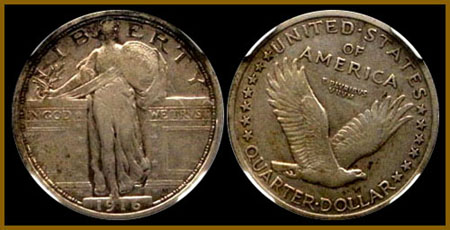
dollar. The obverse shows a full length Liberty looking to
her left with her right breast and shoulder exposed. She is
standing in the doorway of a half wall. In one hand she holds
an olive branch and the other a partially draped shield.
At the top of the wall are
the motto's words "In God" on the left and "We Trust" on the
right. The word "Liberty" is at the top of the coin surrounding
her head, and the date is below her feet. MacNeil's model
for Liberty was first said to be Dora Doscher, a silent film
actress who later used the stage name Doris Doree. However,
it was later found that Irene McDowell, a Broadway actress
whose husband disapproved of her modeling, had posed for MacNeil.
There is evidence that Liberty is actually a composite of
both of these women.
As soon as the coin was released,
the Society for the Suppression of Vice, led by Anthony Comstock,
saw that the drapery exposed Liberty's right breast, including
the details of the nipple on the sharpest struck coins. They
began to put pressure on the Secretary of the Treasury, William
McAdoo, to withdraw the issue. The Treasury refused to withdraw
the coins already in circulation, but the coin was redesigned
and reissued in 1917 with Liberty covered up. It is also likely
that because the coin exhibited the wrong symbolism at the
time of entry into World War I, it was redesigned. In the
Type II version, Liberty wears a coat of medieval chain mail
instead of being seminude.
A major design problem throughout
the series is Liberty's head. It is usually weakly struck
with few details. Full head or FH coins with full facial features
are rare and bring a substantial premium. They bring even
higher prices if full details are found on the knee, central
drapery, and shield including the rivets and central smaller
shield. A second problem is that the date is unprotected and
tended to rapid wear.The reverse of the coin shows an eagle
in flight. The design has been criticized because the eagle
is unrealistic. It was said to have the "head of a hawk, the
wings of an eagle, and the body of a dove." On the Type II
reverse, the eagle was raised and three of the stars were
placed below it. However, its physiology remained unchanged.