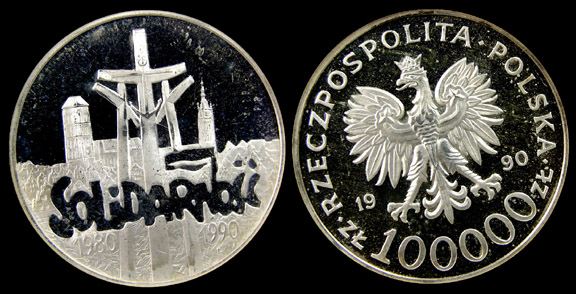
Poland 1990 Solidarity 100,000 Zloty
THE 10TH YEAR ANNIVERSARY OF "SOLIDARNOSC"
POLAND'S LABOR UNION Metal: CuNi Dia: 29.5mm Weight: 10.8g Face Value: 10,000zl
This coin was minted in 1990
27 years ago, in
August 1980, shipyard workers were fighting for dignity
and for the right to freedom. The protest of workers
against the communist system was the initiating event
which created the broad social movement unified within
the framework of the Independent Self-Governing Trade
Union NSZZ Solidarnoæ [solidarity] the movement
which had an impact on the reality and on the decay
of the era of cold war confrontation. Solidarnoæ
made it possible to dispel fear, raise heads, mobilize
millions and fill human hearts with hope. Be not afraid
appealed Pope John Paul II to us. We rose from our
knees and demanded our rights, and the then state
authorities understood that the people, organized
on their grass-roots initiative, turned against them.
And this was Solidarnoæ social activity unprecedented
for decades. It was ÒSolidarnoæ with
a capital , which attracted the attention of Europe
and the world. It was a symbol, an icon of history
in progress before our eyes.
27 years ago we were
fighting not only for better living conditions but
also for ideas, for more dignified life, for freedom
of speech, for civil society. Neither the martial
law nor brutal repressions managed to suppress our
spirit of hope and zest for fight. We were then shouting
ÒThere is no freedom without ÒSolidarnoæ"Ó.
And we won it through strikes and negotiations Ð
in a peaceful way. It was actually the Polish August
which played a pivotal role in putting an end to the
post-Yalta conference division in Europe and opened
the gates of freedom in the states oppressed by totalitarianism.
Solidarnoæ paved the way to the Round Table
talks in Poland, first free elections and first non-communist
government. This was the Polish way to democracy.
Solidarnoæ also contributed to the fall of the
Berlin Wall, i.e. the so-called Autumn of the Nations
of the year 1989, and to the disintegration of the
Soviet Union. The changes spread across all Central
and Eastern Europe which was then under communist
domination.
Even today there is
a need for the spirit of Solidarnoæ. There are
places where the spirit of freedom has not yet come
and places where it has been suppressed by the post-Soviet
dictatorship. We have always been close to those who
seek to regain their freedom. May Solidarnoæ
help those who fight for democracy, citizens liberties,
freedom of speech, raise their heads. This is indeed
the legacy of Solidarnoæ freedom. Lech Wa¸"sa
The origin of "Solidarnoæ"" [Solidarity]
traces back to the strike in the Lenin Shipyard in
GdaÄsk which broke out on 14 August 1980, i.a.
in defence of Anna Walentynowicz, dismissed for her
opposition activities.
On 16 August the strike
in the Shipyard developed into a solidarity protest
at a number of industrial plants in the GdaÄsk
region. The Strike Coordination Committee was formed,
with Lech Wa¸"sa as its leader. The Committee
set out 21 demands with independent trade unions the
highest priority. On 31 August the government committee
under a pressure of the wave of strikes spreading
throughout the country signed the first in the history
of the Peoples Republic of Poland accord with the
Strike Coordination Committee that represented the
plants striking in the GdaÄsk region. The agreement
provided the guarantee of establishing independent
trade unions.
The 16-month period
of legal operation of "Solidarnoæ""
was commenced. In November, after long- lasting hesitations
of the government, the Union was registered with the
Supreme Court, which was an unprecedented event in
the Communist countries. The 1st National Meeting
of Delegates of "Solidarnoæ"",
held in September-October 1981, approved the unionÕs
programme and democratically elected its authorities
Ð the National Committee and its chairperson,
Lech Wa¸"sa. From its very beginning, the
trade union adopted the form of a large social movement
that undermined the Communist ruling in Poland. It
is estimated that 10 million Poles joined "Solidarnoæ""
in 1980-81. The union did not question openly the
system prevailing in Poland. However, the emergence
of a public force that got out of the authorities
control was unacceptable in the long run for the ruling
Polish United Workers.
Party and the USSR
satellite countries. The following months in 1981
witnessed an aggravating conflict between the undemocratic
authorities and "Solidarnoæ"",
which declared freedom demands. The Polish revolution"
attracted attention of the whole world and with an
increasing power affected the international policies
of the world powers.
Arrangements for the
introduction of the martial law, undertaken as early
as in 1980, gained momentum under the Soviet pressure
in 1981. On 13 December 1981, within a few hours thousands
of startled "Solidarnoæ"" activists
were arrested, including most of its leaders. By the
end of 1982, ca. 10,000 people had passed through
the internment camps. Many workers throughout the
country went spontaneously on strike opposing the
martial law. On 16 December 1981 nine persons were
shot down in the WujekCoal Mine, where the militia
opened fire on the striking miners. People involved
in the "Solidarnoæ"" movement
before the martial law were now banned from work and
public life. In the next years those, who illegally
continued the opposition activities, were threatened
by confiscations, arrests, and hard penalties of imprisonment.
Many persons were forced to live in hiding. Seven
"Solidarnoæ"" leaders and four
members of the former Social Self-Defence Committee
KOR ( Komitet Obrony Robotnik).
The Workers Defence
Committee) were imprisoned until mid-1984. In spite
of the repressions, conspiracy structures of the union
began to revive throughout the country. Secret committees
maintained activities at industrial plants, and regional
underground management authorities were established
in larger "Solidarnoæ"" centres.
Warsaw, Wroc¸aw, GdaÄsk and Cracow were
the strongest centres of opposition. On 22 April 1982,
the Temporary Coordination Committee of "Solidarnoæ""
a conspiracy management of the union, in place of
the statutory authorities was established. The list
of its most prominent figures included the chairman
of the Mazovia regional conspiracy centre Zbigniew
Bujak, the leader in the Lower Silesia W¸adys¸aw
Frasyniuk and a representative of "Solidarnoæ""
in GdaÄsk Bogdan Lis.
In the years 1982-89,
in line with the programme of building underground
society announced by "Solidarnoæ"",
independent activity developed on a large scale. Countrywide
underground circulation of information comprised infinite
numbers of leaflets and badges, a few thousand book
and press titles published beyond censorship, conspiracy
radio stations. Every year on 1 and 3 May and 31 August
demonstrations were held to manifest support for "Solidarnoæ"",
then repressed by the authorities. These demonstrations,
organised in large cities and gathering thousands
of "Solidarnoæ"" supporters,
ended with violent clashes with the militia. The freedom
aspirations of "Solidarnoæ""
earned wide recognition in the whole democratic world.
The most spectacular proof of that recognition was
the Nobel Peace Prize awarded to Lech Wa¸"sa
in 1983.
The underground structures
in Poland also obtained significant aid from the West.
The union played a key role in the fall of communism
in Poland and in the whole region. In 1989, the Round
Table negotiations were held between the Communist
authorities and "Solidarnoæ"",
(6 February Ð 5 April 1989). The partly democratic
general elections held on 4 June 1989 under the agreements
concluded during the Round Table negotiations were
a turning point in the recent history of Poland. The
electoral victory of "Solidarnoæ""
precipitated the fall of the Polish United WorkersÕ
Party and led to the appointment of the first in the
region democratic government with the non-communist
Prime Minister Tadeusz Mazowiecki. The changes occurring
in Poland and parallelly in the USSR sparked off a
wave of anti- communist protests in other countries.
It was only two months
after the calling of the MazowieckiÕs government
into office that the Berlin Wall fell. The wall was
a guarded line of fortifications dividing the city
into the Western and Eastern parts, and a symbol of
the division of Germany and of Europe into two hostile
blocks. Also in November 1989 the Velvet Revolution
took place in Czechoslovakia, which within a few days
led to a peaceful change of rule in that country.
After over seven years
of clandestine activities, on 17 April 1989 the Provincial
Court in Warsaw registered the "Solidarnoæ""
Trade Union once more. The fall of Communism in Poland,
confirmed with the election of the "Solidarnoæ""
leader Lech Wa¸"sa for the President of
Poland, closed a period in the history of the union.
However, the ideas of the first "Solidarnoæ""
are still deemed some of the most important foundations
of the Third Republic of Poland. The original wooden
boards, where the demands of the striking workers
were written down in 1980, were included in the UNESCO
Memory of the World Register on 16 October 2003.