Home
Newsletter
About Us
Coins For Sale
Selling Your Coins
Coin Collecting
Investing in Coins
Coin Information
Coin Articles
/World Coins
Books, Loupes etc.
Link to Us
Links
Contact Us
   
  Search 
  Sign up for our free NewsLetter
  e-mail: 
  Sign Up 


1796 QUARTER EAGLE
No Stars on Obverse
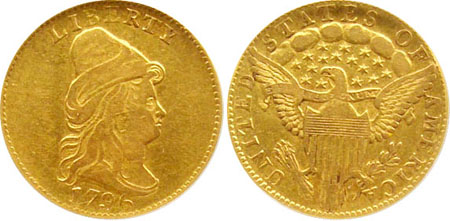
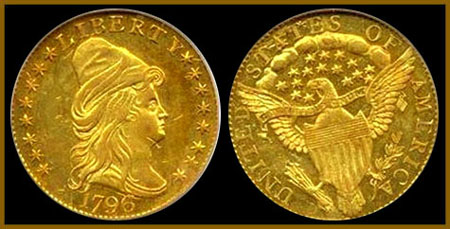
This coin has three distinctions: It is the first precious-metal coin without stars issued for circulation by the USA prior to 1836; it is the first ever to show the heraldic eagle, which would become standard on all silver and gold denominations 1798-1807; it is the earliest made showing 16 reverse stars honoring Tennessee's admission. The dies show evidence of careless haste, suggesting time pressure. Though documentation is lacking, quarter eagles may have been included in presentation sets commemorating the admission, June 1, 1796. Prooflike presentation coins of this date are known of all other denominations above the sent except the half eagle.
Dies are by Robert Scot (possibly with John Smith Gardener's help, as Hilt {1980} believes). The obverse copies the 1795 half eagle, reverse the Great Seal of the United States (1782; compare the version on the back of the current $1 bill). We do not know the obveres's ultimate prototype; conjecturally, it was adapted from some Roman copy of a Hellenistic goddess, her hair altered, a big soft cap added. This was long mistaken for the pilleus, alias Phrygian cap or liberty cap. The latter was a close-fitting felt cap, ceremonially placed on slave's heads when they gained their freedom (partly to conceal the short haircuts which instantly identified slaves); it was also worn by freemen after release from the status of prisoners of war (for similar reasons, slaves were originally prisoners of war and their progeny), and by victorious gladiators whose prizes included release from the arena. The liberty cap had the shape of a half eggshell, symbolizing its wearer as a chick emerged from captivity.
However, Mint Director Moore identified the cap on the gold coins as a high-fashion headdress of the 1790s. Its nearest familiar relative is the mobcap in some portraits of Martha Washington.
On the other hand, all Scot's versions of the heraldic eagle (no less than 10 different device punches) share what is either a heraldic blunder or a piece of stupid saber-rattling bravado: The warlike arrows are in eagle's dexter or more honorable claw (observer's 1.), whereas the olive branch of peace is relegated to his sinister or less honorable claw: heraldically committing this country to a martial posture in excess of even modern hawk's demands. The eagle-and-clouds punch used in 1796-1797 has 16 stripes to shield, representing red by eight solid bars (raised on coin), rather than vertically shaded as later.
Presentation pieces aside, the first batches for circulation come from one obverse and two reverses dies. Pursuant to Warrants 75 and 77, the [66] of September 22 and the [897] of December went to the Bank of the United States. Hilt says the first batch are his var. 2-A (four known); arrows extend well beyond N, first S and F very close to wings, indentations between clouds are directly below upright of T(A) and "1." curve of O; always with vertical crack from rim through E(S) down through head, shield, and tail.
Discovered by Harry Bass. The others (Hilt 2-B) have lump at wingtip almost touching F, and the cloud indentations are "1." of upright of T(A) and well to "r." of center of O; obverse develops a crack from rim at 9:00. Presentation pieces are thought to have this latter reverse, uncracked obverse. Survivors (usually F to EF) are usually unevenly struck; hair near ear, near temple, and at lower part of cap: eagle's neck, breast feathers, and lower part of shield. Border dentils are often weak or incomplete, most of all at lower "1." and lower "r." obverse. Later impressions are often weak at E(RTY), possibly a problem with die alignment as this letter is directly opposite another relief area - eagle's tail. Real UNCs. are prohibitively rare.

Designer, Engraver, Robert Scot. Mint, Philadelphia. Composition, gold 11/12, rest copper with traces of silver. Weight standard, 67.5 grs. = 4.37 gms. Diameter, about 13/16" = 20.6 mm. Edge, vertically reeded. Authorizing act, April 2, 1792. Grade range, VERY GOOD to UNC.

FINE: Partial detail to eye, nose, mouth, wing feathers, horizontal shield lines; only outlines of drapery and outermost curls; motto complete but weak.
VERY FINE: Partial folds of cap and drapery; all major outlines of locks show; partial detail to leaves and tail feathers.
EXTREMELY FINE: Isolated tiny rubbed spots only; generally traces of prooflike surface.
UNCIRCULATED: No trace of wear.
1796 [963] VERY RARE.
2 reverses vars. Real presentation strikings have brilliant prooflike surfaces and are better struck than that ill.
1796 QUARTER EAGLE COINS
With Stars on Obverse
During this whole decade, quarter eagles were coined only in isolated driblets of a few hundred or at most a few thousand pieces. In most of these years, each date represented a new design modification creating instant rarities and type coins.
The problem is less why the coins are rare, why so few were made to begin with, but why any were struck at all! To judge from available Archives records, they were ordered on whim by a few local banks (principally the Bank of Pennsylvania and the Bank of the United States); to judge from the condition of survivors, they spent most of their time in vaults. Between 1803 and 1833, the Mint's major output consisted of cents, half dollars, and half eagles; all other denominations had a kind of poor relative status-seldom called for, few made, little welcome.
Design modifications in this group have mostly to do with number and arrangement of stars in obverse field and above eagle. To understand the sequence, recall that on coins intended for general circulation from 1783 - 1792 the number of stars was normally 13 for the Original 13 United Colonies: The "New Constellation" echoing the flag of 1777, later echoing the Great Seal of 1782. Vermont's copper coins at first used a circle of 14 stars with STELLA QUARTA DECIMA, "The Fourteenth Star," for local desire to join the Union, which became a reality in 1791. Kentucky became the fifteenth state in 1792, and Peter Getz's pattern half dollars continued the concept by showing 15 stars above eagle.
Silver coins in 1794 and gold coins in 1795 followed suit save that the 15 stars were in obverse field. But on Tennessee's admission to the Union, June 1, 1796, Mint Director Elias Boudinot became aware that no law prevented other territories from subsequent admission as new states; which meant that the number of stars on coins had to be frozen, rather than increasing indefinitely. At some unrecorded date in 1797, Boudinot therefore ordered Scot to limit the number of stars on new dies to the original 13; but he left their arrangement to Scot's taste, or lack of it.
The final batch of quarter eagles of 1796 [432], coined at the end of December but delivered January 14, 1797, showed 16 stars, divided 8 + 8. This is, of course, not an alteration of the old No Stars die, which had broken; E R T Y are spaced much farther apart. Reverse shows 16 stars, but differs from either die found which the No Stars obverse or from the 1797. Possibly five prooflike the presentation strikings survive; Probably fewer than 30 business strikes survive. Hilt thinks the [98] delivered February 18, 1797, per Warrant 82, were from these dies, making [530] in all; this is impossible to prove. Most survivors are VF to EF; mint-state ones show some prooflike surface but lack the exceptional detail sharpness of the presentation coins.
Quarter Eagles of 1797 have obverse stars 7 + 6, reflecting Boudinot's order; obverse always shows a heavy crack from Y through field to last star. Reverse must have been made in 1796, as it shows 16 stars randomly scattered above head. Hilt thinks the [585] between 3/14/1797 and 1/11/1798 bore this this date (Warrants 83, 93, and 102). Possibly 20 survive, mostly VF; prohibitively rare in mint state, and the numerous auction records for coins called AU represent possibly four specimens playing Musical Chairs, with another two or three optimistically graded. Those of 1798 have a new reverse device punch: 13 stripes on shield, six vertically shaded for gules (heraldic red), seven blank for argent (heraldic silver or white). Both vars, have the reverse "arc" arrangement discussed under dismes and dollars a row of six stars just below clouds, a row of five below that, plus one each at beak and behind head.
In the 1950s, possibly seven or eight examples from the dies with close date and four berries continually showed up at auctions and in dealer's cases at major conventions. Four are UNC., including "Melish": 1102 with the "fatal" obverse break; a fifth (ex Leo A. Young, 1959 ANA: 956,Bell II:78) is a prooflike presentation piece. Repeated sightings of these same few coins gave the date briefly a reputation for being over-rated in rarity, and this vars was believed the commoner of the two. In recent years these coins have all mysteriously vanished; we have been unable to locate a usable photograph! The other var., with wider date and five berries, was originally believed of the highest rarity, as for many years only four were known, and only one of these (ill.) qualified as UNC.

Since about 1968, others have shown up in lower grades; today, when a 1798 is offered at auction, it is likely to be one of the eight to 10 with five berries, of which three or four qualify as UNC. The delivery of [480], 12/28/1799, was long believed to comprise the Five Berries coins; none with date 1799 has ever been rumored. Beginning in 1802, obverse show stars 8 + 5 , copying the half eagles of 1798 - 1806. The single 1802 obverse is generally called an overdate, 1802/1, a perception possibly influenced by the 1802/1 half-eagle dies. Any trace of 1 within 2 on the quarter eagles requires a microscope. This obverse comes with four reverse dies, two of them also used on dimes; the rarest has leaf wholly free of I, the two least rare respectively with first star (farthest "1.", below first cloud) obviously double-punched, or with A away from wing. Most survivors are VF to EF.
Because annual Director's Reports showed a delivery of 423 quarter eagles for 1803, for long this date was believed to exist as a rarity, though nobody ever managed to find a specimen. Adams-Woodin {1913} managed to compound the confusion by listing alleged copper trial pieces from regular dies of this date, and specifying that these should not be confused with the brass British gambling counters of vaguely similar design with KETTLE "r." of date. The Kettle counters come also very rarely in silver; and some brass specimens have had the name scraped away, possibly to simulate gold coins or trial pieces. But the workmanship is so different from Scot's that no collector who has seen a Kettle counter side by side with a quarter eagle of this design is likely to mistake either for the other. The 1803 delivery is now acknowledge to comprise coins dated 1802.
Two reverse types exist for 1804; The rarer one shows 13 reverse stars in the "arc" arrangement (above), the less rare 14 reverse stars in the old (1798) "cross" arrangement (intersecting straight lines forming diamond-shaped patterns). This latter die was also used on dimes of 1804; it is believed a leftover from 1798 - 1799 when the cross arrangement occurred on dismes, dollars, and half eagles. Possibly nine survive with 13 stars, none above EF; three times as many with 14 stars, in all grades. The single var. of 1805 has stars 7 + 6; this obverse die was softened at year's end and a 6 punched over the 5, as with one each of the Quarter Eagle obverse of this date an emergency measure not again repeated, as the redated dies did not hold up long. Other overdates are normally from dies not earlier used and probably not given initial hardening with their earlier dates; reuse of 1805 dies after overdating testifies to Scot's running out of die steel. Survivors are mostly VF or EF with a few AU's and "sliders," uncandidly upgraded; prohibitively rare in mint state. However, the 1806/4 is from an unsused 1804 die (stars 8 + 5), Most survivors of this design are dated 1807, with stars again 7 + 6; most are better struck than their elders, survivors better presserved.
1796 (Stars 7 + 6. [427] Very rare


<< BACK


US Rare Coin Investments © 2003 - 2012 U.S. Rare Coin Investments
TERMS  |  LEGAL  |  SITE MAP
 

Have a question? Contact us here

Have a friend who might be interested?
Inform them about us now!
Your E-mail: Your Name: Friend's E-mail: Friend's Name:
Send to a Friend