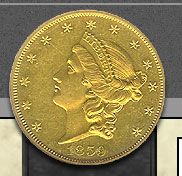
1798
Half Eagle - The final date of the small eagle variety of five
dollar gold pieces, or half eagles, is dated 1798. It is among
the rarest of the early American gold coins, with an estimated
mintage of 300 to 600 pieces. Of these, just seven or eight pieces
are known in all grades, many of which have been known to the
numismatic community for decades. Except for a single piece which
came to light in 1996 (and which might have been included in previous
listings of known specimens) there have been no new discoveries
of this issue in the last 35 years. Since the mid 1800s, unlike
many now rare American coins, it has been considered to be an
extremely rare issue. On average this issue is offered at public
auction just once every decade.
All known specimens were struck from a single
die pair. The reverse die was previously (probably around the
same time) used to strike a single variety dated 1795, and it
(1798 Half Eagle) appears to have been made in late 1796 or early
1797. Soon after it (1798 Half Eagle) was first used for striking
1798 small eagles it broke, and that appears to be the reason
for the rarity of this issue. This die could very well have been
the very last small eagle reverse die which was made and remained
in production, as the Mint switched to the large eagle design
in mid 1797. Because of economical reasons the old dies remained
in use, and were mated with random obverse dies to created famous
and enigmatic issues like the 1798 small eagle five dollar gold
piece. Another factor which might have played a role in the creation
of this issue was the yellow fever epidemic which broke out in
Philadelphia and at the Mint in 1797. Coinage was temporarily
halted; and when it was resumed it might have been the case that
not enough working dies of the correct type were at hand.
Walter Breen, in his Encyclopedia, suggested that
the mintage of this issue was 691 pieces, delivered on January
4, 1798. Another possibility is that it was included in the delivery
of February 28, 1798. Both situations appear to be unlikely given
the number of known specimens compared to the usual survival rate
of early American gold coins. It could very well be part of either
of the two deliveries listed above, but to say that is certain
would be incorrect. No listings of what the deliveries exactly
included have ever been found in the Mint archives, and as such
all this are just assumptions. The early workers did not care
much for quality, so if dies were useable they were used, despite
cracks in the dies or other problems. When it broke, however,
it was damaged beyond repair and a new die was set in the coining
press. Because of these circumstances, modern numismatists now
have a large number of different varieties and die combinations
to study and to reconstruct the sequence of emissions of early
American coinage. These studies were extensively studied by several
researchers, with the most recent work on the subject published
by Bass-Dannreuther, titled “Early U.S. Gold Coin Varieties”.
When Edgar H. Adams studied this issue extensively
during the first years of the 20th century he could only locate
two examples. More have been discovered in the years afterwards,
and this issue now has seven or eight specimens known to exist
in all grades. The last of these sold in 2000 at auction for the
staggering amount of $264,500, it reportedly was discovered in
1996 and graded by PCGS as EF-40. The finest known is the Ex:
Mehl; Green; Farouk; coin, which grades AU-55. Of the number of
pieces known to exist there are three coins which are unavailable
to collectors, with two of them in the Smithsonian institution
and a third in the Harry W. Bass Research Foundation Collection.
This leaves the total number of available coins at just a handful,
and these are seldom available. As such, this is a first-class
rarity of the early Philadelphia Mint, which is always destined
for the finest sets.
We at
U.S. Rare Coin Investments highly recommend these coins for investments
portfolios. Whether a single coin or the long term acquisition
of them with the goal of building a set in terms of historical
importances as well as longterm profit potential, cannot be overstated
in our opinion.