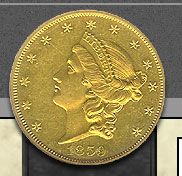
The
1799
Half Eagle is a rare issue with an unknown mintage. Unlike
other issues from this era estimates of the mintage range
widely. Some sources, like the Red Book quote the number struck
as 7,541; and that his also the number Breen mentioned in
his Encyclopedia, although he also mentioned that more might
have been struck. Other sources enlarge the number struck
by claiming that coins with this date were struck well into
1801 and perhaps even in early 1802. This later striking does
not seem unlikely at all, given the circumstances at the early
Philadelphia Mint. One obverse die is also known to have paired
on at least two different occasions with a reverse die which
was also used for coinage of 1800 half eagles. Part of that
variety was struck before the 1799 dated obverse die entered
production once more. Because of this out of sequence use
and the number of pieces known, most modern sources have quoted
the total number of pieces struck between 9,000 and 15,000,
with the correct number probably somewhere in the middle.
Of these, most sources mention an estimated 185 to 250 pieces
that are known to exist today for all varieties combined.
Other sources mention numbers as high as 300 to 400, but estimate
appears to be an extremely high based on the number of auction
appearances. According to our research, approximately 200
pieces in all grades could very well be the correct number
for this date.
Nine different varieties are
known for this date, ranging in rarity from R-5 (forty to
fifty known) to R-7+ (six to eight known) in all grades. Four
different obverse dies were used for coinage, combined with
nine different reverse dies. One of the obverse dies, the
variety now identified as BD-4, was mentioned in older literature
to be a 1799/8 overdate. Modern research, however, has suggested
that it appears to be a minor repunched last nine, perhaps
with a different punch. This question remains a point of discussion
when more people study this particular variety. The nine varieties
can be divided into two separate groups, based on the size
of the reverse stars above the head of the eagle. Seven varieties
have small reverse stars, which is the more frequently encountered
variety. Two more were struck with large reverse stars, which
appear much less frequently. For some varieties it is difficult
to place them in one of the two groups, and other characteristics
are noted for identifying the reverse variety.
The reverse dies of the half
eagles of 1795 to 1807 are believed to have been engraved
by two persons. The first was John Smith Gardner, who is known
to have engraved the first reverse dies used for coinage.
Later varieties are believed to have been the work of Chief
Engraver Robert Scot, who is had much more influence in the
early United States Mint. His reverse style is believed to
have been used from 1799 onwards. There are many differences
between the two engravers, mostly apparent in the eagle’s
neck and the arrangement of the stars. Other differences are
found in the number of vertical lines in the shield and the
presence or absence of a tongue in the beak of the eagle.
The arrangement of the reverse
stars has been well-documented in modern literature on the
subject. Gardner used a so-called cross pattern to arrange
the stars, while Scot placed them in an arc pattern. When
viewed side to side, the difference is obvious, but on individual
varieties they are sometimes hard to identify as a given star
arrangement. Scot’s arc pattern was used on the majority
of known reverse dies from 1799 and onwards, while Gardner
is believed to have only engraved three of the 1799 half eagle
reverse dies. The differences are usually not noted except
by specialists. They do, however, give insight into the working
process of the late 18th century Philadelphia Mint and should
therefore be considered valuable information for researchers.
As for the quality of the
pieces which appear at auction this coin is similar to other
half eagles of this type and era. Uncirculated examples are
rare, especially in grades MS-63 and higher. Many pieces are
damaged, were mounted into jewelry or carelessly handled over
time, and finding a lightly circulated example with no problems
appears to be difficult. The centers of most varieties are
often weakly struck, although it is possible to find a sharply
struck representative of this date with intensive searching.
Specifications:
Weight: 8.75 grams
Composition: .9167 gold, .0833 silver and copper
Diameter: approximately 25 millimeters
Edge: reeded