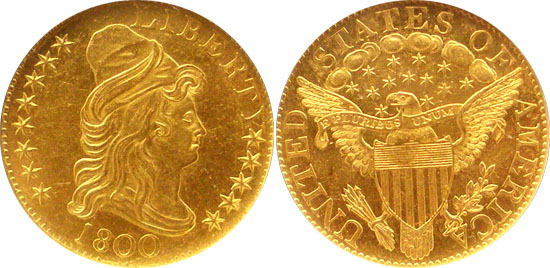
1800
Half Eagle - The 1800 half eagle is considered by many to have excellent
investment potential. As many gold issues from the same era, its
exact mintage is unknown. In their U.S. Gold Coin Varieties reference
on the subject Bass-Dannreuther estimate the total mintage to have
been between 15,000 and 30,000. Breen, in his Encyclopedia mentioned
a number of 37,628, and perhaps more. These include 26,006 half
eagles struck in 1801 but obviously dated one or more of the previous
year, as no half eagles dated 1801 are known to exist. Most sources
quote these pieces to have been dated 1800 but it would also be
possible that the various deliveries included further backdated
issues. With an estimated number of survivors ranging between 600
and 700 in all grades, the number of 30,000 might be very close
to the truth, although it seems generous at first for an early gold
issue. Because of the number of pieces available to collectors in
modern times this coin has also been considered to be a perfect
type coin in a set of American (gold) coinage.
Five different die pairs are known to have struck
1800 dated half eagles, roughly divided into two groups. The first,
used on a single variety with perhaps no more than five pieces known
in all grades, shows a pointed 1 in the date. The other, more available
variety called Blunt-1 is much more available and all other 1800
half eagles were struck using this obverse die. The pointed 1 variety
(BD-1, R-7) is further identified by the use of a reverse die which
is known to have struck 1799 half eagles. The use of the same die
in multiple years further indicates the complexity of determining
true mintages of a certain issue. The early American Mint did not
care much for what they produced, as long as it just produced gold
coins. Because of this we now have a wide variety of early American
gold coins, including issues which probably should not have existed
at all if the Mint would have noticed design changes more carefully!
One of the more available blunt 1 varieties, identified
as BD-4, appears to be the most interesting. It is one of the more
available die varieties for this year with an R-4 rarity rating
and an estimated 125 to 175 pieces known in all grades. Breen thought
that the M in AMERICA on the reverse was a small over large M, and
that conclusion remains to be popular in auction catalogues. However,
further research has indicated that it more likely is a repunched
M, using the same punch for both impressions. Bass-Dannreuther mentions
that there might have been a remarriage of the reverse die, most
likely after it struck a number of BD-5 coins. While not confirmed
this would not be unlikely and such a piece would be identified
by a terminal state of the obverse die as some BD-5 coins are known
in that state. It would also shed further light on the emission
sequences of this issue, a study which remains ongoing as more examples
of certain varieties are discovered and studied.
As previously mentioned this is an excellent issue
for inclusion in a type set or a variable portfolio of gold coins
as an invest.