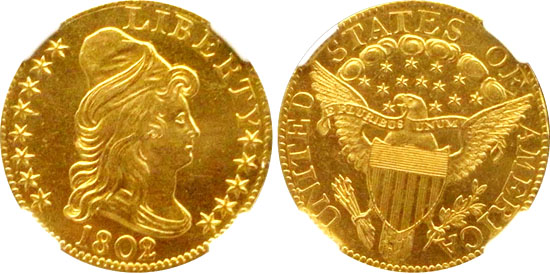
1802/1 Half Eagle -
The United States Mint located in Philadelphia shows in their
records that a total of 26,006 five dollar gold pieces, or
half eagles, were struck during the calendar year of 1801.
However, after more then two centuries not a single example
of that date is known to exist, and collectors have rarely
considered the possibility of the existence of an 1801 half
eagle. It is commonly accepted and most likely true that all
half eagles struck in 1801 were backdated, perhaps as far
back as 1799 or even 1798, as suggested by some numismatists
and researchers. This was common practice at the early United
States Mint, as dies were often illogically paired when they
were still useable, one of many methods of keeping the costs
low and in control. In an early nation as the United States
the economy was still developing, especially so in the agricultural
society of the late 18th century, and money was scarce. As
a result, we now have a large number of different issues which
might have not existed at all, or in the case of the 1801
half eagles, should have existed but do not.
In spite of the above, at least two half eagle obverse dies
dated 1801 were made. These remained unused, and both would
be overdated to 1802/1 dies. These dies are differentiated
by either a centered overdate or a high overdate. A total
of eight different die pairings were used, with the centered
overdate striking five of the varieties while the high overdate
was only used on three. According to research published by
Bass-Dannreuther the centered overdate was used first, and
it failed while producing BD-5, a very rare variety with perhaps
ten pieces known at most. Prior to that point all reverse
dies had failed first, and for some reason this appears to
have been the case with most early American gold coinage.
The reverse die used on BD-5 would continue to strike half
eagles while paired with the high overdated obverse die. Two
more reverse dies were used for coinage, and an estimated
53,176 half eagles are said to have been struck from all die
pairings. Most references on the subject have noted that the
number produced might have been higher, but from the number
of pieces known to exist it appears to be correct.
None of the eight die pairings can be considered to be common,
but some are more available than others. Three of the centered
overdate varieties have less than 10 pieces known to exist
in all grades, including pieces permanently impounded in museum
collections. The two other varieties are more available, with
an estimated 75 to 100 known in all grades. The most common
variety of this date is the final coin, BD-8 which has an
estimated 150 to 200 pieces known to exist in all grades,
and as can be guessed it is also the variety which is usually
available. It must be noted that the other available variety,
BD-7, is known to have struck while mintage of 1803 half eagles
was already ongoing. Apparently, the obverse die had cracked
while striking coins and was being lapped by the Mint employees.
While in that process the reverse die continued to strike
coins, but was not paired with an 1803 overdated die. As the
1802/1 obverse die was lapped sufficiently it re-entered production,
using the same reverse die. After the obverse die was finally
retired the reverse die was again paired with the 1803 obverse
die until it was retired as well. This is another indication
of all the efforts the Mint put in their cost-cutting while
producing coins.
As many other American gold coins of this era this date is
generally available, but could not be called common at all.
Unlike later dates many were not melted in the 1830s, but
others had already been exported and had been melted overseas.
Pieces that did survive have often been cleaned and show damage,
and are usually avoided by specialized collectors and investors.
Most of the pieces that survive with no problems are in lower
About Uncirculated condition, indicating that they did circulate
for some time until put away for a long period. Uncirculated
examples are rare, but are sometimes available in the lower
mint state grades, and occasionally at auction in near-gem
quality. Any opportunity to buy such a coin should be considered
with great care, as chances are slim that such pieces would
appear on the market with any frequency. It must be noted
that the population reports of the major grading companies
show an unusual large number of MS-64 coins. From our research
of auction appearance it appears that more than half of those
numbers are resubmissions, and that perhaps no more than seven
or eight MS-64 1802/1 half eagles exist. Three pieces have
been graded higher, and they are among the grandest of all
early 19th century American gold coinage.
U.S. Rare Coin Investments
has bought and sold many early gold coins like these and are
always interested in purchasing these coins. Please contact
us if you are interested in buying or selling early gold coins
or any other rare coin.