1821
Quarter Eagle - After a hiatus of 13 years, quarter
eagle production resumed. The 1821
Quarter Eagle issue was redesigned with a Capped
Head of Liberty replacing the Capped Bust design. The coin
was designed by Robert Scot because John Reich had left the
job of assistant engraver in 1817. He had received no raise
or promotion in the time he worked at the Mint. Scot, whose
eyesight was failing, is credited with making the major punches,
Liberty’s head and the eagle. It’s possible that
a contract engraver or another assistant added the other design
elements.
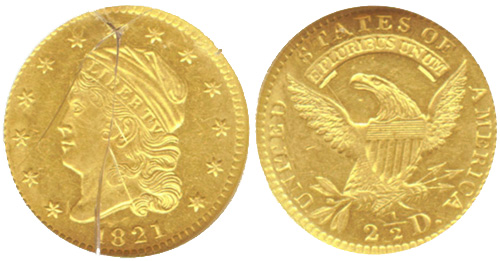
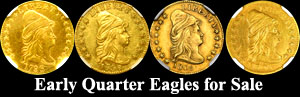
The coin shows a capped head
of Liberty facing left. She is encircled with thirteen six-pointed
stars; the date is below the truncation. LIBERTY is inscribed
on the headband of her Phrygian cap. Her hair falls beneath
her cap in luxurious curls. The reverse is similar to Reich’s
design with a heraldic eagle facing left. Its mouth is opened
and its wings are outstretched. However, its feathers are
more even and less ragged than on the previous type. A banner
above its head bears the motto E PLUIBUS UNUM. In its claws
it holds the arrows and olive branch, symbols of preparedness
and peace. Below the eagle is the denomination written 2 ½
D. The whole is surrounded by the inscription UNITED STATES
OF AMERICA interrupted by the wing tips. Dentils are at the
periphery of both sides and the edge is reeded.
With a mintage of 6,448, highest
for the series, the 1821
quarter eagle would be rare under any circumstances
today; however, many pre-1834 gold coins were melted for bullion.
The 1834 Coinage Act provided that the value of gold was reduced
in its relation to silver. The net effect was that coins minted
prior to 1834 were worth a premium when converted to bullion,
and it happened by the thousands.
Only one die pair was used
to make the 1821
quarter eagle issue. It has small stars in a nearly complete
circle around Liberty’s head. The "1s" in
the date are both centered over dentils. The reverse has large
letters. The fraction is distant with the numerator and denominator
away from the fraction bar. The D of the denomination is large.
In total only 40 to 60 pieces
are known in all conditions today. The coin has an R5 rarity
rating. PCGS has certified 18 in all grades with 11 in Mint
State and NGC has certified 20, 8 in Mint State. These numbers
do not account for crossovers or resubmissions.
Specifications:
Weight: 4.37 grams
Composition: .9167 gold, .0833 silver and copper
Diameter: approximately 20 millimeters
Edge: reeded