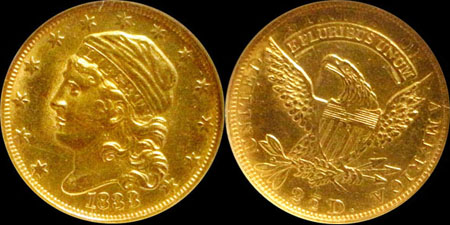
1833 Quarter Eagle. After Robert Scot died in 1823, the Mint hired William Kneass, a local engraver of bank-note plates, as his successor. Kneass's special assigment was not to create new designs but to improve existing designs of all series in his spare time, by mechanically multiplying working dies from current device punches. This project yielded modified designs for dismes in 1828, followed in 1829 by similar improved versions of half dismes, quarter eagles and half eagles, and in 1831 by their counterparts in half cents and quarter dollars. Cents and half dollars would not be attempted for several years; there was still too much demand for coinage in these denominations to afford time to create new device punches.
Kneas's modified designs were notable for smaller stars and letters (from punches by Christian Gobrecht), redrawn heads and eagles (with a more professionally finished look than Scot's frequently crude conceptions), but most of all for beaded borders surrounded by high, plain raised rims produced by a "close collar." This new invention consisted of a heavy block of steel containing a hole the same diameter as the finished coin, grooved to impart the reeded edge; this resisted edgewise expansion of planchets at the moment of striking, furnishing "a mathematical equality to their diameters," according to Mint Director Samuel Moore.
Mintages remained of roughly the same quantities as before; survivors are slightly rarer, and occur in about the same grade range, with perhaps a few more UNCs. Die life was potentially much longer; a single reverse of 1830 stayed in use for proofs and business strikes through 1834 but there was too little bank demand for quarter eagles in any one year to exhaust the effective life of any one obverse die, so that for each year there is only one var.
Proofs exist for each year in this group, but most survivors are impaired; probably most were spent during the 1837 - 1844 "Hard Times" period.
The most famous of these years, and one of the illustrious of all American gold rarities, is 1834 with motto. Most of the coined before May 30 remained in the Mint, to be melted after August 01, when the new law became effective, reducing standard weight enough to render each old-tenor quarter eagle worth.... Several survivors originated as proofs, and not impossibly all did; no mint-state business strike is known, and all the best ones have proof surface. Mint Director J. R. Snowden (1860) could find no record that any business strikes of 1834 old-tenor were released. The roster is as nearly complete as possible, though quality of illustrations in some auction catalogs precludes postitive identification.
1833 Quarter Eagle [4,160 + ?P] Rare.
Rarer in all grades than 1829 - 1832; Much rarer UNC.