Shortly after Col. James Ross Wnowden became Mint Director in 1853, he decided that our national coinage needed refurbishing. One of his prime targets was the gold dollar, which was proportionately smaller and thicker for its weight than he felt it should be. At Snowden's request, Longacre made the original dies of the $3 piece broader than originally planned to minimize any chance that the new coins could be mistaken for either quarter eagles or half eagles. The result was technically satisfactory enough that Snowden then requested Longacre to follow the same proportions in redesigning the gold dollars. This meant increasing the diameters from 1/2" = 12.7 mm (the 1849 - 1854 standard) to 9/16" = 14.3 mm.
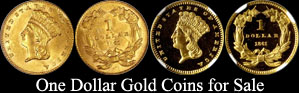
Obverse was an inexact copy of the $3 head: "narrow Indian Princess head," in higher relief than usual (a blunder), statutory inscription replacing stars. Actually, this head did not represent any Native American; it was another of Longacre's numerous copies of the Venus Accrouple, or "Crouching Venus," a Roman marble in one of the Philadelphia museums. Longacre used this head in over a dozen different contexts, altering headdress according to fancy. It first appears on the gold dollar and double eagle of 1849, then on the $3, later on the "Indian Head" cent, still later on the 1865 nickel 3c and a variety of pattern 5c coins, finally on the pattern eagles of 1868 only a few months before Longacre's death.
For reverse, Longacre copied the device originally chosen for the $3 coin but more familiar on the Flying Eagle cents: a wreath of corn, cotton, maple, and possibly tobacco leaves enclosing value and date. Dies were completely hubbed except for dates and mintmarks, which had to be entered by hand as usual. Treasury Secretary Guthrie approved the design on Aug 18, and coinage began the next day. Issues were brief and limited: 1854 - 1855 Philadelphia, 1855 from three Southern branch mints, 1856 San Francisco after the device had been condemned. The 1856 S dies were shipped west in 1855 before Snowden's decision to redesign the obverse. In all, only 1,704,985 were issued for circulation: about 1/7 the mintage of small size dollars.
The coins unsatisfactory from the beginning. Longacre had miscalculated, overestimating the power of coining presses then in use.
This error most of all affected the C- and D-Mint issues: These branches were using presses installed in 1838, some of them much older even then. Inevitably, few "Type II" gold dollars were well enough struck to bring out full central details; most are weak on central hair, with 8 and LL (and sometimes the whole date) blurry or illegible. (This could not have been anticipated from the five Philadelphia proofs.) Even Longacre's L initial on truncation is hard to see and often unnoticed.
Most of the limited mintages wore down quickly to illegibility, and went back to Philadelphia for recoinage. Survivors (many of these alos weak or in low grades) number fewer than 16,000 from all mints: a survival rate of about 0.9%. Many also show traces of solder. High grade specimens stimulate vigorous type collector demand a pressure which did not diminish even after discovery of a hoard of UNC. 1885's.
Designer, Engraver, James Barton Longacre. Mints, Philadelphia (no mintmark), Charlotte (mintmark C), Dahlonega (D), New Orleans (O), San Francisco (S). Mintmark below knot. Physical Specifications, Authorizing Acts, as before, except Diameter now 9/16" = 14.3 mm.
Grade range, POOR to UNC. Not collected in low grades.
FINE: Earlobe clear; TY barely legible, LIBER clear; partial hair and feather details; bow knot, leaves, and cotton bolls completely outlined but mostly without internal details.
VERY FINE: LIBERTY complete; some hair details above forehead and around neck; partial internal details in knot, leaves, and bolls.
EXTREMELY FINE: Isolated tiny rubbed spots at feather tips, forelock, hair above and below ear, check, leaf tips, knot, corn husks, and cotton bolls; partial mint luster.
NOTE: Beware coins with any trace of solder. EXCEPTIONS: Many have weak central hair and dates, most of all 1855 C, D; grade by surface.
1856 S [ all kinds 24,600 ] Upright 5, small "s". Normal s.
6 pairs of dies shipped, March 1856 (probably made late 1855). 2 minor vars.: Date normal or weak, latter from a lapped die which cracks up. Bareford: 32, UNC.,
1856 S Double "s".
RPM 1. Price only for early die state (ill.) with nearly half of extra S plain. Later shattered die states with most of extra S gone will price as preceding. Discovered by this writer, 1959; discovery coin, NN 54:944.