The Silver Dollar or unit
was first authorized in 1792, but the first issues did not
appear until 1794. From then until 1804, all Silver
Dollars had the edge lettering ONE DOLLAR OR UNIT. Early
Silver Dollar coins had several designs including the Flowing
Hair Silver Dollar, issued from 1794 to 1795, the Draped Bust
Silver Dollars, from 1795 to 1804, the Gobrecht Silver Dollars,
from 1836 to 1839, the Liberty Seated Silver Dollars, from
1840 to 1873, and the Trade Silver Dollars, from 1873 to 1885.
Following these Early Silver Dollar Coins, the popular Morgan
Silver Dollars were produced. The Morgan Silver Dollar was
made from 1878 to 1921. It is the most popular Collectible
Silver Dollar from among these groups. For the average collector,
the Early Silver Dollars are too scarce to collect; however,
up until the mid twentieth century, Morgan Silver Dollars
were available from banks at face value. Obviously Early Silver
Dollar coins were not, but many are available today for type
collectors, specialists, and investors. While many Early Silver
Dollars are rare, many Morgan Silver Dollars are not. There
are a few rare dates in the Morgan Silver Dollar series, but
most are attainable. Even most key dates are available in
circulated condition.
The Flowing Hair Silver
Dollar shows a head of Liberty
facing right with her hair flowing down her neck. Above her
head is LIBERTY with the date below. Seven stars are on each
side of the coin between LIBERTY and the date. The reverse
shows a skinny eagle perched on a wreath that is tied with
a bow and surrounded by the legend UNITED STATES OF AMERICA.
The Draped Bust Silver
Dollar shows a draped bust of Liberty with her hair
tied with a ribbon. The word LIBERTY is above and the date
is below. Various combinations of stars were to the left and
right of Liberty including 10 left and 6 right, 9 left and
7 right, 15 stars and 13 stars on the obverse. For the first
three years of the Draped Bust dollar, the small eagle reverse
similar to the prior design was used; however, from 1798 to
1804 a modified heraldic eagle was used for the reverse. It
had mixed up heraldry with the arrows and olive branch in
the wrong talons.
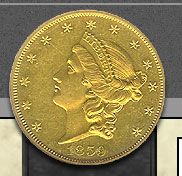
The Gobrecht Silver
Dollar coins, which show a seated figure of Liberty
holding a shield and liberty cap obverse and his magnificent
eagle in flight reverse, are a mixture of circulation issues,
patterns, restrikes, and mules, which had mismatched edge
devices and designs. The mules and restrikes are usually seen
in mint condition. Some were oriented as medals and others
had coin alignment. In 1837 the standard weight for the dollar
was reduced from 26.96 grams to 26.73 grams, which was another
factor that affected the Gobrecht dollars. The Liberty Seated
silver dollar replaces the flying eagle with a heraldic eagle.
There were No Motto and With Motto issues because in 1866
the motto IN GOD WE TRUST was added to a banner above the
eagle.
The Trade Dollar
was issued for export to the Orient. Often seen with chop
marks, it portrayed Liberty seated facing left holding an
olive branch. In addition to the required inscriptions, it
has on its reverse 420 GRAINS 900 FINE and below that TRADE
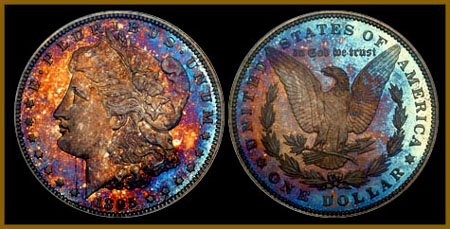
DOLLAR. Morgan Dollar coins were issued from 1878 to 1921.
They show a close head of Liberty facing left. She wears a
headband inscribed LIBERTY. In her hair are cotton, corn,
wheat, and tobacco. She wears a modified Phrygian cap and
is surrounded with the motto E PLURIBUS UNUM, thirteen stars
(seven left and six right), and the date. The reverse shows
an eagle with wings raised looking left. In its talons are
arrows and olive branch. A wreath is below and the motto IN
GOD WE TRUST is above. Except for the eagle’s wing tips,
UNITED STATES OF AMERICA and ONE DOLLAR circumscribe the design.
While not issued continuously,
over the years the silver dollar was a main stay of United
States commerce. The early silver dollar coins showed a young
nation trying to identify itself. In the later years, through
the twentieth century, the Morgan Dollar was a vehicle of
commerce and later a reserve of silver for banks and a source
of collecting adventure upon their release.
Specifications:
1794-1804 (Early Silver Dollar) Edge: Lettered HUNDRED CENTS ONE
DOLLAR OR UNIT with decorations Weight: 26.96 grams Diameter: 39-40 millimeters Composition: 89.24% silver, 10.76% copper Silver Content: 24.06 grams
Specifications: 1837-1921(Gobrecht,
Liberty Seated and Morgan Dollar) Edge: reeded (The Gobrecht Silver Dollar
had both plain and reeded edge.) Weight: 26.73 grams Diameter: 38.1 millimeters Composition: 90% silver, 10% copper Silver content: 24.06 grams