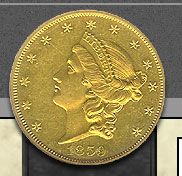
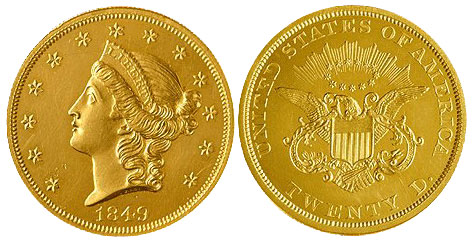
Collectors seem to prefer larger coins hence,
the popularity of United States Silver Dollars and Double
Eagles, two of the largest denominations. They are easier
to see, hold, and appreciate. Double
Eagle coins are also popular because of the history they
represent, extending from prior to the Civil War into the
twentieth century. Double
Eagles are bound up in the stories of the California Gold
Rush, the resurgence of religion, sunken treasure ships, and
the two presidents Roosevelt.
Except for the one pattern piece, the first
Double
Eagle was minted in 1850. With a mintage of over a million,
it became a storehouse for the vast quantities of gold coming
from California. In 1849 the California Gold Rush began in
earnest. Privately minted gold coins circulated, but they
were inconsistent in weight and fineness. The new coinage
law provided for the gold Double
Eagle. It was thought that it would standardize gold transactions.
The government assay office also provided a place where gold
dust, nuggets, and other bullion could be brought to test
for purity. In passing the coinage law, it was felt that Double
Eagles would be useful in large commercial transactions
and in international trade. Approximately 75% of all of the
United States gold coinage minted was in the form of Double
Eagles. The mint in San Francisco struck the largest amount,
88,134,626 pieces while the New Orleans mint struck the least
at 829,191.
Until the discovery of the shipwrecked S.S.
Central America in 1985 by the Columbus-America Discovery
Group, 1850’s Double
Eagle coins in gem condition were virtually unavailable.
The ship, originally called the S.S. George Law, was a United
States mail steamship. In 1857 it sank off the coast of the
Carolinas because of a huge hurricane. The ship was 272 feet
long and had 578 passengers and crew on board. It also had
on board over 5200 newly minted San Francisco gold Double
Eagles. The ship was found at a depth of 8,500 feet off
the coast of South Carolina. It is estimated that the total
coins, ingots, and gold bars found on the ship were worth
more than one hundred million dollars.
In 1933 the last Double
Eagle was struck. Its controversial history leads to today’s
court actions in which the ownership of ten coins that were
in private hands is being contested. They were returned to
the government for authentication and were then confiscated
because the government claimed that they had never been officially
issued and had to have been stolen.
An excellent source of information about Double
Eagles is Bowers’
A Guide Book of Double Eagle Gold Coins. In addition to
the history of the coinage, Bowers provides information about
the designers, the times, and the history of collecting. He
also gives date by date information including market values,
highest auction price, and availability of both circulation
strikes and proof coins for all Double
Eagles minted.